Wig Boutique Product Brief: From Demand to Quote Request
Demand Brief Guide
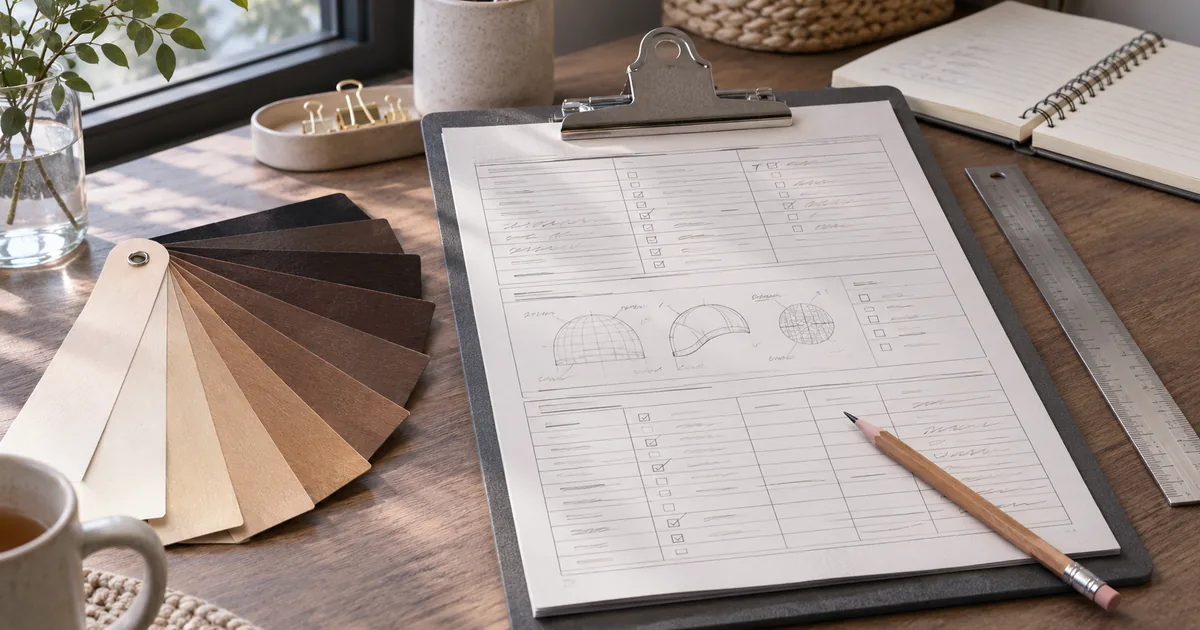
You turn boutique demand into a quote-ready brief by recording what stores actually need in five fields — buyer gaps, length range, color families, constructions, price band — translating each store phrase into a specification field a factory can price, and listing what the supplier must confirm in writing. The two blank templates below — an interview sheet and a quote-ready brief — do exactly that.
Quotes fail before they are written. A new distributor emails five factories “looking for wholesale human hair wigs, please send your price list,” receives five price lists for five different products, and learns nothing — because the brief behind the request was empty. The fix runs in one direction: interview the boutiques that will sell your wigs, record what they actually need, and translate that demand into a specification a factory can price. This guide walks that chain.
The templates on this page are blank — they contain no survey results, no customer quotes, and no percentages, because none exist yet. Their job is to structure your conversations; your market fills in the answers.
Step 1
Interview the Boutiques That Will Sell Your Wigs
Before you ask a factory for anything, ask the stores that would resell it. Five coverage areas keep the conversation useful:
- Who buys — the store’s customer type, and what they ask for that the store cannot currently source.
- Lengths — the range that moves, in inches.
- Colors — the families and effects the store reorders.
- Construction — cap types and features the staff can name.
- Price band — where the store’s shelf needs to sit (a band, never a number to negotiate later).
Copy this sheet per conversation:
| Interview question | Why it matters | Record here |
|---|---|---|
| What do customers ask for that you can’t source today? | Names the gap your first order could fill | |
| Which lengths sell fastest in this shop? | Sets the length range for the brief | |
| Which color families reorder most? | Anchors the color fields later | |
| Which cap constructions can your staff explain and sell? | Filters construction options to sellable ones | |
| Where does your shelf price need to sit? | Bounds the spec before quoting | |
| Would you display samples for a new brand? | Tests the go-to-market, not just the product |
The boutiques are the demand evidence. Without these rows filled, a “brief” is a guess wearing a spreadsheet.
Step 2
Turn Interview Notes Into a Demand Record
Interview notes are anecdotes; a demand record is a pattern. Aggregate the answers across stores by field — lengths that clustered, color families that repeated, constructions named more than once — and keep two kinds of entries apart:
- Aggregate (safe to brief from): ranges and families that appeared across multiple conversations.
- Verbatim (keep attached to its source): one store’s specific request, kept with the store’s name until it is confirmed by a second source.
Resist inventing a “typical distribution” from three conversations — three data points make a to-do list, not a statistic. What your record should end with is a short list: the length range, the color families, the constructions, and the price band your first order must hit to be sellable.
Step 3
Use Reference Samples to Anchor the Conversation
Words like “natural looking” mean nothing twice. Reference samples fix the vocabulary:
- Bring two or three wigs (or swatches) that bracket the range your demand record describes.
- For each, ask the store: closer or further from what your customers ask for?
- Record the reaction against the sample’s identifier — not against adjectives.
Make sample-first your default practice: bring the units to the conversation, and evaluate them before you commit. For two worked examples of the habit in supplier material: one distributor guide directs buyers to check documentation and sample labeling before committing (Helene Hair distributor guide, accessed 2026-11-20), and one maker’s private label service page runs a sample-development step before bulk production (Xuchang Wig, accessed 2026-11-20). The samples anchor the talk; they are not yet the order spec — approving a production sample is a later, separate gate. Systematic sample inspection has its own method on this site; the color side anchors through the color spec guide, and cap fit through the measurements guide.
Step 4
Translate Demand Into Manufacturer Specification Fields
This is the core move: turning store language into fields a factory can price. The translation table works like this (entries are illustrative examples of the mapping, not market data):
| Boutique language | Spec field to write | Why the factory needs it |
|---|---|---|
| “Falls past the collarbone” | Length, in inches (e.g., 20–24 in range — illustrative) | Cutting loss and price band depend on it |
| “Blonde but not yellow-y” | Color family + ring reference position | Color is priced and produced against a reference system, not adjectives |
| “Stays comfortable all day” | Cap construction + cap size set | Construction and sizing drive both comfort claims and cost |
| “Not too thick” | Density wording both sides define | Density labels are maker-relative; the words must be agreed, not assumed |
| “Easy to put on” | Fixation/attachment as offered | Changes construction and possibly price |
Every row ends in a field a supplier can answer in writing. Rows that cannot be translated yet belong in the next section — not in the brief as adjectives.
Step 5
List What You Cannot Know Yet
Some fields are not yours to decide, and pretending otherwise stalls the quote:
- Minimum order quantities — the supplier states them, per style and per color, in writing.
- Price bands — the quotation answers this; the brief only bounds the spec.
- Lead times — production and shipping windows come from the supplier, confirmed before you promise store dates.
- Density feasibility — what the maker can produce at your wording is a capability answer.
- Special color minimums — some color requests carry different minimums; ask rather than assume.
For each unknown, the brief carries a line: the item, and “to be confirmed in writing by the supplier.” Reading what comes back — line by line — is the quotation guide’s job.
Deliverable
Assemble the Quote-Ready Brief
Assemble the two halves and send one document:
| You send | You ask the supplier to confirm in writing |
|---|---|
| Demand summary: length range, color families, constructions, price band (from your record) | That they produce full-top human hair wigs in this range at all |
| Specification fields (translated table, filled) | Minimum order per style and per color |
| Reference sample identifiers (or photos with IDs) | Sample terms: availability, fee, lead time, who pays freight |
| The unknowns list, as questions | Which fields carry different minimums or longer lead times |
Mark the brief with a date and a version. When quotes come back, compare them against the brief — not against anyone’s memory. Reading the quotation line by line is covered in the supplier quotations guide, first-order logistics are in the wholesale startup guide, and the wholesale human hair wigs page is the supply entry point for sending the filled brief as one inquiry.
Boutique Product Briefs: Common Questions
A short document that turns verified boutique demand into fields a factory can price: length range, color families with reference positions, constructions, density wording, and the unknowns you need the supplier to answer in writing. It precedes the quote; the quotation guide handles what comes after.
Enough to cover different channel types, and stop when answers start repeating. There is no fixed number — what matters is that the demand record reflects more than one store's wish list. The sheet on this page is a blank template, not a survey result.
They sharpen the brief enormously: samples anchor color and construction vocabulary before you commit fields to paper. Practical recommendation: bring them as your default practice, and evaluate what you receive before committing — supplier material such as Helene Hair's distributor guide and the sample-development step on Xuchang Wig's private label page shows the check in use; the quote itself still comes from the written brief.
The ones a factory prices against: length, color reference position, cap construction and size set, and density wording. Translate each from store language into a field — the mapping table above shows the move.
Next Step
Next Step
A quote is only as good as the brief behind it. Interview first, record honestly, translate every adjective into a field, and send one dated document. The factories that answer it in writing are the ones ready to build for you.


Building Your Quote-Ready Brief?
Interview the stores, translate the demand into fields, and send one dated document — the factories that answer it in writing are the ones ready to build for you.
Contact LEV Wigs