Construction Comparison
Full Lace vs Lace Front Sheitels: Coverage and Parting
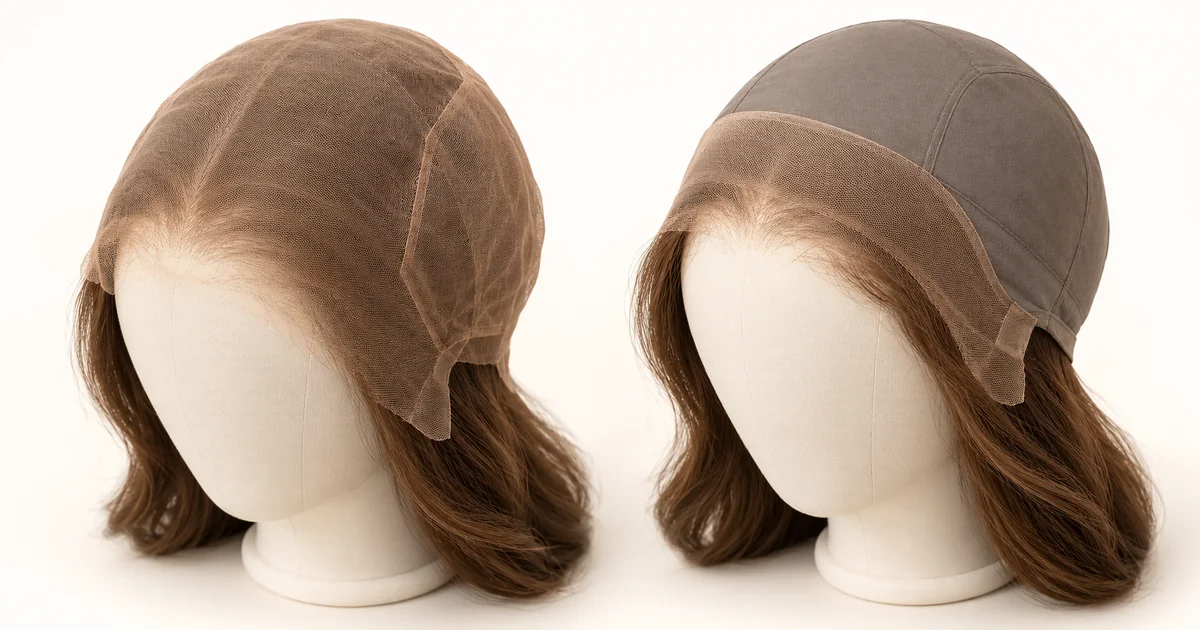
AI-generated editorial illustration of lace coverage only. Crown and back construction vary by build; this is not a photograph of an inspected sample.
Two supplier pages can both promise “lace” and mean different amounts of it. A lace front sheitel carries its lace in a strip across the front hairline; a full lace sheitel uses lace as the base across the entire cap. Neither word is the same as lace top — the crown-panel construction this guide separates out below. Set that dimension first and the full lace vs lace front sheitel comparison becomes straightforward: map the three labels, compare coverage, parting, and breathability, then confirm the order fields that actually protect the buy.
The Dimension
Front Edge, Crown Panel, or Whole Cap: Set the Dimension First
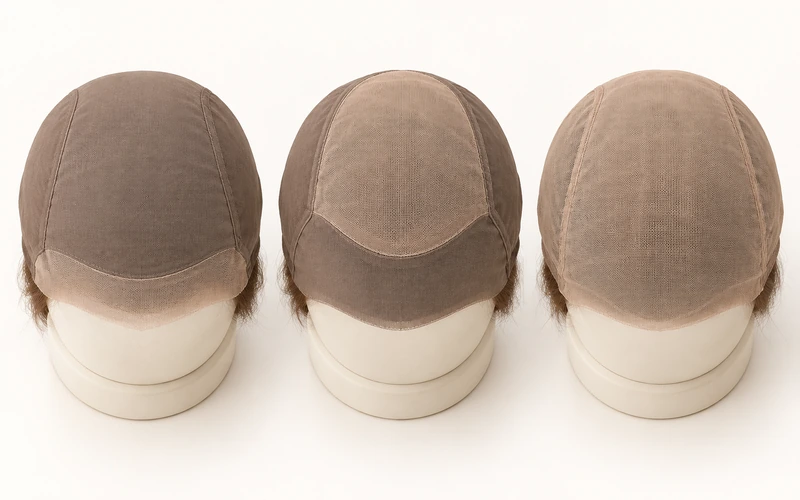
The useful axis here is lace territory — how much of the cap the lace covers — because each label describes a different territory. A lace front puts lace where the hairline shows: one Jewish-wig supplier lists its injection-lace build with a 1″ French lace front and temples over wefted sides and back, and another of its listings pairs a mono top with a 1/2″ French lace front (ReHair System collection, opened October 2026). Full lace makes lace itself the base: Emeda’s Jewish-wig education page describes full lace wigs as “made from a lace material, typically Swiss lace, that provides breathability and a lightweight feel,” with the lace cap creating a natural-looking scalp and hand-tied strands. A lace top concentrates the lace in a crown panel — a construction with its own complete guide, and one a cap construction guide locates inside the full cap anatomy.
The labels also stack, which is the fastest proof that they are not grades of one ladder. The same supplier catalog can offer “silk tops, lace fronts, or full lace” as parallel cap options (Emeda’s Jewish wig education page), a mono top can arrive finished with a 1/2″ French lace front (ReHair System), and a luxury line can sit on a whole-lace base: UCHE HAIR’s Jewish luxury line is listed with “Cap: Full Lace with Multidirectional Skin Top.” Where the lace sits on one listing says nothing about how far it extends on the next — which is why the front-vs-top placement question has its own comparison page, and why this page keeps to the territory question.
Side by Side
Full Lace vs Lace Front Sheitels: The Comparison Table
With the dimension set, the two constructions compare cleanly on territory and its consequences:
Scroll sideways to see the whole table
| Decision point | Full lace sheitel | Lace front sheitel |
|---|---|---|
| Lace territory | Whole cap; lace is the base material across the head | Front strip at the hairline and temples; listed Jewish-market builds quote 1/2″–1″ French lace (e.g., ReHair System) |
| Parting scope | Carried by the lace base wherever it is tied — UCHE HAIR lists its full-lace cap for “multidirectional styling freedom” | Decided by the crown build, not the front strip: mono tops are credited with multi-directional parting (Jon Renau, Ellen Wille); confirm the crown before promising a part |
| Breathability | Supplier material references describe lace bases as breathable and lightweight (e.g., Emeda); confirm the actual build | Open wefted panels are described as ventilation features in manufacturer cap guides (Jon Renau, Ellen Wille); closed wefts, linings and density vary — compare the actual cap |
| Price | Whole-cap builds put tying work across the entire base; ask each maker how that labor is priced | Not fixed by the front label — a front build can pair with a mono top or a hand-tied back; compare quotes on matched specs |
| Handling | A larger delicate surface to protect day to day | Protect the front lace; follow the specified care for each crown/back material |
| Confirm on the sample | Lace extent in numbers, crown and back build, net structure, grip hardware | Strip width in numbers, crown and back build, hairline knotting |
Two rows deserve their evidence. On breathability: manufacturer cap guides describe open wefting as a ventilation feature — Jon Renau credits an “Open Wefted Back” with “superior ventilation for maximum scalp cooling,” and Ellen Wille states that “wefted caps adapt very well to the shape of the head and allow air to circulate.” Emeda’s education page ties full lace bases to “breathability and a lightweight feel,” and AIRAO’s Jewish sheitel listing pairs its “lace front and full lace” design with “comfortable wig nets” and calls it “lightweight, breathable and not stuffy.” None of these are wear tests, and they describe different builds: open wefts, closed wefts, linings, density, and fit all move the result — which is exactly why the checklist below starts with a sample worn through a real day. On price: the labels carry no price by themselves. Whole-cap builds put tying work across the entire base, but a lace front can also sit over a mono top or a hand-tied back that carries its own labor, so hold hair, length, crown, and back construction constant and compare quotes on matching specs.
Terminology
Three Labels, Three Different Questions
Supplier catalogs use these words as if everyone already agreed on them. They rarely stop to say that each label answers its own question about the cap:
Lace front
Where does the hairline show lace?
A strip at the front — the hairline and, on some builds, the temples — hand-tied to look like growth from skin. It answers the hairline question only: the crown can be a mono or silk top, and the back can be wefted or fully hand-tied, so the front label does not tell you how the rest of the cap is built (Jon Renau’s catalog, for example, pairs its lace fronts with mono tops and with both open-wefted and hand-tied backs). For what to check on the strip itself, the lace front buyer’s guide owns the inspection detail.
Lace top
What displays the part at the crown?
A lace panel across the top of the cap, sized for the exposed crown and the part. Its closest cousin is the mono top — a fine crown mesh that manufacturer guides credit with multi-directional parting (Jon Renau; Ellen Wille’s Mega Mono) — and Jewish-market listings show mono tops paired with front strips. The either-or comparison with silk top lives in its own lace top guide.
Full lace
How much of the cap is lace at all?
The whole-cap answer: lace as the base across the head, with the scalp effect and parting freedom that territory allows. It is one of the seven constructions in the Jewish wig types overview; UCHE HAIR’s Jewish luxury line, for example, lists “Cap: Full Lace with Multidirectional Skin Top.”
Read that way, combination listings stop being confusing. ReHair System’s “mono top with 1/2″ French lace front” answers both of its questions in order: crown mesh for the part, a strip for the hairline. UCHE HAIR’s “Full Lace with Multidirectional Skin Top” specifies a skin-top zone on an all-lace base. The words are coordinates, not rivals — and a buyer who asks “which zone does this word cover?” can decode any catalog line without waiting for a supplier to define it.
Choosing
The Selection Checklist for Retail and Salon Buyers
Territory, parting, breathability, price — the table compresses to two questions per buyer. For a retail client, match the construction to the wearer:
- Map her parting, then the crown. Parting flexibility comes from the crown build, not the front label: mono tops are credited with multi-directional parting (Jon Renau; Ellen Wille’s Mega Mono), and UCHE’s full-lace cap is listed for multidirectional freedom. For deep off-center parts and high updos, also confirm the nape and hairline edges by name before promising the style.
- Weight the hairline. If her priority is the front view — hairline realism at the temples — the front strip is doing the visible work, and its quality matters beyond its size.
- Let her wear a sample. Breathability notes on supplier pages are material descriptions; a sample worn through a real day is the client’s own measurement.
- Compare quotes on matched specs. Hold hair, length, crown, and back construction constant so quotes describe the same product, and don’t assume a price from the front label alone.
For a salon or wholesale order, convert the same questions into fields a supplier can confirm in writing:
- Lace territory in numbers. “Full lace” should mean whole-cap coverage stated as such; a front build should carry its strip width at hairline and temples (listed builds in this market quote halves and full inches — ReHair System’s 1/2″ and 1″ French lace fronts are one example).
- The material, named. Swiss and French lace are the names supplier pages use; delicacy and care follow the material, so get it on the line.
- What carries the non-lace zones. Wefted sides and back are the stated pairing on the Jewish-market listings quoted above, and Jon Renau’s catalog shows lace-front caps with fully hand-tied backs as well; one Jewish listing adds supporting wig nets. Ask what your build carries in each zone.
- Grip hardware and placement. Coverage and grip are separate systems; confirm which hardware sits where before production.
- Sample, then bulk. Ask each supplier to state its sample MOQ and its sample and bulk timelines in writing for your exact spec; terms differ by supplier, so don’t carry one program’s numbers to another.
- Combined variants, zone by zone. If the order says “full lace with silk top” or “mono top with lace front,” write which zone is which. The three-label map above is the vocabulary for that line.

No. A lace front carries lace in a strip across the front hairline; full lace uses lace as the base across the entire cap. The words answer different questions — where the hairline shows lace versus how much of the cap is lace — so one build can even carry both ideas, such as a full lace cap finished with a skin top.
Yes — the labels stack. Jewish-market listings pair a 1/2-inch French lace front with a mono top, and UCHE HAIR’s Jewish luxury line lists a full lace cap with a multidirectional skin top. Read each label as the answer to its own cap question.
Ask what the crown is built from before promising a part. Mono tops are credited with multi-directional parting, so a lace front over a mono top can take a range of parts; on other crown builds, confirm the actual parting range on the sample. Check the nape and hairline edges too if an updo is the goal, and confirm the strip width in numbers.
Lace territory in numbers (whole cap, or strip width at the hairline and temples), the lace material named, the crown and back construction written zone by zone, grip hardware and placement, and any combined variant written zone by zone. Ask each supplier to state its sample MOQ and its sample and bulk timelines in writing for your exact spec — terms differ by supplier, so don’t carry one program’s numbers to another.
Conclusion
Buy the Question, Then the Cap
Full lace and lace front are not rival grades of one thing — they are answers to different questions about the same cap. Ask what the part needs, what the hairline shows, and how much of the cap should be lace at all, and the catalog labels become coordinates instead of marketing. Put the territory, the material, and the zone-by-zone build into the written specification, and the words on the listing stop doing the deciding.


Ordering by Specification, Not by Label?
Bring the checklist above — lace territory in numbers, named material, zone-by-zone build, and grip plan — to your next supplier conversation, and ask for each field in writing.
Contact LEV Wigs