Sheitel Care
How to Store a Wig: Factory-Approved Storage Guide

For example, a typical sheitel costs between $800 and $3,000. However, in our Qingdao workshop, we regularly receive wigs for repair that were stored in plastic bags, crammed into drawers, or left on a sunny windowsill. As a result, the damage from poor sheitel storage — warped lace fronts, frizzed cuticles, stretched-out caps — often costs more to fix than the wig itself.
In fact, we've been manufacturing sheitels for wholesale buyers in Brooklyn, London, and Jerusalem for over a decade. Therefore, our factory has developed specific storage protocols based on how different materials respond to environmental conditions. For example, Swiss lace behaves differently than silk tops. Meanwhile, hair cuticles react to humidity within hours. Furthermore, this guide covers every storage scenario: daily use, seasonal rotation, travel, and long-term preservation. Therefore, every recommendation comes directly from what we've observed on the production floor and heard back from retailers worldwide.
In addition, if you're looking for a manufacturer who understands the full lifecycle of a sheitel — from construction to daily care to proper storage — our Qingdao workshop offers free sample kits for qualified wholesale buyers.
Key Takeaways
- Proper storage extends sheitel lifespan by 30–50% — lace, cuticle, and cap materials all degrade faster in poor conditions
- Wig stands for daily use; breathable bags for rotation — matching method to duration prevents 80% of common damage
- Ideal range: 60–70°F and humidity below 50% for preserving both lace construction and hair fiber integrity
- Never store in plastic bags or damp conditions — the two most common mistakes seen in our repair workshop
Material Science
Why Sheitel Storage Matters: The Material Science
In fact, most storage advice treats a sheitel like any other accessory. However, it isn't. Specifically, a high-quality sheitel is a composite of three distinct materials — lace or silk base, human hair fiber, and elastic cap construction — each with different vulnerability points.
How Lace, Hair, and Cap Materials React
Lace degradation happens silently. For example, Swiss lace, which we use on our premium lace top sheitels, measures approximately 0.08mm in thickness. When you fold or compress lace incorrectly over weeks, the mesh develops micro-cracks along the fold lines. Over time, these cracks don't show immediately, but they weaken the ventilation knots until hair starts shedding in clumps. For example, we've seen wigs arrive at our workshop with hair falling out in specific strips — always along the fold.
Hair cuticle sensitivity to humidity is another factor most people underestimate. Meanwhile, human hair cuticles are layered structures that respond to moisture. Specifically, in high humidity (above 60% RH), cuticle scales lift and swell, which causes frizz, tangling, and eventually breakage. By contrast, in very dry conditions (below 30% RH), the hair loses its natural moisture and becomes brittle. However, both scenarios are reversible with proper conditioning — but only if you catch them early.
Cap elasticity degrades with heat. Finally, the stretch bands that keep a sheitel snug on your head are typically made from polyurethane or silicone. Consequently, at temperatures above 80°F (27°C), these materials begin to lose their elasticity permanently. As a result, a sheitel stored in a hot car or near a radiator will fit looser over time, regardless of how well the hair itself is preserved.
Damage Timeline by Material
| Material | Vulnerability | Speed of Damage | Reversible? |
|---|---|---|---|
| Swiss Lace (0.08mm) | Micro-cracks from folding and pressure | 2–6 weeks of bad storage | Partially — costly repair |
| Hair Cuticle | Humidity swelling causes frizz and tangling | Hours to days | Yes — with deep conditioning |
| Cap Elastic Bands | Heat causes permanent stretch loss | Days to weeks | No — requires cap replacement |
| Silk Top Base | Creasing from compression | Weeks | Partially — steam treatment |
Tip
For example, run your finger along the lace edge of your sheitel. If it feels stiff or crunchy instead of soft and supple, humidity damage has already started. Therefore, move it to a climate-controlled space immediately.
Storage Sensitivity by Lace Type
| Lace Type | Thickness | Storage Sensitivity | Key Precaution |
|---|---|---|---|
| Swiss Lace | 0.08mm | High — prone to micro-cracks | Never fold; store flat or on stand |
| HD Lace | 0.06mm | Very High — tears easily | Always on mannequin head, never compressed |
| Silk Top | Multi-layer | Medium — creases visible | Store with tissue padding inside cap |
Storage Methods
5 Storage Methods Compared
In fact, there's no single "best" way to store a sheitel — the right method depends on how often you wear it, how long it sits between wears, and how much space you have. Therefore, the five main approaches need to be matched to usage pattern rather than chosen by habit.
Choosing a Method by Wear Frequency
1. Wig Stand (Canvas or Wire) — The everyday workhorse. For example, a canvas wig stand holds the cap shape and lets air circulate through the hair. In fact, it's ideal for your primary sheitel — the one you wear most days. Next, keep it on a stable surface away from windows and vents. Then cover it with a hair net to block dust.
2. Mannequin Head (Styrofoam or Canvas) — A step up from a basic stand. Mannequin heads maintain the exact shape of the cap and allow you to pre-style the sheitel so it's ready to wear. Although they take up more space, they offer the best structure preservation. Therefore, our workshop uses canvas heads for all display and quality-check wigs.
3. Breathable Silk or Satin Bag — The go-to for rotation wigs you don't wear daily. Silk allows airflow while protecting hair from dust and friction. In fact, this is our recommended method for sheitels worn once a week or less. Finally, always detangle and loosely braid longer hair before bagging.
4. Original Box with Tissue Paper — For long-term or seasonal storage. In addition, cardboard regulates moisture better than plastic, and tissue paper prevents the hair from pressing against itself. First, fold the sheitel ear-to-ear with lace facing inward. Then pad the cap with tissue.
5. Hard-Sided Travel Case — Specifically designed for transport. As a result, these cases have structured interiors that prevent crushing. Nevertheless, they're overkill for home storage but essential for travel, especially for lace front sheitels.
Method Comparison for Buyers
| Method | Best For | Protection | Space | Cost |
|---|---|---|---|---|
| Wig Stand | Daily wear sheitel | ★★★☆☆ | Medium | $8–20 |
| Mannequin Head | Primary + styling | ★★★★☆ | Large | $20–55 |
| Silk Bag | Weekly rotation | ★★★★☆ | Small | $10–25 |
| Original Box | Seasonal/long-term | ★★★★★ | Medium | Free |
| Travel Case | Transport only | ★★★★★ | Medium | $25–60 |
| Storage Duration | Recommended Method | Why |
|---|---|---|
| Overnight (daily) | Wig stand + hair net | Quick access, maintains style |
| 1–7 days | Wig stand or silk bag | Allows airflow, minimal handling |
| 1–4 weeks | Silk bag in cool, dry closet | Full dust protection, saves space |
| 1–6 months | Original box with tissue + silica gel | Maximum structural protection |
| 6+ months | Box + periodic check every 8 weeks | Prevents moisture buildup |
Note
Swiss lace lasts 4–6 months with daily wear when stored properly, while HD lace typically needs replacement after 2–3 months. Therefore, storage quality is the single biggest factor in closing that gap.
Daily Storage
Daily Storage: Your Go-To Sheitel
For example, your everyday sheitel deserves a permanent spot on a wig stand, positioned where you can grab it in the morning without hassle. However, the placement matters more than most people think.
Where to Place a Daily-Wear Sheitel
Therefore, keep it away from three things: direct sunlight, bathroom humidity, and heat sources. For example, a bedroom corner or dedicated shelf works well. By contrast, bathroom storage seems convenient but destructive, because humidity spikes from hot showers hit 70–80% RH — exactly the range where cuticles start lifting and mold spores thrive.
Two-Minute Evening Routine
In fact, your evening routine should take under two minutes. First, gently brush through the hair with a wide-tooth comb or wig brush, working from ends to roots. Next, place it on the stand with the hair falling naturally. Finally, cover with a hair net or loosely drape a silk scarf over it. That's it.
In fact, we learned this the hard way. A wholesale client in Brooklyn sent back six sheitels for repair after just three months — every single one had been stored on a windowsill "because the light was nice in the morning." As a result, the UV exposure had faded the color by two shades and made the lace brittle enough to tear during a routine brushing. Therefore, we now include a storage instruction card with every wholesale shipment.
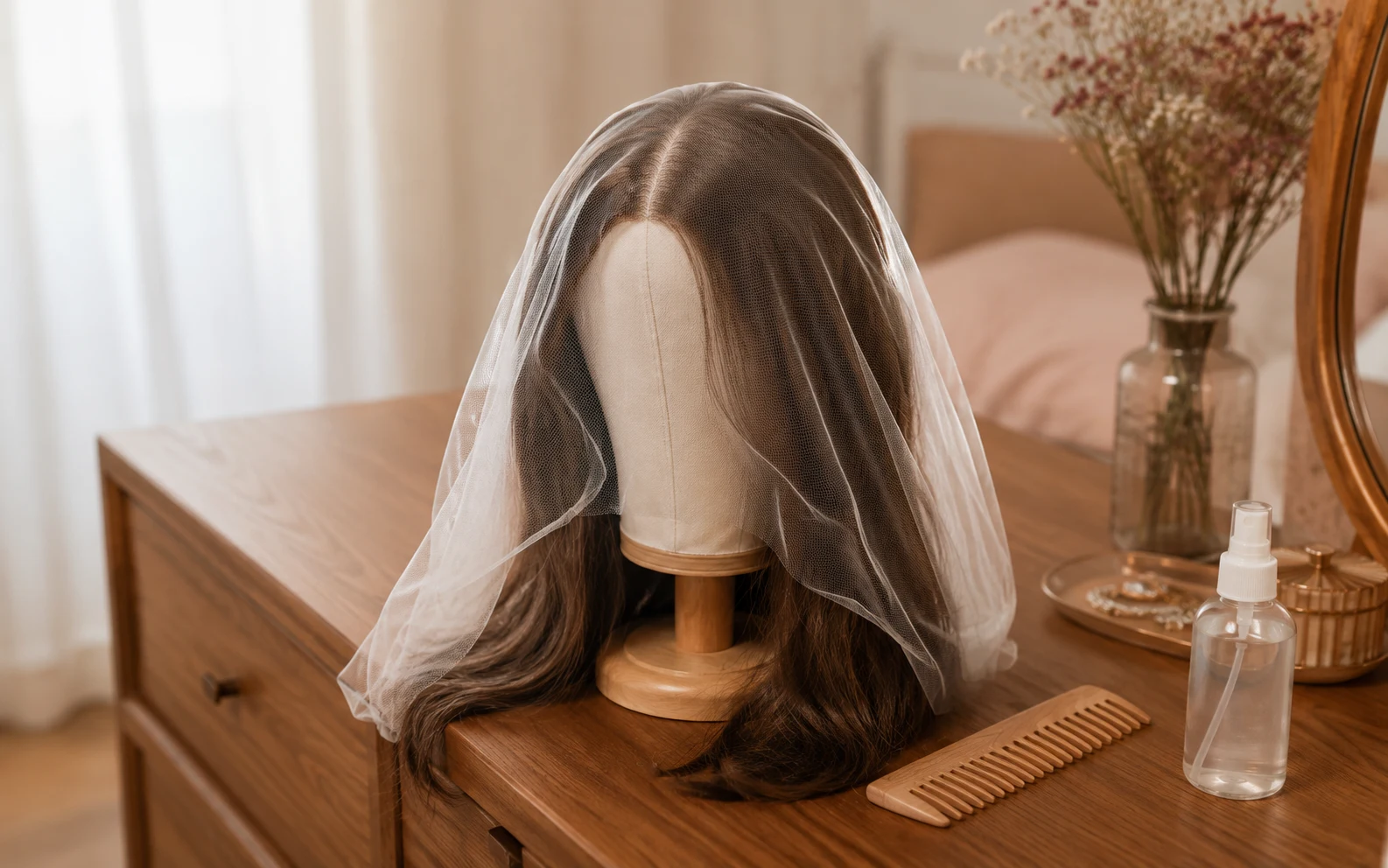
| Time | Action | Purpose |
|---|---|---|
| Evening | Gentle brush-through, ends to roots | Prevents overnight tangles |
| Evening | Place on wig stand | Maintains cap shape |
| Evening | Cover with hair net or silk scarf | Blocks dust without trapping moisture |
| Weekly | Light conditioning spray | Keeps hair supple between washes |
| Every 2 weeks | Move to fresh air for 30 minutes | Prevents musty odor buildup |
Seasonal Storage
Long-Term and Seasonal Storage
When a sheitel goes into storage for more than a few weeks — a summer wig put away for winter, or a backup piece rotating out — the preparation matters as much as the storage method itself. Therefore, treat packing as a short preservation process, not a quick cleanup task.
Prepare the Hair Before Packing
Before packing, wash and condition the hair thoroughly. Therefore, don't store a sheitel with product buildup, natural oils, or environmental residue. Otherwise, these attract dust and create breeding grounds for bacteria. For example, follow the same washing process we detail in our lace top sheitel washing guide.
Then air dry completely. This is non-negotiable. Even slightly damp hair trapped in a bag will develop mold within 72 hours because the moisture cannot escape. In our workshop, controlled airflow at room temperature runs for 24–36 hours after every wash before packing.
After that, detangle and loosely braid. For wigs longer than 14 inches, a loose braid prevents the hair from tangling against itself during storage. Meanwhile, short styles just need a gentle comb-through.
Protect the Cap Shape and Storage Environment
Next, pad and wrap the cap. Then place tissue paper inside the cap to help it hold its shape. For lace fronts, fold from ear to ear with the lace facing inward — never crumple or roll. Finally, wrap the entire sheitel in a silk scarf or place it in a breathable cotton bag.
Finally, store it in the right environment. Therefore, aim for 60–70°F (15–21°C) and relative humidity below 50%. For example, a bedroom closet on an interior wall works well. Instead, avoid attics, basements, and garages where temperature swings wildly.
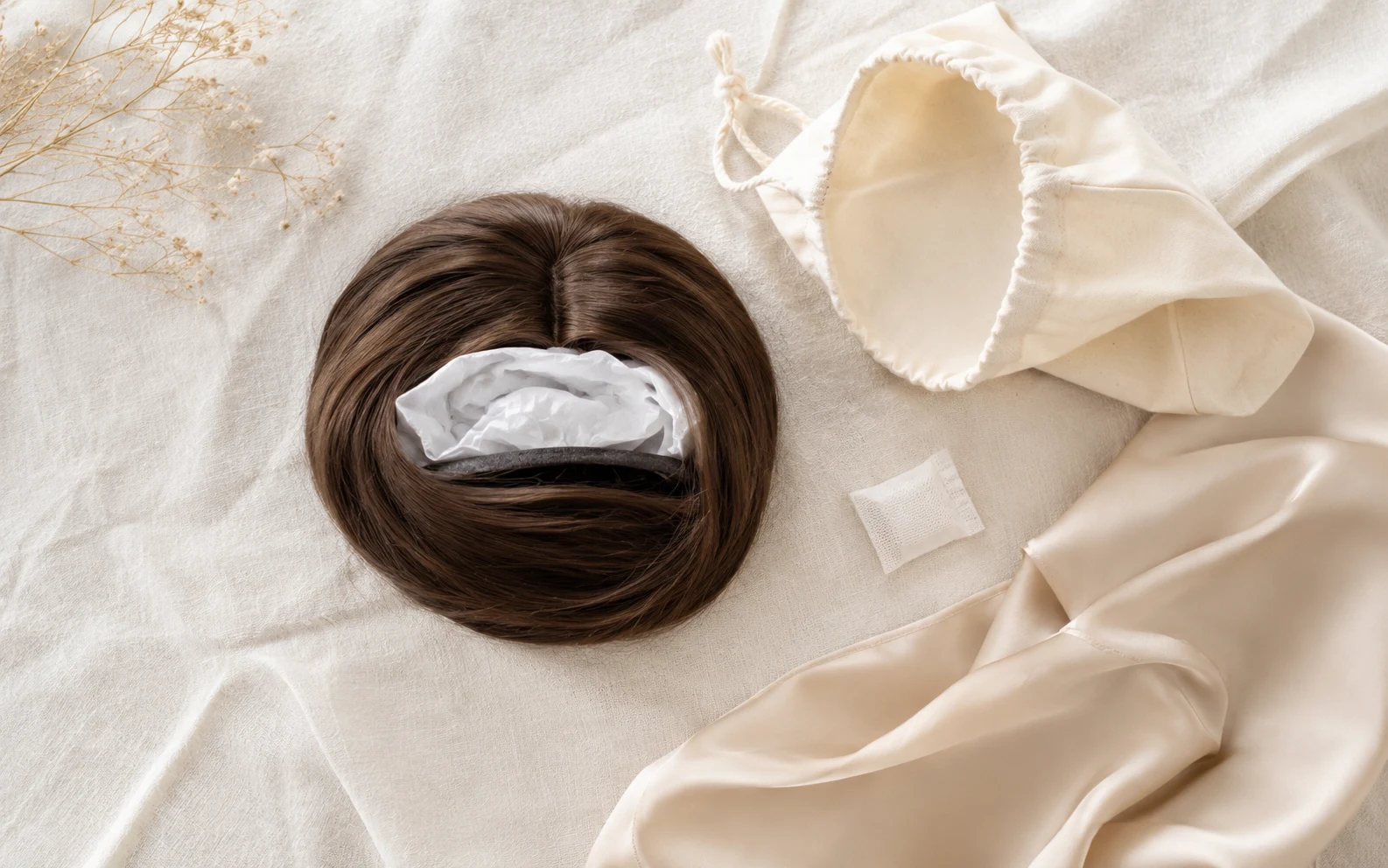
| Season | Humidity Risk | Storage Adjustment |
|---|---|---|
| Spring | Moderate | Standard box storage, check monthly |
| Summer | High (60–80% RH) | Add silica gel packet, check every 2 weeks |
| Fall | Moderate | Standard box storage, check monthly |
| Winter | Low (20–35% RH indoors) | Add moisture — damp cloth nearby, not touching wig |
| Product | Purpose | Price Range | Our Recommendation |
|---|---|---|---|
| Canvas wig stand | Daily support | $8–15 | Best value for daily use |
| Silk storage bag | Rotation and travel | $10–25 | Essential for multi-wig owners |
| Silica gel packets | Moisture control | $5–10 / 50 pack | Must-have for humid climates |
| Tissue paper (acid-free) | Cap padding | $3–8 | Use for any long-term storage |
| Wig hair nets | Dust protection | $3–6 / 10 pack | Cheapest way to extend wig life |
Tip
For example, place a silica gel packet inside your storage box — it absorbs excess moisture without any chemicals touching the hair. Then replace the packet every 3 months or when the indicator beads change color.
Packing for Trips
Travel Storage Without the Damage
Most storage damage from a single incident happens during travel. Because compression, temperature changes, and unfamiliar environments combine, they create a perfect storm for lace tears and tangled hair. Consequently, the travel container matters as much as the trip length.
Pack for Compression and Airflow
Choose the right container. For example, a satin-lined hard case is ideal for lace front and silk top sheitels. Meanwhile, soft travel bags work for shorter, simpler styles. The key requirement is breathability. If you can feel condensation forming inside after closing it, it's trapping moisture.
Fold Lace Fronts Without Stressing the Mesh
Folding technique for lace fronts. Before folding, place the sheitel face-down on a clean silk scarf. Then fold from ear to ear so the lace panels fold against each other — lace-on-lace contact is safer than lace-on-fabric or lace-on-hair. Instead, don't fold the lace itself; fold at the ear tabs where the cap transitions from lace to wefted material. Then, once folded, wrap the silk scarf around it and place inside your travel container.
After that, remove the sheitel from the container within 2 hours of arrival. Next, place it on a stand or mannequin head so it can breathe. However, if it looks flattened, mist lightly with water and gently reshape with your fingers. Don't brush until the hair has fully relaxed. In addition, see our lace top sheitel styling guide for a deeper routine on refreshing your sheitel after travel or storage.
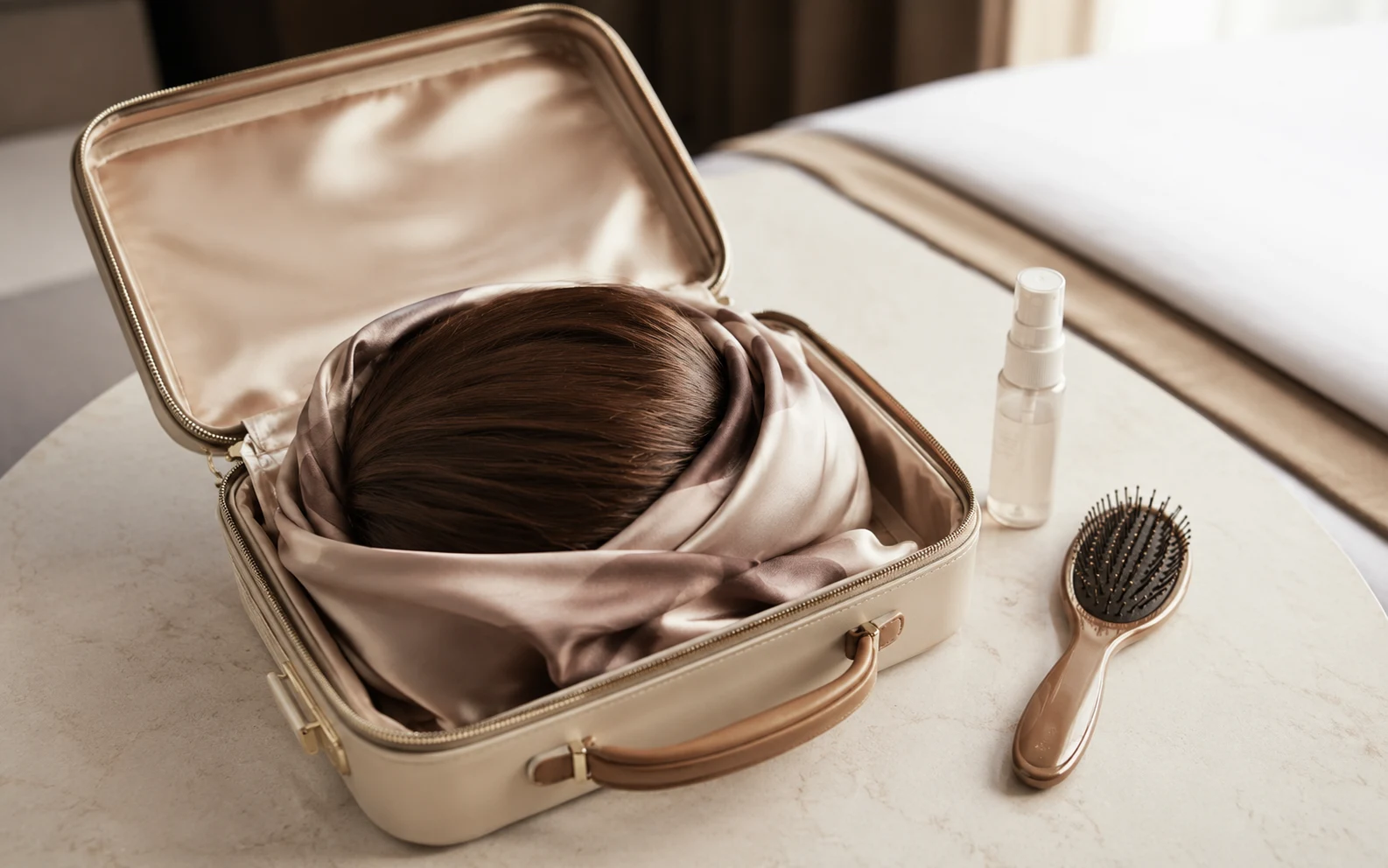
| Item | Pack It? | Why |
|---|---|---|
| Satin travel bag or hard case | Essential | Prevents compression damage |
| Small wig brush or wide-tooth comb | Essential | For detangling after travel |
| Travel-size conditioning spray | Recommended | Refreshes hair after being packed |
| Silk scarf (for wrapping) | Recommended | Extra protection for lace fronts |
| Portable collapsible wig stand | Optional | Best for trips longer than 3 days |
| Plastic bag | Never | Traps moisture and causes mold |
Tip
Before packing, place your sheitel in the storage bag and seal it. Next, check inside after 24 hours — if you see any condensation on the bag's interior, the material isn't breathable enough for travel storage.
Common Mistakes
Common Storage Mistakes That Ruin Sheitels
For example, in our repair workshop, we see the same five problems on repeat. Therefore, this section focuses on what goes wrong and how to avoid each issue.
Moisture and Heat Mistakes
Plastic bags. In fact, this is the single most common mistake. Plastic traps moisture against the hair and cap, creating a greenhouse effect. As a result, within days, the humidity inside the bag exceeds 70% — enough to trigger mold growth on the cap lining and cause cuticle swelling. For example, we've unpacked wigs from plastic bags that had visible green mold spots on the inside of the cap. Therefore, at that point, professional cleaning is the only safe option.
Storing while damp. However, even after air-drying for several hours, the cap lining and the hair closest to the scalp area can retain moisture. Therefore, our workshop standard is a minimum 24-hour drying period before packing. If you're unsure whether your sheitel is fully dry, give it another day — overdrying doesn't exist, but underdrying is catastrophic.
Direct sunlight and UV exposure. In addition, ultraviolet light breaks down the protein structure in human hair, causing color fading and fiber weakening. For example, a sheitel stored on a sunny windowsill can lose a full shade of color in 4–6 weeks. UV also degrades the polyurethane in lace fronts, making them brittle.
Bathroom storage. It feels convenient, but it is destructive. Meanwhile, daily shower steam raises bathroom humidity to 70–90% for extended periods. Consequently, even with the door open, that moisture penetrates lace and lifts cuticles repeatedly. As a result, over months, the hair becomes chronically frizzy and the cap loses its shape.
Compression Mistakes
Stacking without structure. Piling one sheitel on top of another — or throwing accessories on top of a wig on a stand — compresses the cap and ventilation knots. As a result, the weight crushes the lace mesh and can permanently flatten the crown area. Therefore, each wig needs its own dedicated space.
| Mistake | What Happens | Timeline | Fix |
|---|---|---|---|
| Plastic bag storage | Mold and cuticle damage | 3–7 days | Switch to breathable bag; professional cleaning if mold visible |
| Storing damp | Bacterial growth, musty smell | 1–3 days | Always dry 24+ hours before storing |
| Direct sunlight | Color fading, fiber weakening | 2–6 weeks | Move to shaded area or closet |
| Bathroom storage | Chronic frizz, cap distortion | 2–8 weeks | Relocate to bedroom or dedicated space |
| Stacking/compression | Crushed cap, lace damage | Days to weeks | Give each wig its own space |
FAQ
Frequently Asked Questions
How often should I wash my sheitel before putting it into storage?
Always wash your sheitel before any storage period longer than one week. Otherwise, product buildup, natural oils, and environmental residue attract dust and feed bacteria. For daily-wear sheitels going onto a stand overnight, a wash every 10–15 wears is sufficient. For seasonal storage, a fresh wash right before packing is non-negotiable — any residue left on the hair will set in over weeks and become much harder to remove.
Can I store multiple sheitels in one bag?
Technically yes, but we don't recommend it. Instead, each sheitel should have its own silk scarf or tissue paper wrapping to prevent the hair from different wigs tangling together. Storing two wigs in direct contact creates friction that leads to matting and cuticle damage — especially at the nape area where hair tends to bunch up.
Storage Conditions and Wholesale Support
What temperature and humidity should I aim for?
The sweet spot is 60–70°F (15–21°C) with relative humidity between 35% and 50%. Below 30% RH, hair dries out and becomes brittle. Above 60% RH, cuticles lift and mold risk increases. Therefore, most indoor spaces work except during peak summer humidity or winter heating season — those are the times to use silica gel packets or a small humidifier near (not directly next to) your storage area.
Should I cover my sheitel when it's on a wig stand?
Yes — use a hair net or loosely draped silk scarf. A cover blocks dust and airborne oils from settling on the hair between wears. However, avoid tight covers or anything that presses down on the style. The goal is a loose barrier that lets air circulate while keeping particles off the fiber. Our workshop uses loose mesh nets on all display wigs.
Can wholesale buyers request custom sheitel care and storage cards?
Yes. LEV Wigs can prepare branded care and storage cards for qualified wholesale orders. In addition, retailers can request their logo, preferred care wording, and market-specific contact details. Confirm the card format, language, quantity, and packaging requirements with our team during sampling so the final materials match the bulk order.
Conclusion
Protecting Your Sheitel Investment
In fact, proper sheitel storage isn't complicated — it's consistent. In short, the five principles to remember are simple: keep it dry, give it structure, control the temperature, avoid plastic, and give each wig its own space. Whether you're managing a single everyday sheitel or rotating between four or five across seasons, these same rules apply.
| Your Situation | Recommended Method | Key Action |
|---|---|---|
| One daily sheitel | Wig stand + hair net | Cover nightly, brush before bed |
| 2–3 wigs in rotation | Stand for primary + silk bags for backups | Check bags every 2 weeks |
| Seasonal storage | Box with tissue + silica gel | Inspect every 8 weeks |
| Frequent travel | Hard case with silk lining | Unpack within 2 hours of arrival |
In addition, see our lace top sheitels complete guide for detailed construction, daily wear, and maintenance routines from our factory floor. If you're a wholesale buyer looking for a manufacturer who understands the full sheitel lifecycle — from ventilation to storage — reach out to our Qingdao workshop. Therefore, we include care and storage cards with every shipment.


Need a Manufacturer Who Understands Sheitel Care?
From ventilation to storage, our Qingdao workshop builds sheitels designed to last. Get wholesale pricing and free sample kits for qualified buyers.
Request Wholesale Pricing