Pillar Guide
Hair Toppers: Types, Sizing, and Wholesale Buying Guide
Buying Snapshot
Hair Toppers Buying Guide at a Glance
The global hair enhancement market reached $7.95 billion in 2025, and within that market, hair toppers have emerged as the fastest-growing segment — expanding at 15 to 20 percent annually, roughly double the rate of traditional wigs. In fact, nearly 50% of women experience visible hair thinning by age 40, according to the American Academy of Dermatology. However, most are not ready for a full wig. Instead, they want something that blends with their existing hair, covers the thinning crown or parting area, and lets them walk out the door looking like themselves.
That is exactly what a hair topper does. In addition, at our Qingdao workshop, we have seen wholesale orders for topper pieces triple over the past three years — driven largely by salon owners expanding their hair loss solution menus. Therefore, this guide pulls together everything we have learned from a decade of production and thousands of wholesale orders. Whether you are stocking your first topper rack or expanding an existing catalog, the sections below walk you through the decisions that matter most.
Key Decisions for Buyers
Key Takeaways
- Topper pieces cover specific thinning areas — they blend with natural hair, unlike full wigs
- Three base types dominate the market: silk top, lace top, and monofilament
- Sizing accuracy is the #1 factor in customer satisfaction and return rates
- Human hair topper units last 12 to 18 months with proper care; synthetic options, 4 to 6 months
- Factory-direct wholesale pricing from Qingdao manufacturers offers 40 to 60% margin potential
Overview
What Are Hair Toppers?
A hair topper, sometimes called a half wig or crown enhancer, is a partial hairpiece designed to cover thinning areas on the top and crown of the head. Specifically, unlike full wigs that cover the entire scalp, toppers integrate with your client's existing hair. As a result, the natural hair pulls through or blends around the topper base, creating a seamless look that adds volume and coverage precisely where it is needed.
Furthermore, this category addresses a specific gap in the hair loss market. For example, many women experience thinning at the crown or a widening part line long before they need — or want — a full wig. For these clients, a topper provides the coverage they need without the commitment, cost, or psychological adjustment of a complete wig. Consequently, the category has grown particularly fast among women aged 30 to 55, who represent the bulk of first-time buyers.
Where Toppers Fit in a Salon Catalog
| Feature | Hair Topper | Full Wig | Hair Extensions |
|---|---|---|---|
| Coverage Area | Top and crown only | Full head | Length and volume |
| Natural Hair Visible | Yes — blends seamlessly | No — fully concealed | Yes — adds length |
| Application Time | 2 to 5 minutes | 5 to 10 minutes | 30 to 90 minutes |
| Best For | Thinning crown or part | Total hair loss | Length and volume |
| Wholesale Price Tier | Mid-range | Higher | Mid-range |
For a detailed beginner-friendly explanation, see our guide on what a hair topper is and how it works.

Base Construction
Base Construction Types Explained
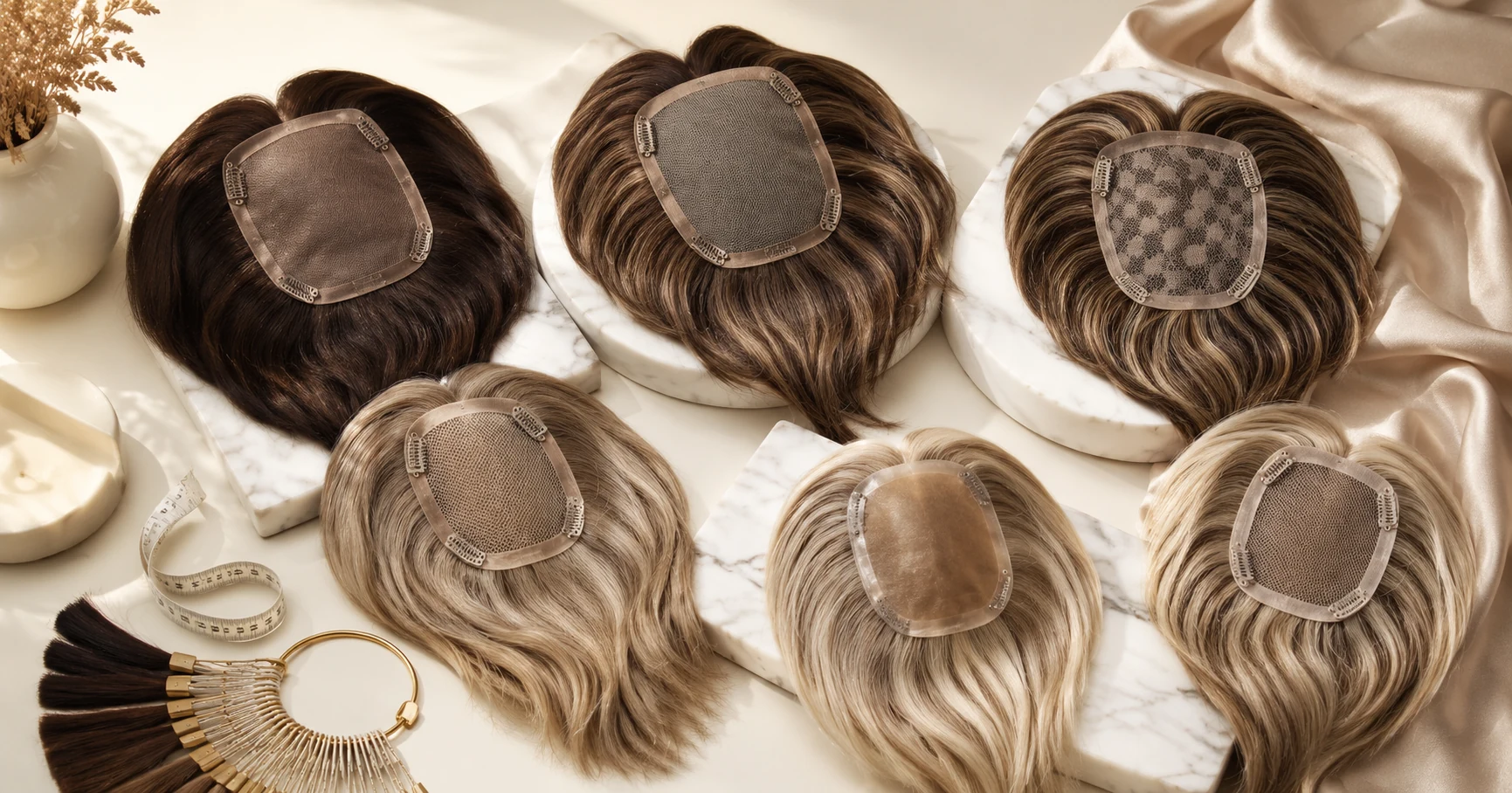
You might be asking: does the base really matter if the hair quality is good? In practice, it does — more than most first-time buyers expect. The base determines how realistic the scalp looks, how breathable the piece feels, how long it lasts, and how much it costs. Overall, three base types account for the vast majority of the market.
Silk Top Construction
A silk top hair topper uses a triple-layer system. First, the top layer is a flesh-toned silk fabric. Beneath it sits a lace mesh for structural support. Next, hair strands are hand-tied through both layers at our Qingdao factory, trapping the knots between the silk and lace. As a result, there are zero visible knots, even under close inspection. The scalp appearance is remarkably natural, and the construction allows multi-directional parting across the entire base area.
Lace Top Construction
By contrast, lace top toppers use a single layer of lace mesh. Hair is hand-tied directly onto the lace with knots sitting on the surface. Therefore, these knots are visible without bleaching or tinting. However, the primary advantage is superior airflow — the single mesh keeps the scalp cooler, which matters significantly in hot or humid climates.
Monofilament Construction
Similarly, monofilament toppers use a translucent mesh where each hair is hand-tied underneath the mesh layer. This provides partial knot concealment — better than lace alone but not as complete as silk top. Consequently, monofilament sits in the middle on price, breathability, and realism, making it an effective mid-range option for wholesalers building a tiered product catalog.
| Feature | Silk Top | Lace Top | Monofilament |
|---|---|---|---|
| Scalp Realism | Excellent — knots fully hidden | Good — knots visible without bleaching | Very good — partial concealment |
| Breathability | Moderate — triple layer | Excellent — single mesh | Good — translucent mesh |
| Durability | 18 to 24 months | 12 to 18 months | 15 to 20 months |
| Knot Visibility | Zero | Requires bleaching | Partially concealed |
| Parting Flexibility | Full multi-directional | Limited to hand-tied zones | Multi-directional |
| Price Tier | Premium | Budget-friendly | Mid-range |
Tip
Specifically, run your finger under the base. A silk top feels smooth and continuous across the entire surface. By contrast, lace top has a slightly textured mesh feel. If you notice loose threads or uneven knot spacing under 3x magnification, the unit did not pass proper quality inspection.
For an in-depth head-to-head comparison, see our silk top vs lace top topper guide.
Attachment
Attachment Methods: Clip-in, Tape-in, and Halo
Even the best-made topper is useless if it does not stay in place. Therefore, the attachment method determines daily convenience, security level, and which clients can wear each option.
Clip-in Attachment
The most common method is clip-in attachment. Specifically, pressure-sensitive clips sewn along the base perimeter snap open and close around sections of natural hair. Application takes two to five minutes. Removal is equally fast. For most everyday wear situations, clip-in provides sufficient security and is the method we recommend for first-time buyers.
Tape-in Attachment
Meanwhile, double-sided adhesive tape bonds the topper base directly to the scalp or hair. This creates a very secure hold that lasts three to five days before needing reapplication. As a result, tape-in works well for clients with active lifestyles or those who want to sleep in their topper without worry.
Halo (Wire) Attachment
A thin, transparent wire sits on the head like a headband, with the topper attached. Natural hair covers the wire. This method involves no clips, no tape, and no stress on thinning hair. Consequently, it is the gentlest option — though the least secure for vigorous activity.
| Method | Security | Daily Removal | Best For | Skill Level |
|---|---|---|---|---|
| Clip-in | High | Yes — 2 to 5 min | Everyday wear | Beginner |
| Tape-in | Very high | No — lasts 3 to 5 days | Active lifestyles | Professional |
| Halo | Moderate | Yes — instant | Temporary or occasional use | Beginner |
Note
For clients with very fine hair at the attachment points, clip-in clips can sometimes slip. In those cases, tape-in provides a gentler and more secure grip without putting mechanical stress on fragile strands.
For a detailed comparison of clip-in and tape-in methods, see our clip-in vs tape-in hair topper guide.
Material
Human Hair vs Synthetic Toppers
Material choice affects everything: lifespan, styling versatility, daily maintenance, and wholesale pricing. Therefore, wholesalers should decide which quality tier they want to represent before comparing quotes.
Human Hair Topper Units
Human hair topper units move, bounce, and reflect light like natural hair. In addition, they can be heat-styled, colored within two shades, and washed with standard hair products. With proper care, a quality human hair topper lasts 12 to 18 months of daily wear. Specifically, Remy human hair — where all cuticles are aligned in the same direction — represents the highest quality tier and resists tangling while maintaining its luster longer than non-Remy alternatives.
Synthetic Toppers
By contrast, synthetic toppers come pre-styled and hold their shape through washing and humidity. They require minimal daily maintenance. However, they cannot be heat-styled or colored, and their lifespan is shorter — typically 4 to 6 months. In addition, the movement and light reflection do not perfectly match natural hair, which can be noticeable under certain lighting conditions.
| Feature | Human Hair | Synthetic |
|---|---|---|
| Lifespan | 12 to 18 months | 4 to 6 months |
| Styling | Heat and color safe | Pre-styled only |
| Movement | Natural bounce | Can look stiff |
| Maintenance | Regular washing | Very low |
| Wholesale Price | Higher | Lower |
| Client Perception | Premium quality | Entry-level |
Tip
First, drop a few strands from a sample unit into a glass of water. Virgin human hair sinks slowly because the cuticle layer absorbs water gradually. By contrast, synthetic fibers float or sink rapidly. Therefore, this simple test reveals whether a supplier is being honest about their material.
For a comprehensive breakdown of material differences, see our human hair vs synthetic toppers wholesale guide. For sourcing Remy hair specifically, our Remy hair topper sourcing guide covers factory selection and quality benchmarks.
Sizing
How to Choose the Right Size
How hard can it be to pick a size? In reality, it is harder than most people think. Getting the right size is the single most important factor in client satisfaction. For example, a topper that is too small leaves thinning areas exposed. Meanwhile, one that is too large can feel heavy and shift during wear. Measuring is straightforward, but it needs to be done correctly.
Measuring Your Client
First, use a soft measuring tape. Measure from the front hairline — where the thinning begins — to the back of the thinning area. Then measure ear to ear across the widest point. Finally, add approximately one inch to each measurement to ensure the topper base extends beyond the thinning area for secure clip placement.
| Size | Base Dimensions | Coverage Area | Best For |
|---|---|---|---|
| Small | 5 x 5 inches | Small crown spot | Early thinning |
| Medium | 6 x 6 inches | Standard crown | Most common — moderate thinning |
| Large | 7 x 7 inches | Extended crown | Advanced thinning |
| Extra Large | 8 x 8 inches | Full top coverage | Diffuse thinning |
| Custom | Per specification | Any area | Unique patterns |
Tip
Therefore, when in doubt, size up. A slightly larger base provides better coverage and more room for clip placement. In fact, a topper that is too small is the number one reason for returns and exchanges — and it is entirely preventable with accurate measuring.

For a detailed measuring walkthrough with photos, see our human hair topper size chart guide. For fitting advice specific to crown thinning, our salon fit guide for thinning crowns covers common challenges.
Thinning Hair
Hair Toppers for Thinning Hair
Thinning hair is the primary reason clients seek out toppers, but not all thinning is the same. Therefore, matching the topper to the specific type and stage of thinning is what separates a satisfied client from a return.
Crown Thinning
This is the most common pattern. In this case, hair gradually thins at the crown while the hairline and sides remain dense. A 5 x 5 or 6 x 6 inch topper placed over the crown restores fullness without affecting the rest of the head. For salon owners, this is your highest-volume topper sale.
Widening Part Line
Similarly, the part gradually becomes wider as hair density decreases along the top of the head. A narrower topper — 4 x 4 or 5 x 5 inches — centered on the part line provides coverage without excess bulk.
Diffuse Thinning
Overall thinning across the entire top of the head. This requires a larger base — 7 x 7 or 8 x 8 inches — to cover the full affected area. Density selection is critical here: too dense looks unnatural against thin natural hair.
| Thinning Level | Recommended Base Size | Density | Base Type |
|---|---|---|---|
| Early thinning | 5 x 5 inches | 100 to 120% | Lace top |
| Moderate thinning | 6 x 6 inches | 130 to 150% | Silk top |
| Advanced thinning | 8 x 8 inches | 150 to 180% | Silk top |
| Patchy loss | Custom shape | Varies | Monofilament |
Density selection deserves special attention. For thin natural hair, 100 to 120% density creates a believable look. By contrast, for medium-thick natural hair, 130 to 150% matches better. Going above 180% is rarely necessary and often looks artificial. In addition, our Qingdao production line produces custom density gradients that taper from higher density at the crown to lower density at the edges, mimicking natural growth patterns. If you are evaluating suppliers, request density gradient samples — most manufacturers including our factory provide them at wholesale cost.
For detailed recommendations, see our silk top topper thinning hair guide.
Color
Color Matching Guide
Even a perfectly sized, beautifully constructed topper will look wrong if the color does not match. Consequently, color matching is the step most often rushed — and the one most often regretted.
The Matching Principle
Hair topper color must match the client's hair at the mid-length to ends, not at the root. Because the root area is covered by the topper base, root color is irrelevant. Therefore, the visible lengths and ends are what need to blend with the topper hair.
Color Ring Matching
Most manufacturers, including our factory, provide color ring swatches — physical hair samples that show each available shade under natural light. In fact, ordering a color ring before placing a bulk order is the single most reliable way to prevent color mismatch complaints from your clients. Since screen colors vary by one to two shades compared to real hair swatches, online color selection is unreliable.
| Client Hair Type | Recommended Approach | Notes |
|---|---|---|
| Single solid color | Direct color ring match | Most straightforward |
| Highlighted | Match the dominant tone | Secondary highlights blend naturally |
| Two-tone | Custom blend at factory | Specify percentages for each shade |
| Gray blending | Salt-and-pepper custom blend | Growing demand in 50+ demographic |
| Unusual shade | Custom coloring service | Stay within 2 shades of original |
Tip
Always order a color ring before placing a bulk order. Since screen colors vary by 1 to 2 shades from real hair swatches, visual matching from a monitor is unreliable. As a result, a color ring sample costs a few dollars and prevents hundreds in return shipping and client dissatisfaction.
For our full shade chart with ordering codes, see the wholesale silk top hair toppers color and spec guide.
Wholesale
Wholesale Buying Guide for Salon Owners
What separates a real manufacturer from a trading company posing as one? Knowing the difference protects your margins and your reputation. Therefore, buying toppers wholesale requires a different evaluation framework than retail purchasing — you are not just buying a product, you are selecting a manufacturing partner.
Minimum Order Quantity
Factories set MOQs based on their production economics. For topper units, typical MOQs range from 10 to 50 units per order. However, some factories, including ours, offer lower MOQs for first-time buyers who want to test quality before committing to a larger order.
Sample Policy
Always order samples before a bulk purchase. A reputable factory will provide 1 to 3 sample units at or near wholesale cost. Next, examine the base construction, hair quality, density, and color accuracy. In practice, this step alone prevents most quality disputes.
Lead Times and Customization
Production lead times for custom topper orders typically range from 15 to 25 business days. Meanwhile, stock items ship faster — often within 5 to 7 business days. In addition, the best manufacturers offer customization across base size, base type, hair density, hair length, color, and silk tone. If a supplier only offers pre-made sizes and colors with no customization, they are likely a reseller, not a manufacturer.
| Factor | What to Ask | Why It Matters |
|---|---|---|
| MOQ | Minimum order quantity per style? | Budget planning |
| Sample policy | Can you order 1 to 2 units first? | Quality verification before bulk |
| Lead time | Production plus shipping timeline? | Inventory timing |
| Customization | Color, density, base size options? | Client matching capability |
| Payment terms | Deposit and balance structure? | Cash flow management |
| Quality guarantee | Return policy for defects? | Risk management |
If you are evaluating suppliers, our Qingdao factory offers sample kits for qualified wholesale buyers — reach out to discuss your requirements. For a deep dive into sourcing strategy, our Remy hair topper wholesale sourcing guide covers factory vetting, negotiation, and quality benchmarks in detail.
Quality Tests
Quality Verification: 5 Tests Every Buyer Should Know
Whether you are evaluating a new supplier or spot-checking a regular shipment, these five tests give you reliable information about hair topper quality. In fact, we run these on every production batch at our Qingdao facility.
1. The Water Test
First, drop a few strands from the topper into a glass of water. Virgin human hair sinks slowly because the cuticle layer absorbs water gradually. By contrast, synthetic fibers float or sink rapidly. Similarly, coated or chemically treated hair may sink at an unusual speed.
2. The Stretch Test
Next, gently pull 5 to 6 strands. Virgin human hair stretches 20 to 30% of its length and bounces back. However, hair that has been over-processed will break or not return to its original length.
3. The Burn Test
Then burn a single strand with a lighter. Human hair burns to fine ash that crumbles easily. By contrast, synthetic hair melts into hard beads. This test is definitive but destructive — only use it on sample units.
4. The Smell Test
In addition, new toppers should smell neutral or faintly of hair product. A strong chemical or acid smell indicates aggressive processing that may have compromised the hair cuticle.
5. The Shed Test
Finally, run your fingers through the topper 10 times. Count the strands that come loose. A well-ventilated topper sheds 3 to 5 strands maximum. However, excessive shedding indicates poor knot quality.
| Test | Human Hair Result | Synthetic or Fake Result |
|---|---|---|
| Water test | Sinks slowly | Floats or rapid sink |
| Stretch test | Stretches 20 to 30%, bounces back | No stretch or breaks |
| Burn test | Burns to fine ash | Melts into hard beads |
| Smell test | Neutral or faint protein | Strong chemical or acid |
| Shed test | 3 to 5 strands maximum | Excessive shedding |
Most reputable manufacturers will run these same tests on their production line if you ask. Likewise, our workshop includes them as standard quality control — and we encourage wholesale partners to verify for themselves.
FAQ
Frequently Asked Questions
How long do human hair toppers last?
A well-maintained human hair topper lasts 12 to 18 months with daily wear. With proper care — gentle washing every 7 to 10 wears, minimal heat styling, and storage on a mannequin head — many clients extend that to 24 months. The most common reason for replacement is density loss at the crown, not base failure. Rotating between two toppers can push each unit's lifespan to 30 months or more. Remy hair toppers typically outlast non-Remy by 3 to 6 months due to the aligned cuticle structure.
Can you sleep in a hair topper?
Clip-in toppers should be removed before sleeping. The clips can pull on natural hair during sleep movement, causing tension damage over time. Tape-in toppers, however, are designed for extended wear including sleeping. If a client insists on sleeping in a clip-in, recommend a silk pillowcase and a loose braid to minimize friction and pulling.
What is the best base type for beginners?
Lace top with clip-in attachment. The lower wholesale price point lets new wearers test the concept without a large investment, and clip-in application is straightforward enough for self-application at home. In our experience, many first-time lace top buyers upgrade to silk top within six to twelve months once they understand the maintenance difference firsthand.
Are hair toppers detectable?
A properly fitted, correctly colored hair topper is virtually undetectable in normal social settings. The key factors are base type — silk top provides the most realistic scalp appearance — exact color matching, and density selection that mirrors the client's natural hair. Silk top toppers, in particular, hide all knots between the silk and lace layers, so there are no visible root dots even under direct overhead lighting.
How do I start buying hair toppers wholesale?
Order samples from two or three factories, verify quality using the five tests in this guide, then place a minimum order with the supplier that meets your standards. Our Qingdao factory accepts initial orders from 10 units for new wholesale partners.
Conclusion
Making the Right Choice for Your Clients
Overall, choosing the right hair topper comes down to three decisions: base type, material, and attachment method. Match those to your client's thinning pattern, lifestyle, and budget, and you have a product that sells itself. For salon owners and retailers, the opportunity is clear — this is a high-growth category with strong margins and repeat purchase potential.
Therefore, the key is partnering with a factory that delivers consistent quality, because one bad unit does not just lose a sale, it loses a client. At LEV Wigs, our Qingdao production line manufactures toppers across all base types, sizes, and material grades, with lead times of 15 to 25 business days for production orders.
| If You Need... | Base Type | Attachment | Material |
|---|---|---|---|
| Maximum realism | Silk top | Clip-in | Human hair |
| Budget-friendly entry | Lace top | Clip-in | Synthetic |
| Hot climate comfort | Lace top | Tape-in | Human hair |
| Versatile styling | Silk top | Clip-in | Remy human hair |
Next, contact our team to request samples, spec sheets, or wholesale pricing for your market.

Ready to Stock Hair Toppers?
Whether you are adding toppers to your salon's hair loss solutions or building a wholesale catalog from scratch, our team in Qingdao is ready to help you select the right products for your clients.
Request Wholesale Pricing