COMPLETE GUIDE
Jewish Wigs and Sheitels: Wholesale Buyer Essentials

Jewish wigs, known as sheitels, sit at the intersection of religious practice, craft, and commerce. In communities where married women choose wigs for hair covering, buyers need a unit that looks natural, holds up structurally, and matches the requirements their customers follow. That combination means the category cannot be treated like an ordinary fashion wig.
This page is the hub for everything LEV Wigs has written about Jewish wigs and sheitels. As a Qingdao-based manufacturer, we make sourcing, cap-construction, and quality-control decisions on the factory floor. Therefore, the sections below use a manufacturing perspective rather than a retail-counter perspective. Each section gives you an overview, then links to a deeper article when you need the full detail.
A note on scope: this guide focuses on the wig itself and on how wholesale buyers, salon owners, and retailers should think about sourcing it. We cover what a Jewish wig is, why the practice exists, how the types differ, what goes into a quality unit, how kosher standards work, what cost and lifespan to expect, and how the actual wholesale buying journey unfolds. If a topic here deserves its own page, there is a Deep Dive link to take you there.
Before an order is placed, the buyer should document the customer's coverage, construction, and styling requirements. This guide is organized as a hub so each decision can be checked against a focused spoke article before a sample or bulk order is approved.
Definition
What Is a Jewish Wig?
A Jewish wig, or sheitel, is a wig worn for hair covering in many Orthodox Jewish communities. The defining feature is the use context rather than a single cap shape: the buyer specifies coverage, construction, hair, and styling requirements for the customer and community served.
A sheitel should not be sold as a generic fashion wig. For example, a buyer may need source documentation, an opaque lining, a particular cap construction, or full-coverage styling. These requirements are not uniform. Therefore, a retailer should confirm them with the customer and, where appropriate, the customer's rabbinic authority before promising suitability.
Modern sheitel construction can combine lace, silk, hand-tied ventilation, and wefted sections. The correct combination is a procurement decision informed by the customer's fit brief, wearing habits, and community guidance—not a universal religious specification.
Background
Why Do Jewish Women Wear Wigs?
For many Orthodox Jewish women, hair covering after marriage is a religious practice, and a sheitel may be one of the accepted covering options. The details of practice and acceptability vary by community and individual guidance; this article does not offer halachic rulings.
That variation matters commercially. For example, some customers may prefer a natural-looking wig, while others may choose a tichel, snood, hat, or a different construction. Therefore, buyers should ask for the customer's actual requirements rather than assuming that one style, lining, or degree of coverage suits an entire community.
For a wholesale buyer, the takeaway is that “Jewish wig” is a family of products, not a single specification. Inventory and custom briefs should be based on the communities the retailer actually serves, with religious questions confirmed by the customer's own rabbinic authority.
Types
Types of Jewish Wigs: A Decision Tree
Rather than list every sheitel variant in a flat catalog, it is more useful to think in terms of what the wearer needs to cover and how. The decision branches below are how we frame the choice when a retail partner asks us what to stock. Each branch leads to a different construction, a different price tier, and a different ideal customer.
Full Coverage: The Full Sheitel
If the wearer needs her entire head of natural hair covered by the wig alone, the answer is a full sheitel. This is the most common form and the category most people picture when they hear the word. Within it, the cap construction at the crown and front hairline determines the sub-type: a lace top sheitel uses an open mesh that breathes and allows the part to move, a silk top sheitel uses a double-layer silk insert that simulates a scalp at a fixed part line, and a lace front sheitel pairs a natural front hairline with a more structured back. Each has its own tradeoffs in breathability, realism, and durability.
Partial Coverage: The Fall and Hat Combination
If the wearer is comfortable pairing the wig with a hat, beret, or snood, a sheitel fall becomes an option. A fall covers only the back and sides, leaving the crown to be covered by the hat itself. Falls are lighter, cooler, and less expensive than full sheitels, and in some Hasidic and Haredi communities the fall-plus-hat combination is the preferred or even required form of covering. For a retailer, falls are a strong secondary product line because they serve a distinct segment rather than competing directly with full wigs.
When Neither Is the Answer
If the wearer's community favors non-wig coverings, no sheitel is needed and a tichel, snood, or hat alone may suffice. LEV Wigs manufactures wigs, so this branch falls outside our product line, but a buyer should know it exists before assuming every Orthodox customer wants a wig. Matching inventory to the actual covering practices of the target community is what separates a profitable sheitel selection from one that sits on the shelf.
Materials
What Goes Into a Quality Sheitel
Two things determine whether a sheitel looks good after a year of daily wear: the hair and the construction. Of the two, the hair matters more, because a premium cap built with low-grade hair still looks tired quickly, while premium hair on a modest cap tends to age well. This is why our factory spends more time on hair sourcing and inspection than on any other production stage.
Hair Origins in Plain Terms
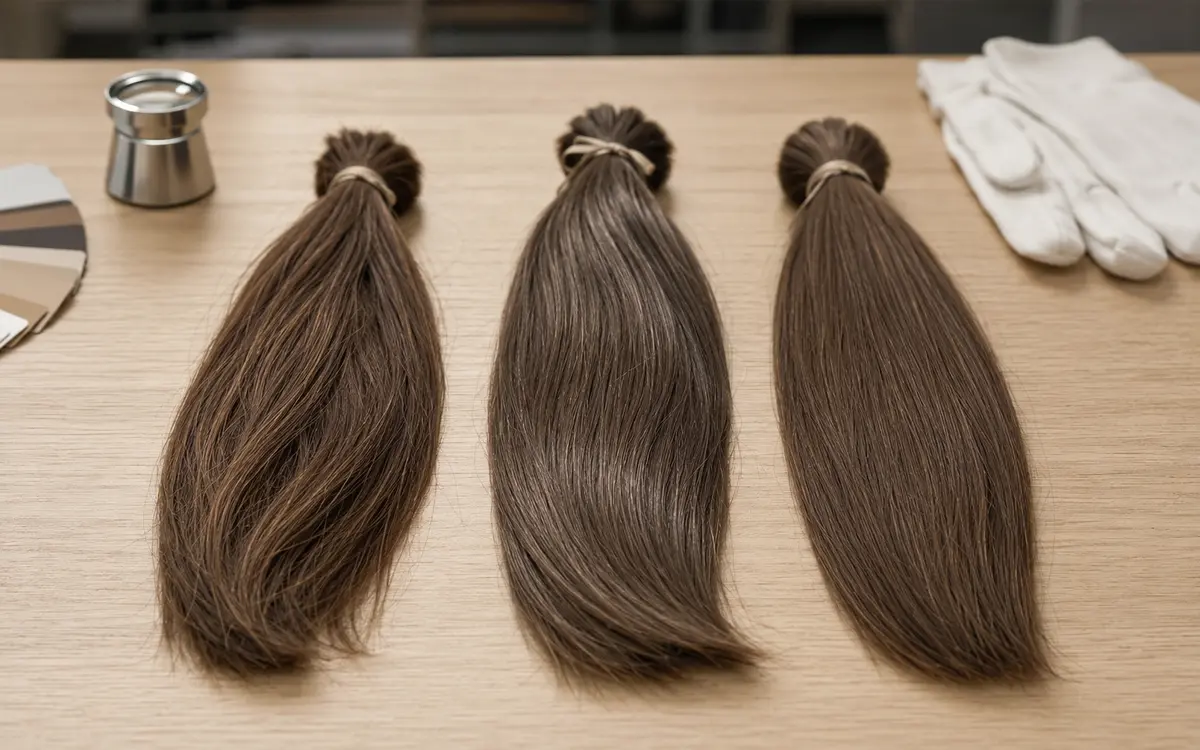
European virgin hair, Russian hair, and Remy hair are commercial labels used for different sourcing and processing briefs; they do not replace a sample-based quality check. Ask the supplier to describe the hair's processing, cuticle alignment, color work, and intended use, then inspect a finished sample under the conditions in which the customer will wear it. Texture, luster, and price vary by batch and specification.
Construction and the Knot
On the cap side, the meaningful distinction is hand-tied versus wefted. A hand-tied section, where each strand is individually ventilated through lace or silk, can create a natural part and hairline. By contrast, wefted sections use machine-sewn tracks to provide volume and structure more economically. Many sheitels combine both: hand-tied at the visible front and crown, and wefted at the hidden back. Knot technique also matters. At LEV, a double knot at the first rows of the lace front is our standard option for daily wear; it requires more labor per unit than a single knot.
How We Inspect on Entry
Every bundle of hair that enters our Qingdao facility goes through a multi-point incoming inspection before it is approved for production. We check cuticle direction under magnification, color consistency across the bundle, elasticity, and diameter. If a bundle fails a check, it is rejected and returned to the supplier rather than downgraded into a cheaper line. This is a qualitative account of our process, not a controlled study. Even so, only hair that passes this review reaches the ventilating bench.
Halacha
Kosher Wigs: What Makes a Wig Halachically Acceptable
“Kosher wig” is used differently across the market and should not be treated as a universal certification or a factory claim. A supplier can document hair sourcing and construction, but only the customer and the relevant rabbinic authority can determine whether a specific unit meets that customer's religious requirements.
For procurement, record the agreed cap construction, lining preference, hair documentation, and coverage expectations in the written brief. Do not infer a community standard from a label, a style name, or a previous order.
The practical implication for a buyer is that "kosher" is not a binary label you can assume. The right question is "acceptable to which community," and the answer determines whether you stock lined or unlined caps, which hair origins you offer, and how you label the product for your retail customer. When a community standard is unclear, the honest move is to tell the retail customer to confirm with her own rabbinic authority before buying, rather than to promise compliance you cannot verify. A custom order built to a clear community spec is almost always safer than a stock unit sold on assumption.
Value
How Much Does a Sheitel Cost and How Long Does It Last
Compare Value Before Price
Cost and lifespan are connected because a sheitel is a daily-wear item. Its value is better measured per wear than by the sticker price alone. A unit that lasts longer may deliver a lower cost per wear even when its initial price is higher. For that reason, retail partners should discuss durability and care as well as the initial price.
On cost, the variables are the same ones that drive any wig: hair origin, cap construction, density, and length, with custom work adding a premium over stock configurations. European virgin hair commands more than Remy, a full silk top commands more than a lace front, and a fully custom order commands more than a stock size. Rather than quote a fixed number that goes stale, we price each wholesale order against the buyer's actual spec. The honest framing for retail customers is that a quality daily-wear sheitel is an investment piece, comparable in lifecycle cost to a well-made coat or a pair of orthopedic shoes, not a disposable fashion accessory.
Give Care Guidance by Unit
Care affects lifespan, but the outcome also depends on hair processing, construction, fitting, styling frequency, and the customer's routine. Give each customer the supplier's care instructions for the exact unit, including approved washing, storage, and heat practices; do not use one universal wash schedule or heat setting for every cap and hair specification.
Wholesale
The Wholesale Buying Journey
Most online content about Jewish wigs is written for the end wearer. However, this section is for the salon owner, wig retailer, or distributor who needs to source sheitels at scale. The sequence below shows how a first order can be evaluated. Skipping a step is where costly mistakes often enter.

Use a Five-Step Evaluation Process
Define the target community's requirements
Before contacting any supplier, record the coverage, construction, and styling requirements your retail customers actually request. This document drives later decisions, from lining preferences to the hair and cap options presented for approval.
Evaluate suppliers on sourcing transparency
Ask each candidate supplier for hair sourcing documentation and a description of its incoming inspection process. In addition, request a concrete explanation of the QC steps. A supplier that can answer both questions is easier to evaluate than one that competes only on price. Vague answers at this stage rarely improve later.
Order a paid sample unit
A single sample built to the intended production spec is the cheapest insurance in this process. Then inspect front-knot security, cap fit on a real head form, daylight color consistency, and weight. If the sample is wrong, the bulk order is likely to repeat the problem at a much larger cost.
Run a small trial order
Once the sample passes, place a small trial order before committing to full volume. This confirms whether production quality matches the sample. It also tests lead time and communication under a real order. Trial orders matter because samples and bulk do not always align.
Scale into a long-term partnership
Finally, a supplier that has cleared the first four stages may be ready for a long-term partnership. Agree on lead times, which specifications are standard or custom, and how quality issues will be handled. The goal is a relationship in which the supplier works from an approved brief rather than reopening the basics on every order.
Set Terms After the Trial
Two practical notes from our side of the table. We offer paid sample units to qualified buyers because we want the evaluation stage to be real, not theoretical, and our minimum order quantity is set low enough that a trial order is a genuine test rather than a financial commitment. The exact MOQ and sample policy depend on the configuration, so the cleanest path is to tell us your target community and expected volume, and we will come back with a concrete proposal rather than a generic price list.
Selection
How to Choose the Right Jewish Wig
Once the categories are clear, selection follows a short decision sequence. Requirements come first: a perfectly built sheitel can still be unsuitable if the confirmed customer brief was not followed.
Confirm the Brief Before Comparing Construction
First, confirm the community standard. Lined or unlined, fall or full, acceptable hair origins, any style expectations. If the answer is uncertain, the buyer should confirm with her rabbinic authority before the order, not after the unit arrives. Second, set the budget tier. This determines whether the conversation is about European virgin hair, Russian hair, or Remy, and whether the cap is a full silk top, a lace top, or a lace front. Third, choose the construction. Within the budget, pick the cap that matches the wearer's styling habits and wear duration. Fourth, verify the supplier. A unit is only as reliable as the factory that stands behind it, and the wholesale journey above is how that verification happens.
| Construction | Best For | Coverage | Realism |
|---|---|---|---|
| Silk top full sheitel | Fixed part, maximum scalp realism | Full | Highest at part line |
| Lace top full sheitel | Daily wear, restyling freedom | Full | Very high, movable part |
| Lace front sheitel | Natural hairline at lower cost | Full | High at front, structured back |
| Sheitel fall with hat | Hasidic and Haredi segments, hot climates | Partial (back and sides) | Depends on hat pairing |
| Custom order | Specific community spec not met by stock | As specified | As specified |
The table is a starting point, not a verdict. A lace top is not objectively better than a silk top; it is better for a wearer who restyles often, while a silk top is better for a wearer who keeps a fixed part and wants it flawless under any lighting. The construction choice always folds back into the community and budget steps above it, which is why those steps come first.
FAQ
Frequently Asked Questions
A sheitel is a wig worn for hair covering in many Orthodox Jewish communities. The appropriate cap, lining, hair documentation, and coverage depend on the customer's requirements; a retailer should confirm those requirements before promising that a unit is suitable.
Pass on the supplier's written care instructions for the exact unit, including approved washing, storage, and heat practices. Care needs vary with the hair, cap construction, processing, and styling routine, so avoid presenting one universal wash schedule or heat setting as suitable for every sheitel.
“Kosher” is not a hair type or a universal factory certification. Ask the supplier for the relevant sourcing and construction documentation, then have the customer confirm any religious requirements with her own rabbinic authority before an order is represented as suitable.
Evaluate four things before committing. Request hair sourcing documentation and confirm the supplier can trace origin to the donor or a verified collection point. Order a paid sample unit to inspect knot security, cap fit, and color consistency before placing bulk. Confirm the MOQ, lead time, and customization scope in writing. Ask for references from other salon or retail partners in your region.
Yes. A manufacturer can tailor cap construction, lining, lace grade, hair brief, density, length, and color to a documented customer specification. Confirm any religious requirement with the customer and her rabbinic authority before production; the factory should then build to that approved brief rather than infer it from a generic stock unit.
Conclusion
A Jewish Wig Is a Religious Object Built Like a Craft Product
The thread running through every section above is that a Jewish wig cannot be understood as either purely religious or purely commercial. It is a daily-wear religious object that has to be built to craft standards, sourced through trusted channels, and matched to a specific community's halachic requirements. Getting any one of those three wrong turns a sale into a return, which is why the categories, the materials, and the buying journey all matter before the first unit is ordered.
For a wholesale buyer, the practical sequence is straightforward in hindsight: know the community first, evaluate the supplier on sourcing transparency, test with a sample and a small trial, then scale into a partnership. The factories that last in this market are the ones that treat each of those steps as a real conversation rather than a sales funnel. That is the approach we take at LEV Wigs, and it is the reason this guide links out to dedicated articles rather than trying to compress every detail onto one page.
If you are considering adding Jewish wigs and sheitels to your product line, or if you want a manufacturing partner who can build to your community spec at scale, we would welcome that conversation. LEV Wigs hand-ties sheitels in Qingdao, China, using supervised human hair and configurable cap construction, and we ship to retail partners worldwide. Contact us for wholesale pricing and tell us which community you serve.



Ready to Source Jewish Wigs for Your Store?
LEV Wigs hand-ties sheitels in Qingdao, China, using supervised human hair and configurable cap construction. Paid samples and low-MOQ trial orders available for qualified buyers.
Request Wholesale Pricing