Wholesale Sourcing
Lace Top Wigs Human Hair: A Wholesale Specification Guide

Every sheitel boutique, Jewish wig retailer, and wholesale buyer we work with eventually asks the same question in some form: two suppliers both say "human hair" — what is actually different between their offers? The label itself answers nothing. It commits the seller to no origin, no cuticle condition, no processing history, no texture, and no repeat-order consistency. What separates a supplier worth ordering from is whether "human hair" can be expanded into a written specification — and whether the pieces that arrive can be checked against it.
This guide is written for the buying side of that exchange: sheitel machers commissioning bases, boutique owners building a house line, and wholesale buyers placing repeat orders across seasons. It walks through how professional buyers define, compare, and record human-hair quality specifications for lace top sheitels — field by field, and in the order the decisions actually arise.
We write from the workshop side of the table: LEV records the hair tier and origin for each lace-top order in the approved specification. That position lets us show which fields carry real information, which claims can and cannot be verified by a buyer, and how a specification becomes the instrument that keeps your third order matched to your first.
The Label Problem
Why "Human Hair" Alone Is Not a Purchasing Specification
A specification is a set of written, checkable fields attached to a purchase order. "Human hair" is a material category — the broadest possible one. Between the category and a piece your client will wear sits every decision that determines price, wear behavior, and reordering: tier, origin, cuticle condition, processing, texture, color, density, and length.
The practical test is simple: if a dispute arose, could either side point to a document and read the answer out? "Premium European hair" fails that test — premium is an opinion and the phrase names no verifiable attribute. "European-origin hair, cuticle-aligned, drawn root-to-tip, unprocessed color, matched to swatch #14" passes it. The first is marketing vocabulary; the second is a specification.
This distinction matters in the sheitel trade because clients may rely on the piece through extended daily wear, while a retailer's reputation depends on how the hair behaves after repeated service — not only how it looks in the box. A Jewish wig retailer who reorders the same specification each season is selling consistency; that consistency lives in the paperwork, not in the label.
The rest of this guide takes the label apart. If you are also still comparing cap constructions, our lace top sheitels complete guide covers what a lace top is and how it is built — this article assumes the construction decision is made and asks what the hair on it must be specified as.
Material Fields
Hair Tier and Origin Disclosure
The two fields that carry the most commercial weight on a lace-top order are material tier (the graded quality of the hair within a supplier's system) and origin (where the hair was collected). They are also the two fields most often reduced to a single word on a price list. A workable specification treats them as recorded, per-order facts.
Tier
The supplier's own quality grade, defined by what the workshop inspects: cuticle alignment, draw direction, thickness consistency, luster. Ask how tiers differ in inspection, not just in price.
Origin
The requested hair source or supplier line offered for that order. Record the exact disclosed term in the approved specification so the piece and the paperwork say the same thing.
Draw direction
Whether the hair is drawn root-to-tip in one direction. Determines how the crown behaves under daily brushing.
Sourcing mode
Whether hair is sourced for the order or selected from available stock, and how the supplier confirms the requested texture and color in either route.
What should a wholesale buyer actually require? At minimum, that the supplier writes the tier and origin into the order confirmation and stands behind it at receiving. On our side, each lace-top order records the hair material, the requested origin, cuticle alignment, and draw direction in the approved specification before production starts — the buyer's copy is the reference both parties check against when the goods arrive.
Be skeptical of origin claims that arrive without any supporting mechanism. The useful question is not simply "is this really the stated origin?" but "what documentation and inspection records support the disclosed term?" Ask what the supplier records at intake, which checks are actually performed, and what evidence can be shared for the order. If the supplier cannot describe the process or evidence boundary, the label remains difficult for a buyer to verify.
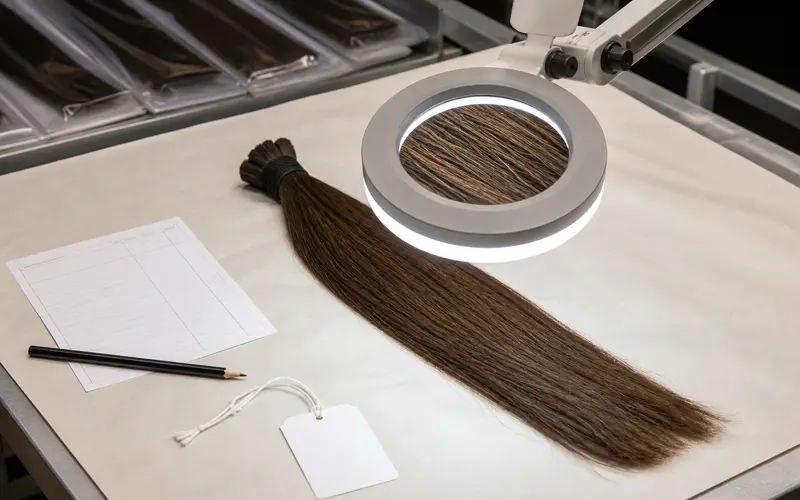
For a macher commissioning bases to finish personally, add the exact texture, color, and blending target to the same written fields. If a supplier offers a separately documented sourcing option for the order, record the option by its confirmed name and evidence rather than assuming what the label guarantees.
Verification Boundaries
What Cuticle Alignment Can — and Cannot — Tell You
Cuticle alignment is the most commonly cited quality claim in human-hair sourcing, and the most commonly over-read. It deserves a precise boundary in your specification thinking.
Alignment does tell you
- Scales along each strand run in one direction, root to tip
- Such hair will resist matting far better under daily brushing
- It shows the workshop drew and sorted the hair with discipline — a process indicator
- Friction behavior: aligned hair moves and reflects light more like growing hair
It does not tell you
- The origin of the hair — aligned hair can come from any source
- Whether the hair is virgin — aligned hair is routinely color-processed
- Donor history, chemical exposure before collection, or age of the hair
- Texture or diameter — fine aligned hair and coarse aligned hair behave differently
The boundary matters because "cuticle-aligned" is sometimes sold as a synonym for "top quality," and it is not. Remy hair is by definition aligned, and it is frequently processed for color and texture — legitimately, and at a price point that serves budget lines well. Virgin hair is unprocessed, but only behaves like premium hair when it is also drawn and sorted with the same root-to-tip discipline. The two words describe different axes: one is about direction, the other about processing history.
When you evaluate a supplier, move the conversation from the claim to the inspection behind it. Ask what incoming inspection is performed before production — cuticle direction, color consistency, elasticity — and how the results are documented and shared with you. Our Remy topper sourcing guide covers the physical checks a buyer can run on a sample; on the specification side, the question is whether those checks happen per batch upstream of your order and leave a record you can point to later.
Matching the Client Base
Texture, Diameter, and Luster: Specifying for Your Clients
Origin talk eventually has to meet the mirror. What your Orthodox client base perceives as "natural" is a combination of three observable properties, and all three can be specified:
- Texture — the feel and behavior of the strand: fine and soft, medium, or with body. Fine European-texture hair matches the hair common in many communities your boutique serves; coarser hair with more body photographs fuller and holds shape with less product.
- Diameter — the thickness of individual strands. It drives how the crown lies, how the part reads, and whether the piece looks like it belongs on the woman wearing it.
- Luster — the quality of reflected light, from soft and matte to high-gloss. Softer, lower-luster hair can read understated in daylight; higher luster may look different under bright indoor lighting, so compare it in the environments your clients actually use.
The specification move is to describe the target, not the adjective. "Natural-looking" is not a field. "Fine texture, soft natural luster, medium-brown with warm undertone" is. When you anchor these fields to your client base — the women who actually walk into your store — the supplier can match hair to the target rather than shipping whatever the generic market prefers.
One caution inherited from honest sourcing practice: if a supplier's entire stock drifts toward one texture and luster profile, "premium" is doing no work in their price list. A workshop that sources for your order can pull toward fine-and-soft or toward body-and-gloss depending on the brief; a stock-only operation cannot. That flexibility — more than any grade number — is what lets a Jewish wig retailer build a house look that clients recognize across seasons.
Verification Limits
Processed and Unprocessed Claims: The Honest Verification Boundary
"Virgin" and "unprocessed" are the highest-stakes words on the page, and the ones a professional buyer should treat with the most discipline — in both directions.
What a boutique buyer can realistically verify is bounded: careful observation of feel, wash behavior, and combing can reveal performance concerns, but it cannot prove origin or establish every treatment the hair received. The workable standard is documented process plus repeatable sample observations, not an impossible guarantee.
The practical layering looks like this:
- Sample-level observations identify performance concerns. A smooth first touch proves little; document how the sample behaves after the agreed wash and gentle-combing routine, then ask the supplier to explain any unexpected change.
- Workshop-level rejection standards are the next layer. Ask what a supplier refuses: hair that has been acid-washed, silicone-coated, or over-processed. A published rejection standard is a stronger commitment than any adjective.
- Batch documentation is the audit layer. Incoming batches catalogued and tested before production — texture consistency, cuticle integrity, luster — leave a record that connects the claim to the goods.
- Per-order confirmation closes the loop. Whether material is sourced for the order or selected from available stock, the supplier should confirm what was selected against the written brief.

One more boundary worth naming: processed is not a synonym for bad. Color-processed Remy hair, honestly specified, is the right answer for price-sensitive lines and first-time buyers — the wrongness is only in the mislabeling. The specification discipline that protects your boutique is the same in both directions: whatever the hair is, the order documents say so.
Repeat-Order Discipline
Color Consistency and Batch Records
Color is where repeat orders most often go wrong — and where the fix is almost purely administrative. The failure pattern is familiar to every retailer: season one arrives a perfect match; the reorder, placed against the same color name, arrives a half-tone off. Nobody lied; the color name was never a specification, and the batch behind it changed.
On the specification side, the answer is a batch and color record kept on your side:
- The approved reference — a physical swatch, a photo of the approved unit under daylight, or the reference unit itself, retained.
- The batch identifier — what the supplier's paperwork says the hair for that order was, so a reorder can reference it.
- Daylight documentation — a photo of each delivered batch under consistent natural light, so drift is visible over seasons, not arguable.
Keep that record attached to the order number on your side.
On repeat orders, the purchase order should reference the previous batch explicitly — "match to the batch recorded on order #___," not "same color as last time" — and the supplier's confirmation should come back against that reference. Color consistency between batches is a standard upstream inspection question; on your side, the record is what makes the question askable eighteen months later.
For boutiques serving a specific community palette — the natural dark blondes and warm browns that dominate many Orthodox client bases — this record is also merchandising intelligence. Over seasons it shows which tones actually move, and reorders can be tuned to the palette rather than to a generic color ring.
Construction Interaction
Density, Length, and Movement Under a Lace Crown
Hair specifications do not sit in isolation from the cap — and on a lace top, the interaction runs through the crown. The lace layer accepts free-direction parting, which means the density and draw of the hair at the crown are visible in a way they are not under a silk layer.
- Density should be specified per zone for premium lines — lighter at the front hairline, fuller through the crown and nape — because a flat lace crown with uniform density reads as a wig immediately under daylight.
- Length interacts with draw: longer hair concentrates weight at the crown, and a density that works at 16" can look thin at 24" on the same cap.
- Movement is the composite outcome — texture, diameter, luster, density, and ventilation direction together. If your client base values hair that moves like biological hair during daily wear, movement belongs in the brief even though it arrives as a judgment at inspection rather than a number on a form.

The supporting cap carries fit and comfort; the lace crown carries the visual argument of the whole piece. That division of labor is why our order process confirms lace direction and cap details before production rather than publishing a fixed list — the density that reads natural depends on the client brief your studio writes. When you compare suppliers, compare how they handle that conversation: a workshop that asks about the client's wearing day and styling routine is building to a specification; one that quotes a flat density percentage is selling a configuration.
The Working Document
The Quality Specification Matrix: Fields for Every Order
Everything above compresses into one working document. The matrix below is the field set a professional buyer can put on a purchase order for lace top sheitels — and hand to a new staff member as the definition of "what we order." Use it as a checklist: every field the supplier confirms in writing strengthens the order; every field left as a conversation is a future dispute.
| Specification Field | What to Record | Why It Matters at Receiving |
|---|---|---|
| Material tier | Supplier's grade, with the inspection behind it cuticle alignment, draw direction, thickness consistency | Tier is the price argument; the inspection is what makes it checkable |
| Origin | Requested source or supplier line, recorded in the approved specification Use the exact term the supplier confirms for the order | Connects the piece to the paperwork if provenance is ever questioned |
| Cuticle condition | Requested alignment and draw direction; any separately documented sourcing option if applicable | Provides a documented construction field to compare with sample and receiving-check behavior |
| Processing status | Unprocessed, or the specific processing color, texture treatment | Sets client expectations for styling, coloring, and lifespan behavior |
| Texture and diameter | Fine / medium / with-body, matched to client base | Determines whether the crown reads natural on your clients |
| Luster | Soft-natural through high-gloss, as a stated target | The most visible "reads like a wig" signal under daylight |
| Color reference | Swatch or unit reference plus batch identifier with daylight photo retained | The anchor that makes repeat orders match the first |
| Density | Overall level, zoned for premium lines front hairline lighter, crown and nape fuller | Visible at every part under a lace crown |
| Length and cap size | Ordered length, cap measurements on file | The fields clients notice first and return over |
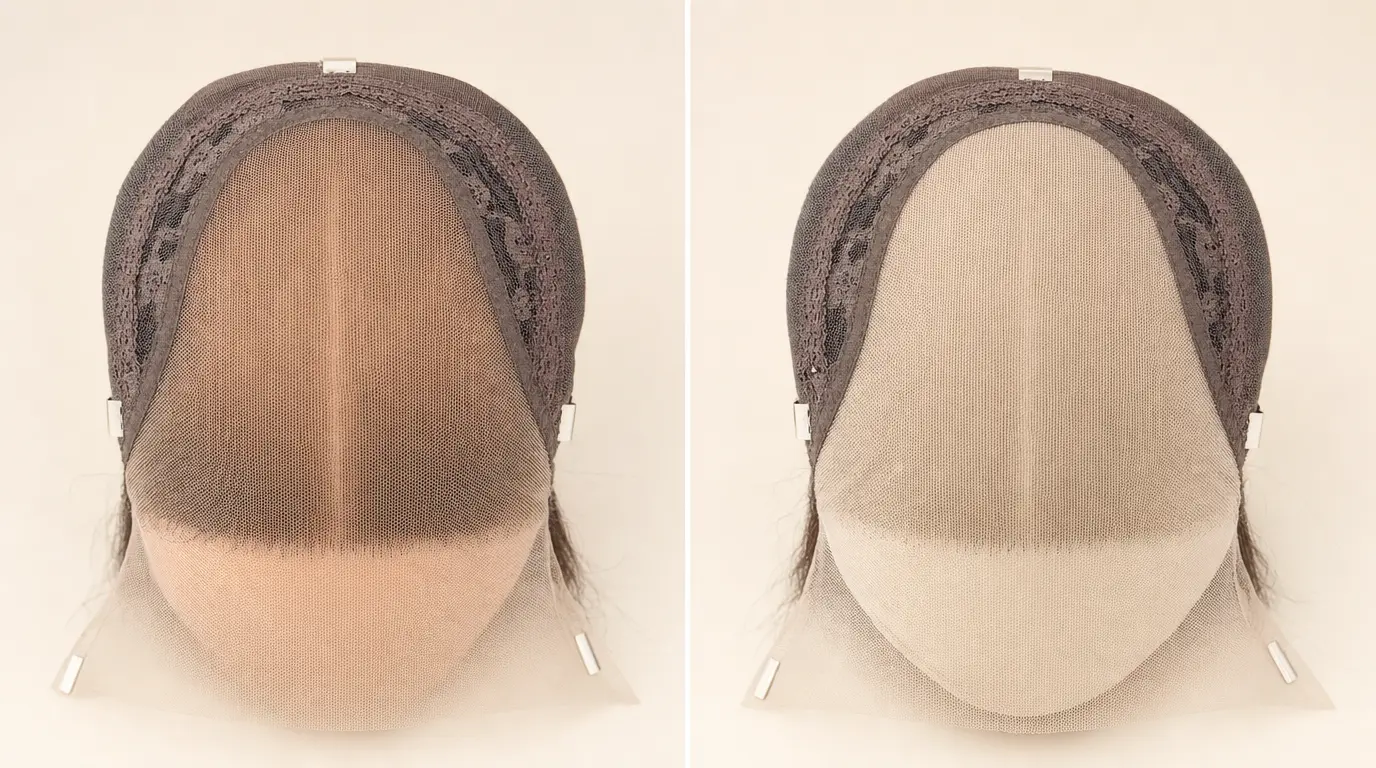
| Lace and knots | Lace tone and weight, knot style, any lightening treatment confirmed for the crown finish | Completes the construction side of the same document |
Two habits make the matrix work over time. First, the buyer's copy and the supplier's confirmation must be the same document — if the fields exist only on your side, they are a wish list, not a specification. Second, attach the record to the order number and keep it with the batch photo; a specification you cannot find in eighteen months cannot defend a reorder.
If your next step is a first order rather than a repeat, the natural companion is a sample evaluated against this matrix — what to check physically when a lace top sample is on the table is its own procedure, and our lace top sheitel sample evaluation guide covers it.
Order Control
Receiving Checks and Escalation When Goods Differ
A specification only earns its keep at the moment of delivery. The receiving pass is not a full re-inspection — it is a structured comparison of goods against the agreed document, done before the pieces enter retail rotation.
- Compare field by field. Tier and origin as documented; color against the recorded reference under daylight; density, length, and cap size as ordered; lace and knot finish as confirmed.
- Record in writing, with photos, the moment a mismatch appears — not after the client complains.
- Escalate with the document, not the impression: "order #___ specified X; the delivered piece shows Y" is a conversation a serious supplier can act on immediately.
- Ask what happens when a check fails upstream. A workshop that adjusts hair batch or density when a sample fails is telling you the specification is enforced inside production, not just quoted outside it.
The escalation path matters as much as the check itself. Disputes between buyers and factories almost never start as disagreements about quality — they start as two parties holding different unwritten expectations. The specification sheet is the instrument that resolves most of them before they start, because it converts "this isn't what I expected" into a specific, fixable field.
FAQ
Buyer Questions on Human Hair Specifications
At minimum: the material tier, the requested origin, cuticle alignment and draw direction, processed or unprocessed status, texture and luster targets, the color reference with its batch record, density, and length. Each field should be confirmed by the supplier in the approved order specification, not left as a label on a catalogue page.
Ask what documentation travels with the batch — sourcing records, incoming inspection results for cuticle direction and color consistency, and whether hair is sourced for your order or pulled from stock. A supplier that records origin per order and can describe its incoming inspection gives you more to verify than one that repeats a label.
No. Cuticle alignment means the scales run in one direction, which reduces matting. It says nothing about origin, donor history, or whether the hair was colored or texturized. Remy hair is aligned but commonly processed; virgin hair is unprocessed but is only 'aligned' when it is also drawn root-to-tip during sorting.
Keep a batch and color record for every order: the approved swatch or reference unit, the batch identifier the supplier used, and photos under daylight. On repeat orders, reference the previous batch explicitly and ask the supplier to match against it rather than starting from a generic color ring.
Compare each unit against the approved specification sheet field by field — tier and origin as documented, color against the recorded reference, density and length as ordered, and the lace crown construction as confirmed. Record mismatches in writing with photos and raise them with the supplier before the pieces go into retail rotation.
Conclusion
The Specification Is the Product
For a sheitel boutique or Jewish wig retailer, the gap between ordering "human hair" and ordering against a written specification is the gap between hoping a reorder matches and knowing it will. The labels — European, Remy, virgin, premium — are vocabulary. The specification is the product: the recorded tier and origin, the boundary of what each claim proves, the batch and color log, and the receiving check that closes the loop.
None of this requires a laboratory or a law degree. It requires a one-page field list, a supplier who confirms it in writing, and the discipline to keep the record with the order. Buyers who build that habit find the rest of sourcing gets simpler: comparisons become field-by-field instead of faith-based, disputes become specific instead of emotional, and the third order arrives looking like the first.

Submit Your Target Specification
Send us the fields you specify — tier, origin, texture, color reference, density — and our workshop team will confirm what can be built to your brief and quote against it.
Get Wholesale Specifications