Lace Top Sheitel Size Guide: 3.5x5 vs 4x4 vs 5x5 Panels

The lace top sheitel size printed on a supplier’s listing looks self-explanatory — 3.5x5, 4x4, 5x5 — until pages from several sellers sit side by side. The listings opened for this guide on October 29, 2026 present the figure in four presentation modes. They are a sized panel line, a measured parting area, a one-dimensional width, and structure wording with no figure. Bases differ where they are stated, and several pages state none, so numbers alone do not establish the same construction or styling behavior. Each section below covers one layer: measuring bases, parting range, and the fields to put in writing.
The Measurement
How Is a Lace Top Sheitel Size Measured?
A two-number figure such as 3.5x5 or 4x4.5 describes two edges of the area at the front of the cap. In other words, they are a front-to-back depth and a side-to-side span. Which number is which — and where each measurement starts and stops — is defined by the seller or left undefined.
What Each Listing Prints About the Basis
Silk or Lace is the one seller in the checked set that prints a measuring definition. Its Sayar Lace Top Wig listing (R3330) reads: “Parting area (measured center cross section of area, side to side x front to back): 4 x 4.5 in.” Specifically, the first number runs side to side, the second front to back, measured at the center cross section. However, the page carries no Jewish, Kosher, or Sheitel wording, so it is cited as a structural reference rather than a sheitel-market listing.
Phrase Bases, Unprinted Bases, Words Only
Rosa Hair (Ruisa), a Jewish wig wholesaler, attaches a phrase where Silk or Lace prints a definition. Its line reads: “Lace Top Size:3.5”×5” lace top from ear to ear, or by request.” Even so, the phrase points toward a side-to-side reading. It does not say which number is the depth or where the panel boundaries fall.
Meanwhile, Her Hair My Head’s ALICE listing puts the title’s middle figure on a lace top: “Choose from a 4 x 4" lace top parting with an ear-to-ear lace front, or a 4 x 4" silk top parting”. The lace option and the silk option print as separate choices. A removable silk liner is offered under the lace option’s parting area (observed 2026-10-29). The page prints no measuring basis for the 4 x 4, so its edges are an inquiry line. By contrast, Factory Wigs takes another route on its Jewish Kosher Wig listing. Its cap structure prints in words only — “Real Swiss lace top & ear to ear, with elastic net back” — with no figure in the spec text.
The Largest Figure and the One-Dimensional Widths
The Silk or Lace family also carries the title’s largest figure on a double lace top. The Faye R3587 record prints “Top Type : Double lace top with mesh lining and lace front, multidirectional parting. Parting area (measured center cross section of area, side to side x front to back): 5 x 5” (observed 2026-10-29). The page shows the piece as like-new, owned about a year, and run out of stock. It is recorded as a listing observation, not a current purchase option. Neither Faye nor ALICE carries Kosher, Jewish, or Sheitel labeling. Both are structural references, not market representatives.
Milano, meanwhile, measures in one dimension. The front-options panel on its Victoria “Soft Black w/ Bangs” listing offers “Zig Zag Lace — A narrower lace top (1.5" wide)” and “Zig Zag Deep Lace — A wider lace top (5.5" wide)” (observed 2026-10-29) — widths, with no depth figure.
Compared Listings
Lace Top Sheitel Size Compared: 3.5x5 vs 4x4 vs 5x5 Panels
Side by side, these listings’ figures describe four presentation modes, not one scale. The set spans five sellers across six rows (Silk or Lace appears twice, on two listings from the same authority). Wording below is quoted verbatim from the listings opened on October 29, 2026:
Rows That Print a Two-Edge Figure
| Seller and listing | Seller-listed wording | Presentation mode | Qualifier observed on the page |
|---|---|---|---|
| Rosa Hair (Ruisa) — Natural layered human hair lace wig | “Lace Top Size:3.5”×5” lace top from ear to ear, or by request” | Sized panel (component line) | Jewish/Sheitel-labeled site; basis not defined beyond the attached phrase; “Kosher” absent |
| Silk or Lace — Sayar Lace Top Wig “Custom Bronde” (R3330) | “Parting area (measured center cross section of area, side to side x front to back): 4 x 4.5 in.” | Measured parting area with definition sentence | No Jewish/Kosher/Sheitel wording — structural reference; “double lace lining” listed with the top; kept as the measuring-basis example, not as the title’s 4x4 |
| Her Hair My Head — ALICE luxury hand-tied wig | “Choose from a 4 x 4" lace top parting with an ear-to-ear lace front, or a 4 x 4" silk top parting” | Sized lace-top parting, printed beside a separate silk-top option | No Kosher/Sheitel labeling — structural reference; measuring basis not printed; removable silk liner noted under the lace option |
| Silk or Lace — 2.0 Glueless Cap Lace Top Wig “Faye with Dark Root” (R3587) | “Top Type : Double lace top with mesh lining and lace front, multidirectional parting. Parting area (measured center cross section of area, side to side x front to back): 5 x 5” | Measured parting area with definition sentence (double lace top) | No Kosher/Sheitel labeling — structural reference; like-new resale record shown as run out of stock |
Rows Without a Two-Edge Figure
| Seller and listing | Seller-listed wording | Presentation mode | Qualifier observed on the page |
|---|---|---|---|
| Factory Wigs — Jewish Kosher Wig | “Real Swiss lace top & ear to ear, with elastic net back.” | Spec line without dimensions | Jewish + Kosher in the title; no figure printed in the spec text |
| Milano — Victoria “Soft Black w/ Bangs” listing | “Zig Zag Lace — A narrower lace top (1.5" wide)” / “Zig Zag Deep Lace — A wider lace top (5.5" wide)” | One-dimensional width | No Kosher/Sheitel labeling — structural reference; figures print in the listing’s front-options panel |
Reading Across the Rows
Read across the rows, the title’s three figures each sit on a different basis. First, Rosa’s 3.5”×5” line sizes a panel on a phrase basis. Next, ALICE prints a 4 x 4" lace-top parting with no measuring basis at all. Finally, Faye measures a 5 x 5 parting area on a double lace top with the definition sentence. Around them sit Silk or Lace’s 4 x 4.5 in. R3330 — a reminder that a near-miss figure is not the title’s 4x4. The set also holds structure wording without a figure (Factory Wigs), and widths without depth (Milano). Rosa’s line adds an “or by request” clause, leaving the dimension open to request.
Still, the labels do not by themselves establish equivalent measuring bases. The numbers alone do not establish the same construction, lining, or parting behavior. Figures on a stated basis can be compared as extents. By contrast, figures on a phrase basis or no basis cannot be placed on that scale until each seller answers. That is why the basis travels with the number on the order, not just the digits.
Parting Range
How Panel Size Affects Parting Range
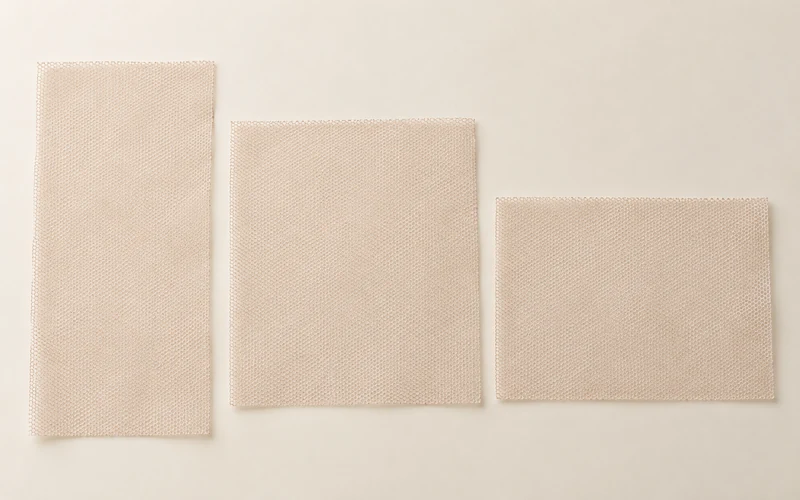
What the figures mean for parting range is the question the specification has to settle. On the wording of the opened pages, though, the parting surface is the lace or silk top. Superhairpieces’ Sarah listing — “French lace front for a natural hairline, an injected silk top for a realistic scalp, and machine wefts in the back” — names the top zones separately from the wefted back. Similarly, the cap construction guide describes that zone split.
One seller links freedom and bounds in print. Silk or Lace prints “multidirectional parting” in the same spec block as its measured parting area on both listings opened. So on those pages the freedom and the measured zone appear together. Likewise, Rosa lists “Free Part: Yes” on a separate spec line from its 3.5”×5” top. Its cap lines name the parting surface: “Top lace with lace front and wefts.” However, none of the opened listings words a rule. No page states how a deeper or wider figure would change the range, or that parting stops at the figure’s edge. So treat the range as a written question tied to the measured area, not an inference from the digits.
The Whole Cap
Panel Size vs Overall Cap Construction
A lace top sheitel size is one line in a cap specification. The surrounding lines decide what it is worth on a given cap. Silk or Lace pairs its parting-area figure with “Cap Material: Wefted” and a “double lace lining”. Factory Wigs describes “Real Swiss lace top & ear to ear, with elastic net back”. Milano separates top options from secure-method linings (“Freedom Lining, Silicone Lining, PU Lining”). Together, panel, front, lining, and back print as separate fields.
However, disclosure is not uniform across the set. Superhairpieces’ Sarah listing — explicitly a Kosher Sheitel — names its construction zones and prints no panel dimension on the page. A missing dimension line is not a small panel; it is an open question for the written inquiry.
Two caps carrying the same panel figure can differ in lining, in lace-front depth, and in back construction. So the figure should be read beside the rest of the cap lines. Lace front vs lace top sheitels separates the two top constructions. The complete lace top guide covers lace grades, lining, and care.
Before You Order
A Specification Chart for Boutique Buyers
The opened sellers state different bases — or print none at all. So a boutique wanting comparable quotes for the same lace top sheitel size builds the comparison in writing. Five fields carry it:
The Five Fields to Confirm
| Field to confirm | What a specific answer looks like |
|---|---|
| Panel dimensions | Both edges with units and their order — front-to-back and side-to-side — as the seller defines them |
| Measuring basis | A definition sentence modeled on Silk or Lace’s printed wording |
| Top material | Lace top or silk top — and whether the figure describes the panel, the parting area, or the whole lace zone |
| Lining | What sits under the top — for example, double lace lining — plus any secure-method lining offered |
| Parting claim | The parting options offered and the surface they are tied to |
Sent to each supplier before quoting, these fields turn “panel size” from a listing artifact into a specification line. Where a seller answers with a phrase rather than a definition — Rosa’s “from ear to ear” style — the follow-up writes itself. It asks which edge is which, from where to where.

Lace Top Panel Sizes: Common Questions
It is that seller’s dimension statement for the top area; its content depends on the seller’s measuring basis. In the opened set the 4x4 figure is real but basis-free: Her Hair My Head’s ALICE listing offers “a 4 x 4" lace top parting with an ear-to-ear lace front” without printing how the 4 x 4 is measured, while Silk or Lace prints the definition sentence “measured center cross section of area, side to side x front to back” at 4 x 4.5 in. on the R3330 lace top and 5 x 5 on the Faye double lace top. Where a page defines nothing, ask for one in writing.
Only when the basis is known. Figures printed on the same definition sentence can be compared as extents — Silk or Lace’s 5 x 5 on the Faye double lace top against its 4 x 4.5 in. on the R3330 lace top, for example — while Rosa’s 3.5”×5” line and ALICE’s 4 x 4" print on a phrase basis or none, so they cannot be placed on the same scale. And even a shared basis does not establish the same construction, lining, or parting behavior; those stay separate written questions (dimensions, measuring basis, top material, lining, parting claim).
Measuring and Ordering
However the seller defines it — one seller in the checked set defines it in print. Silk or Lace’s wording is “Parting area (measured center cross section of area, side to side x front to back)”: the side-to-side and front-to-back edges of the area, measured at the center cross section. The other pages opened print no measuring definition — the basis belongs in the written specification.
It depends on the client’s parting habits and on the rest of the cap, so there is no chart answer to copy. The practical step is putting five fields in writing with each supplier — panel dimensions with edge order, the measuring basis, top material, lining, and the parting claim. With those answers, quotes can be compared line for line.
Conclusion
Read the Basis, Then Compare the Numbers
3.5x5, 4x4 and 5x5 are seller-listed figures from the opened set. They include Rosa’s phrase-based panel line, ALICE’s 4 x 4" lace-top parting printed without a basis, and Faye’s 5 x 5 measured parting area on a double lace top. The set adds Silk or Lace’s 4 x 4.5 in. measuring-basis example, widths without depth (Milano), and structure wording with no figure (Factory Wigs). The figures are not wrong. They compare only when the basis is known, and numbers alone do not establish the same construction or styling performance. Recording the five fields above for each supplier turns each lace top sheitel size into one specification line. The comparison then becomes routine rather than a guess.


Ordering by Panel Size?
Prepare the four specification fields — panel dimensions, measuring basis, top material, and lining — and ask each supplier to confirm them in writing before the sample round.
Contact LEV Wigs