Complete Guide
Lace Top Sheitels — Complete Guide 2026
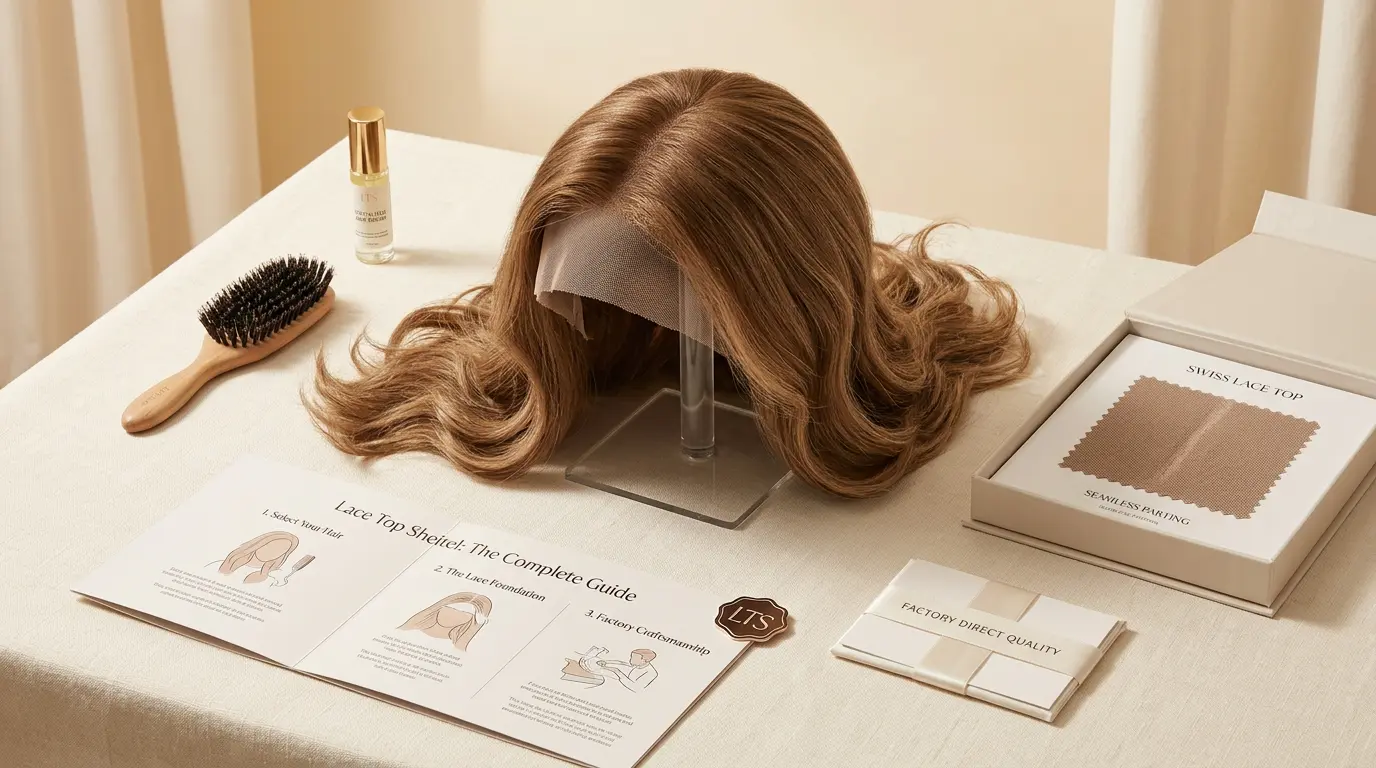
Lace top sheitels have become one of the most requested cap constructions in the Orthodox Jewish wig market. The open mesh top lets air move through the cap, keeps weight down, and allows the part and style to be moved — a combination that matters for wearers who keep a sheitel on for most of the day.
This guide is written for sheitel machers, salon owners, and wholesale buyers who need to evaluate lace top construction at a practical level — the lace, the hair, and the factory behind them — rather than through marketing language.
We cover cap construction, lace grade evaluation, how lace tops compare with silk tops, hair and material assessment, community considerations, care and troubleshooting, and a framework for wholesale evaluation and client selection. Where commercial specifics such as minimums, lead times, and material specifications vary by order, we note what should be confirmed during inquiry or per purchase order.
Overview
What Is a Lace Top Sheitel?
A lace top sheitel is a wig built with an open mesh lace base across the crown and front section. Individual hair strands are hand-tied into this mesh using a technique called ventilating — each strand passes through a hole in the lace and is secured with a knot on the underside. Because the top of the cap is an open weave, air passes through it naturally, which many wearers notice during extended wear.
Most lace top sheitels follow a hybrid structure with three zones: a hand-tied lace section covering the crown and front hairline, a wefted back section that carries volume and structure, and an adjustable nape with straps or clips. Exact lace depth, cap measurements, and weight are set by the pattern for each program and are confirmed per purchase order.
A related but distinct construction: lace front sheitels place the mesh along the front hairline only, while a lace top extends the hand-tied area across the crown. The wider the hand-tied zone, the more freely the hair can be parted and restyled — and the more of the cap depends on careful handling.
Lace Grades
Evaluating Lace: HD, Swiss, and French Grades
Not all lace is equal. The grade you specify affects three things at once: how natural the hairline looks, how the cap stands up to daily handling, and how the sheitel feels against the scalp. Three grades dominate the wholesale market.
| Characteristic | HD Lace | Swiss Lace | French Lace |
|---|---|---|---|
| Visibility at hairline | Finest, most discreet | Very natural | Natural, slight mesh texture |
| Durability in daily wear | Most delicate | Balanced | Most robust |
| Breathability | Excellent | Very good | Good |
| Typical use | Occasion wear, sensitive scalps | Daily wear, most requested | Entry-level programs |
| Relative price tier | Premium | Mid | Standard |
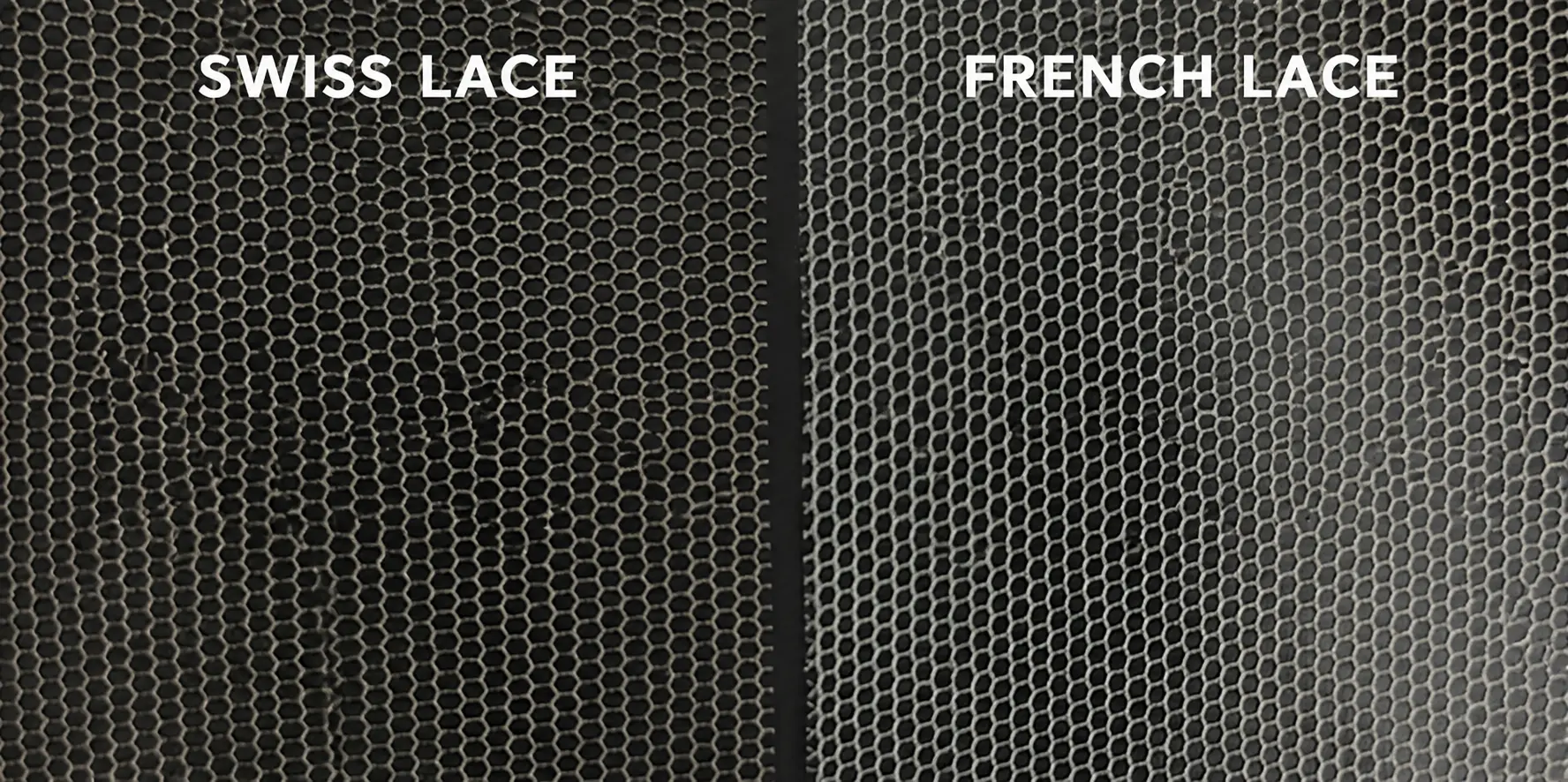
The Core Tradeoff: Naturalness vs Durability
The tradeoff runs on one axis. HD lace virtually disappears against the skin, but its fineness means it tears more easily and shows wear sooner under rough daily handling. French lace holds up well under heavy use, at the cost of a slightly more visible mesh pattern in bright, close-range lighting. Swiss lace is the usual middle path for daily-wear programs: soft enough at the hairline, strong enough for regular wear.
Specification Note
Mesh thickness and other lace specifications vary between mills and production runs. Ask for the lace specification sheet and a physical swatch before committing to a program, and record the agreed grade in the purchase order.
Comparison
Lace Top vs Silk Top: A Quick Comparison
| Factor | Lace Top | Silk Top |
|---|---|---|
| Breathability | Open mesh, strong airflow | Multi-layer base, traps more heat |
| Scalp realism at the part | Natural hairline; knots may show up close | Simulates scalp at the part line |
| Styling flexibility | Part and restyle freely | Best with a consistent part |
| Handling character | Mesh needs careful handling | Fabric base resists abrasion |
| Relative weight | Lighter | Heavier |
If a client values breathability and styling freedom, the lace top is usually the stronger recommendation: the open mesh keeps the scalp cooler, and because the hair is individually tied, the part can move anywhere — center, side, or pulled back. Silk tops earn their place with clients who keep one consistent part and want it to look like a scalp under any lighting.
For a deeper walkthrough of how each base is actually built and how the differences translate at retail, read our lace top vs silk top comparison guide.
Materials
Hair Assessment: European, Russian, and Remy
The hair is what your client sees in the mirror every morning. A lace top built with premium hair on a modest cap will usually still outperform a premium cap carrying low-grade hair, so material assessment deserves as much attention as cap construction.
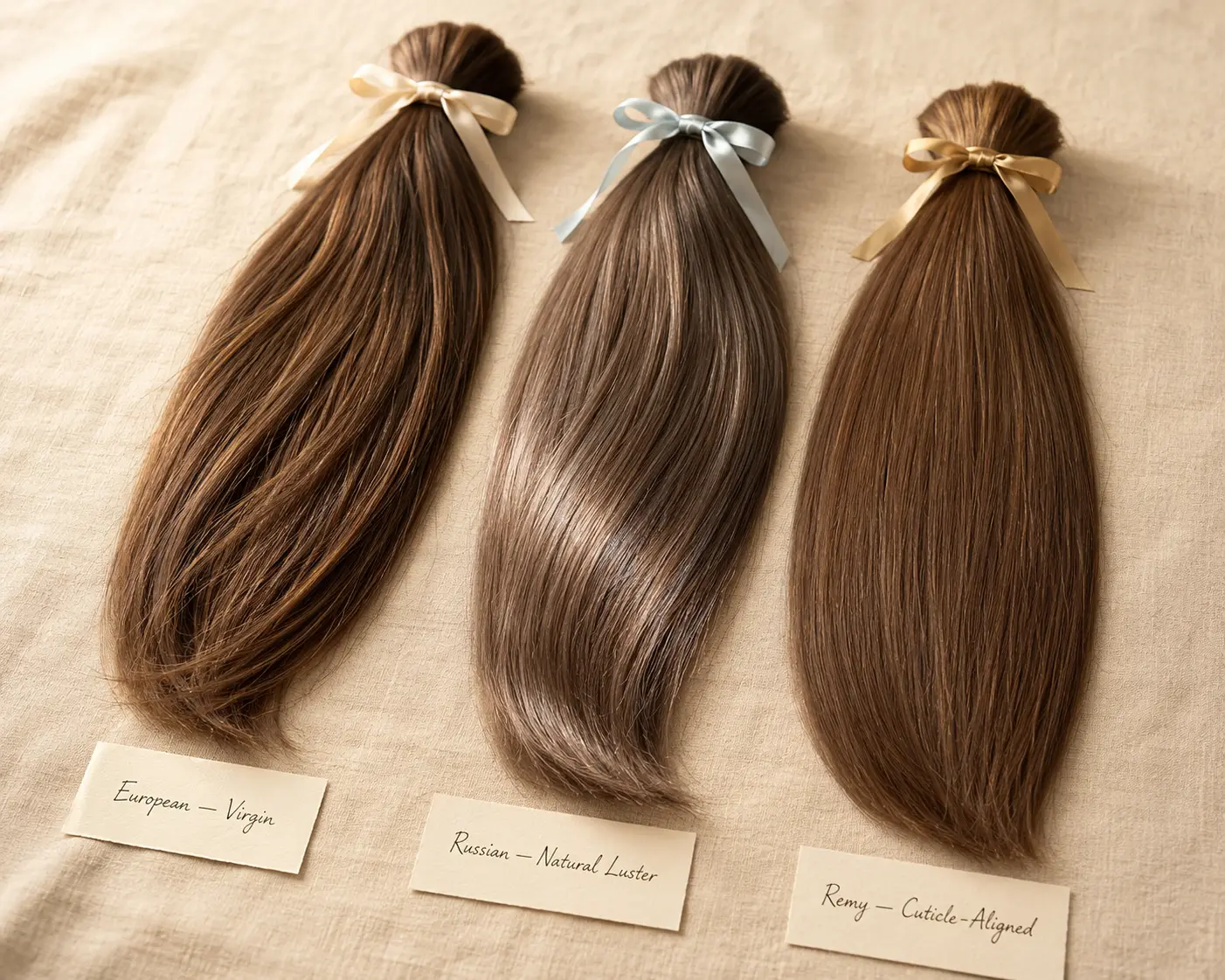
European Virgin Hair
European virgin hair is the reference grade for premium sheitels. It is cuticle-intact and unprocessed, with a softer, finer texture that matches the hair common in many Orthodox Jewish communities, and it holds color and heat styling the way natural hair does. Because "European" is used loosely across the market, ask suppliers how origin and processing are documented, and verify the paperwork during inquiry rather than relying on the label.
Russian Hair
Russian hair is similar to European in fineness but tends toward a cooler tone and higher natural luster. It is rarer and commands a higher price, which suits clients who want a glossy, polished finish without chemical processing. Its slightly thicker diameter gives more body, at the cost of feeling a little less fine.
Remy Hair
Remy hair is cuticle-aligned but may be processed for color and texture. It is the practical entry point for price-sensitive programs while still avoiding the worst tangling problems — because the cuticles all face the same direction, the hair resists matting far better than non-Remy grades. It is a reasonable recommendation for first-time sheitel buyers and budget lines.
Why Cuticle Alignment Matters
Cuticle alignment is what separates wearable hair from frustrating hair. When cuticles face different directions, they catch on each other and mat, and no amount of conditioner fully reverses it. When you evaluate a supplier, ask what incoming inspection is performed on hair before production — cuticle direction, color consistency, elasticity — and how the results are documented and shared with you.
Community Considerations
Lined vs Unlined Lace Tops
The recurring question around lace top sheitels is whether an open mesh base — through which the scalp or natural hair could theoretically be visible — meets the standard for hair covering that a wearer follows. There is no single answer that applies everywhere: practices and rabbinic guidance vary between communities, and many buyers confirm the standard they follow with their own rabbinic authority before ordering. We describe the construction options; we do not issue halachic rulings.
Lined Lace Tops
Lined lace tops add a solid fabric layer sewn beneath the lace mesh, so the wearer's natural hair and scalp are not visible through the holes in the lace. Where visibility through the mesh is a concern, the lined version is the more widely accepted configuration. The lining adds a small amount of weight and slightly reduces airflow, though many wearers find the difference minor in daily wear.
Unlined Lace Tops
Unlined lace tops use only the lace mesh, without a fabric barrier. They are accepted in some communities — particularly where the mesh is dense enough that visibility is minimal — while other communities prefer or require a lining. Because the acceptable standard is set locally, retailers are best served by stocking or offering both options with clear labeling, and letting each client decide in line with her own community's guidance.
Care Overview
Caring for a Lace Top Sheitel
Lace requires different handling than silk top or fully wefted caps. The mesh can tear, stretch, or yellow if it is treated like a sturdier construction, so the points below are worth communicating to every retail customer at the point of sale.
Essential Care Guidelines
- Wash regularly with a sulfate-free shampoo formulated for human hair wigs, before product residue builds up
- Use lukewarm water only — heat weakens the hand-tied knots at the lace base
- Air dry on a wig stand; avoid directing hot airflow at the lace section
- Keep heat tools at low-to-medium settings on and near the lace, and confirm safe temperature ranges with the manufacturer
- Store on a canvas block away from direct sunlight to slow lace yellowing
- Detangle from the ends upward with a wide-tooth comb; avoid brushing directly at the lace
Why Care Matters More for Lace
The hand-tied knots are the structural foundation of the cap — each one holds a single strand in place. Once a knot loosens, from hot water, aggressive brushing, or prolonged UV exposure, that strand begins to shed. Consistent, gentle handling is the difference between a cap that stays dense and one that thins at the hairline, and it is the single most cost-effective "repair" any wearer can make.
Troubleshooting
Common Problems and How to Prevent Them
Four issues account for most lace top complaints that reach a salon or factory. All four are largely preventable with the right handling habits.
Lace Tearing
Lace tearing comes from rough handling, pulling at edges, or snagging on jewelry. Grip the cap edge rather than the lace when adjusting, store on a smooth canvas block rather than a textured surface, and remove earrings before putting the sheitel on or taking it off — posts and hooks are the most common snagging culprits.
Hair Shedding
Shedding at the lace area usually traces back to aggressive brushing or washing in hot water. Comb from the ends upward, never roots-down through the lace, and keep wash water lukewarm. Reinforced knotting at the front rows can often be specified for programs where hairline shedding is a recurring complaint — confirm availability and cost during inquiry.
Lace Yellowing
Yellowing is caused by UV exposure and product buildup over months of wear. Store the sheitel out of direct sunlight, use clear rather than yellow-toned styling products, and wash residue off regularly instead of letting it accumulate. Once yellowing sets in it is difficult to reverse, so prevention is the reliable strategy.
Cap Stretching
Cap stretching follows from pulling the sheitel on over wet hair or wearing it too tight. Always put it on over dry, pinned hair. If stretching has already occurred, a wig technician can often re-block the cap on a canvas mold; reinforced elastic at the nape and temples can also be specified for programs that see heavy daily handling.
Wholesale
Wholesale Evaluation: What Buyers Should Confirm
Ordering lace top sheitels wholesale is fundamentally different from buying retail: you control the specification — lace grade, hair origin, density, length, cap size, color — and you are responsible for verifying that what arrives matches what was agreed. The checklist below frames that evaluation.
Minimums, Lead Times, and Terms
Minimum order quantities, trial-order options, payment terms, and lead times vary by configuration and production schedule. Confirm them during inquiry and have them written into the purchase order before any deposit. For seasonal stock, build the calendar backwards from your on-shelf date, allowing time for sample approval, production, inspection, and international shipping.
Customization Parameters
- Lace grade — HD, Swiss, or French
- Hair origin — European virgin, Russian, or Remy
- Density and length, mapped to your target clientele
- Cap size, including custom measurements for non-standard fits
- Color matching against a swatch or reference unit
- Lined or unlined top, per your community's requirements
Inspection and Documentation
Confirm during inquiry what inspection is performed on each unit before shipment — knot security, lace integrity, color consistency, cap fit — and whether it is documented per unit or sampled. Ask whether orders ship with a specification sheet you can check the goods against on arrival; that single document resolves most disputes before they start.
Pricing
Wholesale pricing is quoted per configuration, built from lace grade, hair origin, density, length, and construction, so it is compared configuration-for-configuration rather than as a flat discount. Sourcing directly from a manufacturer gives you control over those specifications; evaluate quoted pricing against your target retail margin, not against another supplier's list price for a different build.
Selection Guide
How to Choose the Right Lace Top Sheitel
Matching a client to the right lace top comes down to three questions. Train fitting staff to ask them every time — the answers remove most of the guesswork that leads to returns and exchanges.
1. How Long Is the Average Wearing Day?
For occasional or shorter wear, most lace grades — including economical French lace — perform acceptably. As the wearing day gets longer, prioritize the grades that balance airflow with strength, because comfort and hairline durability are where the differences show up first. Clients in warm climates or active routines feel this distinction most.
2. Fixed Part or Frequent Restyling?
Frequent restyling — moved parts, ponytails, half-up styles — is where lace tops earn their place, since the hand-tied section lets the part travel freely. If a client wears the same center part every day and never restyles, a silk top may actually be the better recommendation, because its scalp illusion at the part line is the stronger of the two. For named cuts and how they read on a lace top base, our sheitel styles guide walks through the options length by length.
3. Where Does It Sit in Your Assortment?
Entry tier: French lace with Remy hair — durable and accessible for first-time buyers. Mid tier: Swiss lace with European hair — the balanced daily-wear configuration most programs build around. Premium tier: finer lace grades with European virgin or Russian hair — for clients who prioritize hairline naturalness and material quality. To compare available builds, browse the lace top wig collection for specifications and wholesale details.
FAQ
Frequently Asked Questions
The open mesh top lets heat escape and keeps the cap lighter than most multi-layer constructions, which many wearers notice on longer wearing days or in warmer settings. Lace tops also allow the part and style to be changed, because the hair is hand-tied strand by strand across the lace section.
HD lace is the finest grade, so it blends softly against the skin but needs the gentlest handling. Swiss lace sits in the middle and is the most common choice for daily-wear sheitels because it balances a natural hairline finish with better durability. French lace is the most robust and the most economical. Exact mesh specifications vary by supplier and should be confirmed during inquiry.
Pricing is built from the lace grade, hair origin, density, length, cap construction, and customization level, so it is quoted per configuration rather than listed as a fixed rate. A Swiss lace cap with European hair costs more than French lace with processed Remy hair, but it usually supports a stronger retail position. Final pricing, minimums, and lead times are confirmed per purchase order.
Ask for consistent lace quality across samples, documented hair sourcing, clear specification sheets, and a defined pre-shipment inspection process covering knot security, lace integrity, color consistency, and cap fit. A reliable manufacturer explains cap construction openly and confirms commercial terms, realistic lead times, and after-sales support before you place a bulk order.
Lead times vary with order volume and how custom the work is — standard configurations move faster than bespoke density mapping, custom color matching, or non-standard cap sizes. Confirm the schedule during inquiry and per purchase order. For seasonal stock, order early enough to allow sample approval, production, inspection, and international shipping.
Conclusion
The Right Lace Top Sheitel Starts With Understanding What Goes Into It
Lace top sheitels occupy the most versatile position in a sheitel assortment: breathable enough for all-day wear, flexible enough for any styling preference, and configurable across every tier from accessible first purchases to premium material builds. A Swiss lace cap with European hair remains the configuration that satisfies the broadest range of clients, which is why most retail programs build around it.
The difference between a sheitel that disappoints and one that earns repeat business comes down to three things: the quality of the materials, the precision of the construction, and the care it receives in daily wear. A retailer who understands all three — and communicates them clearly at the point of sale — sees fewer returns and stronger word-of-mouth than one who sells on price alone.
If you are considering adding this cap construction to your product line, start with a sample: touch the lace, check the knotting under light, and compare the specification sheet against the physical unit. That evaluation does more to de-risk a wholesale relationship than any catalog description.
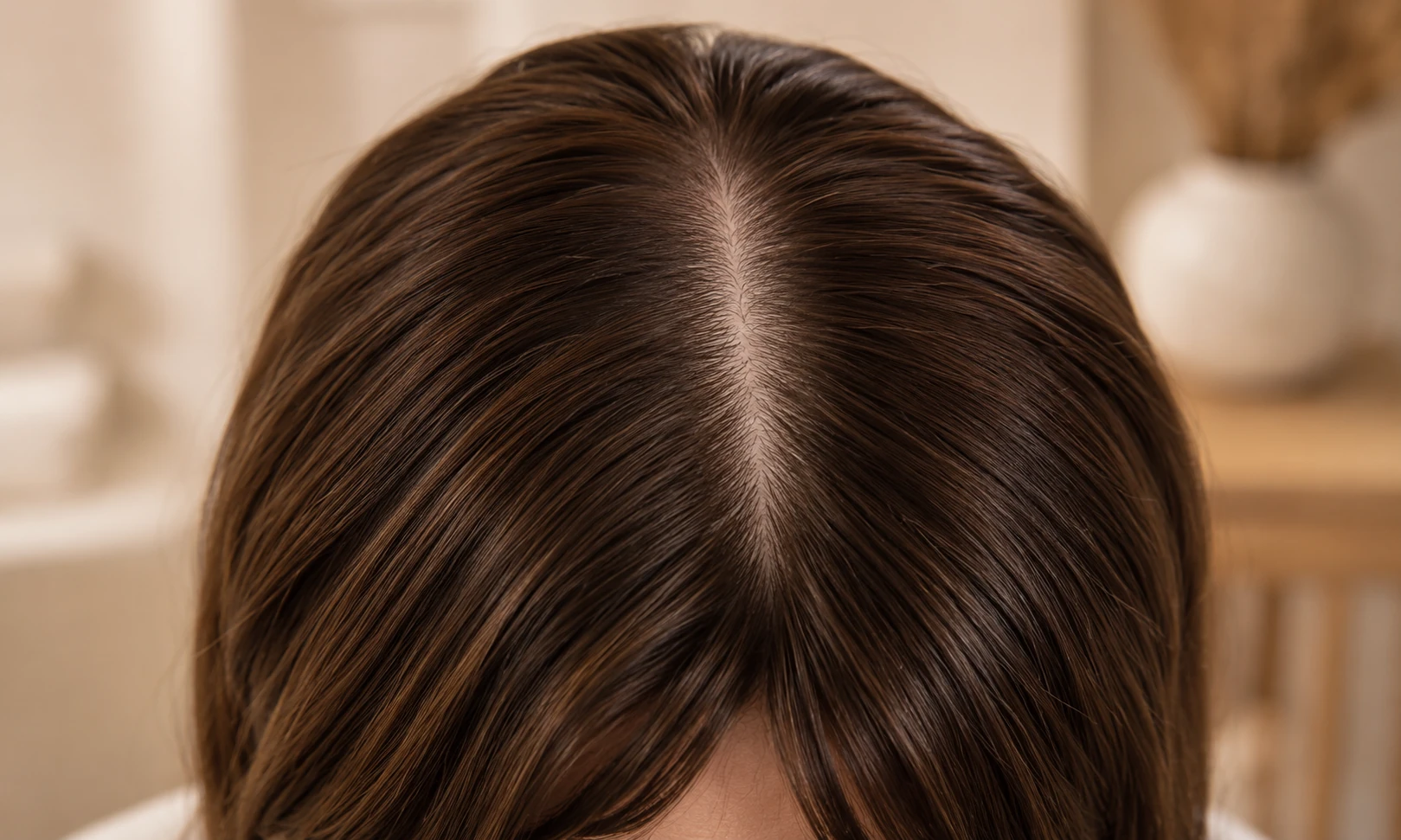


Ready to Add Lace Top Sheitels to Your Product Line?
LEV Wigs hand-ties lace top sheitels in Qingdao, China. Lace grade, hair origin, density, cap size, and color are specified per order — minimums, lead times, and pricing confirmed during inquiry.
Request Wholesale Pricing