Buying Guide
Ponytail Sheitels: Nape, Perimeter, and Fit Checks

A ponytail sheitel is designed for styles with the hair tied up. Before buying, check the nape, behind-ear coverage, fit, and intended ponytail height on the actual piece. A maker or stylist may be able to adapt some pieces; the result must be checked on the piece you plan to wear.
The Job
What a Ponytail Sheitel Has to Do
Tying the hair back can make the nape, ear tabs, and perimeter more visible. Check how those areas look at the intended ponytail height.
Milano describes hand-tied and under-ventilated edges on its ponytail line, while Design by Flora lists purpose-built ponytail designs. These are examples; confirm the construction and intended styling of the piece you are considering.
Styling Check
What Changes When the Hair Is Tied Up
Worn down, the nape and sides of a cap stay covered by the fall of the hair. Tied up, the same zones are on display. How believable they look pulled back depends on the design, the finishing, and the fit of that particular piece — not on a construction-class name.
When checking the piece with the hair up, note any visible cap edge, base material, or abrupt change in coverage. Visible edges show what needs a closer look; ask the maker to confirm the construction.
The second consideration is how the piece behaves while worn up. Rather than assuming, observe it directly: how it sits, whether it shifts with head movement, and how comfortable it stays over a wearing session. If a piece will regularly be worn up, ask its maker how the construction is meant to handle that and how the piece is best secured.
For how caps are built zone by zone — and why those zones matter for any styling plan — the cap construction guide and the lace top vs silk top comparison cover the background this article builds on.
The Checks
The Nape and Perimeter Check
Run these checks on the actual piece, ideally against your own head or a block, in daylight-level lighting. The point of each one is to observe and record — not to diagnose a defect from a single glance.
- Try the intended height. Tie the piece at the height the wearer plans to use.
- Inspect the center of the nape. Note any visible cap edge, base material, or abrupt change in coverage. Ask the maker to confirm the finish.
- Check behind both ears. Compare the visible coverage and fit on both sides.
- Follow the perimeter. Record areas you want the maker or stylist to examine more closely.
- Compare hair up and down. Use the same light and camera angle to keep the observations easy to discuss.
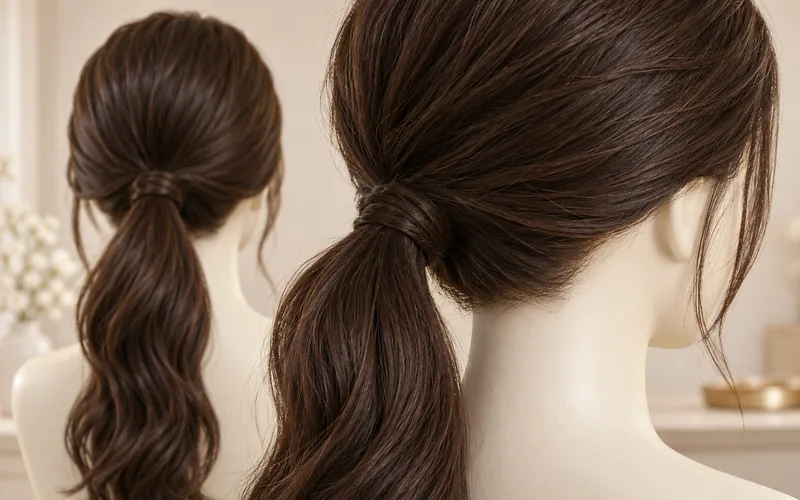
If you are buying wholesale, the same pass belongs in your receiving routine, next to the other checks on a new unit — the receiving inspection checklist shows where a construction check slots in before a piece reaches the rack.
Height
Pony Height: What to Ask Before You Commit
Ask which ponytail heights the maker recommends for this piece, then compare those heights during the sample check. Try the low, mid, or high position you intend to wear, and inspect the nape and both sides at each position.
Agree on the intended height and length before approving a sample. If weight matters, ask for the actual gram weight rather than estimating it from a length or density label.
Movement & Weight
Movement and Weight
Worn up, a piece moves differently than it does worn down, and two things are worth judging with the sample in hand.
Milano describes its own ponytail line as low density. For the piece you are considering, judge the gathered silhouette and actual fit rather than assuming that the density label predicts comfort or weight.
Second, securing. Milano suggests a soft comfort band in place of clips, combs, glues, or tapes for its own ponytail styles — one maker's approach, not a rule. Ask the supplier of the piece you are buying how it is meant to be secured in an up style, and try that on the head.
Before You Order
What to Confirm With Your Supplier
Ask what “ponytail-ready” means for this specific cap. Use the points below to confirm the perimeter finish, intended height, length, and fit on the sample and in the order notes.
| Field to confirm | What a specific answer looks like |
|---|---|
| Perimeter construction | Named zones (nape, ear tabs, hairline) with the finish used on each — hand-tied, under-ventilated, lace, wefted |
| Specified ponytail height | Low / mid / high, stated for this construction — not "yes" to the general question |
| Density and length options | The actual density level and the lengths offered for this same cap |
| Sample check | Agreement that you may tie the sample at the intended height and inspect the perimeter before the batch runs |

FAQ
Ponytail Sheitels: Common Questions
A ponytail sheitel is a wig designed for wearing the hair tied up. Specialist sellers offer purpose-built versions, but the nape, behind-ear coverage, and fit still need checking on the actual piece at the intended ponytail height.
Not with equal results. Some caps finish the back with wefted panels that stay hidden when hair is worn down but can show banding or a cap edge once tied up. How much the piece shows depends on the height — so check it at the exact heights the wearer intends, on the sample. Whether a specific piece holds up is a construction question to check on the sample, not a property of sheitels in general.
Tie the piece at the height it will actually be worn and look at the nape center, behind both ears, and along the hairline edge. Record what is visible at the edge — the finish, the base material, the coverage — and ask the maker to confirm the finishing method. Photograph the piece up and down under the same light so the comparison is on record.
Ask which heights the maker recommends, then try the piece at your preferred height. Look at the nape and both sides, check the fit while moving your head, and photograph the result. For an order, confirm the intended height and length with the supplier.
Conclusion
Buy the Construction, Not the Label
Check the hair up at the intended height, compare the nape and both sides, and assess the fit while moving your head. Keep the sample photos and the maker’s answers together. For a wholesale order, use that record when agreeing on the sample and order specifications.


Planning a Ponytail Sheitel Order?
Use the sample checklist to prepare your questions about perimeter coverage, fit, and intended styling before contacting a supplier.
Contact LEV Wigs