Wholesale Sourcing
Lace Front Sheitels: Factory-Direct Buyer's Guide 2026
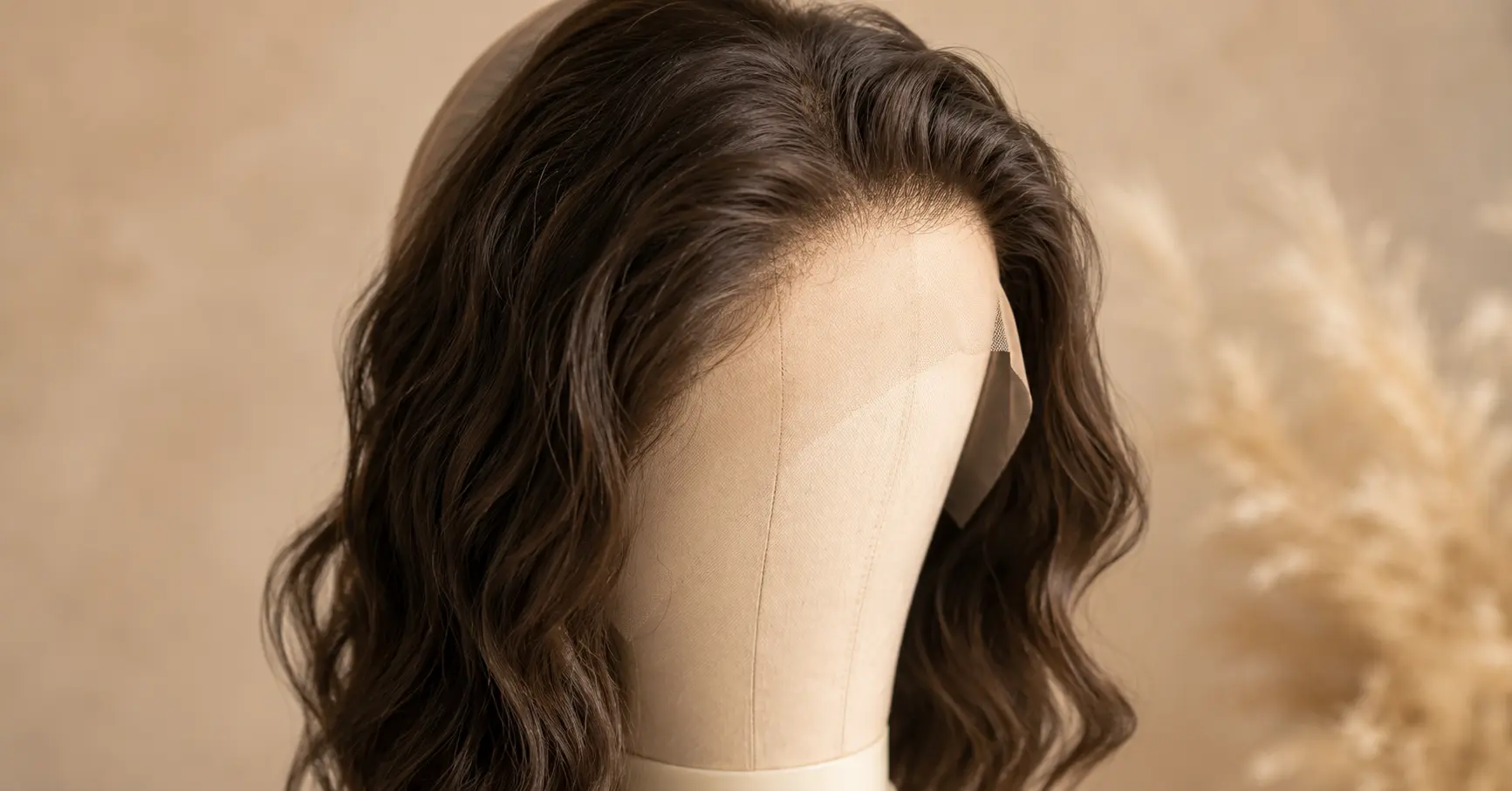
Last month, a salon owner from Monsey called us frustrated. She had just received 30 lace front sheitels from a new supplier — and 11 of them had lace so thin it tore during the first fitting. The hair was beautiful. The construction was not. That $8,400 order became a write-off.
We see this constantly at our Qingdao factory. As a lace front sheitel manufacturer, we process hundreds of wholesale orders each quarter, and the quality gap between factories is staggering. Some use Swiss lace that lasts 18 months with daily wear. Others ship polyester mesh disguised as "lace" that disintegrates within weeks.
This guide is our answer to that gap. We're walking you through exactly how a lace front sheitel is built, what separates factory-direct quality from cheap imitations, and the five checkpoints every wholesale buyer should use before placing a bulk order. Furthermore, for a broader understanding of sheitel cap constructions, see our complete lace top sheitel guide.
Cap Construction
What Exactly Is a Lace Front Sheitel?
A lace front sheitel uses a strip of fine lace mesh across the front hairline, typically extending 2 to 4 inches deep from the forehead. Each hair strand in this zone is hand-tied through the lace holes using a single-knot ventilating technique. The rest of the cap — the crown, sides, and back — uses a different material: machine-sewn wefts, a silk base, or a combination. Consequently, the lace front focuses its realism exactly where it matters most: the hairline.
Swiss Lace vs HD Lace: What We Actually Use
There's a persistent myth in the market that HD lace is the "premium" option. Honestly, we learned this the hard way — we tried HD lace on a batch of 50 units in 2024, and the return rate was triple our average. Why? HD lace (0.06mm) is ultra-thin, which sounds great on paper. In practice, it tears during fitting, stretches out within weeks, and doesn't hold knots securely.
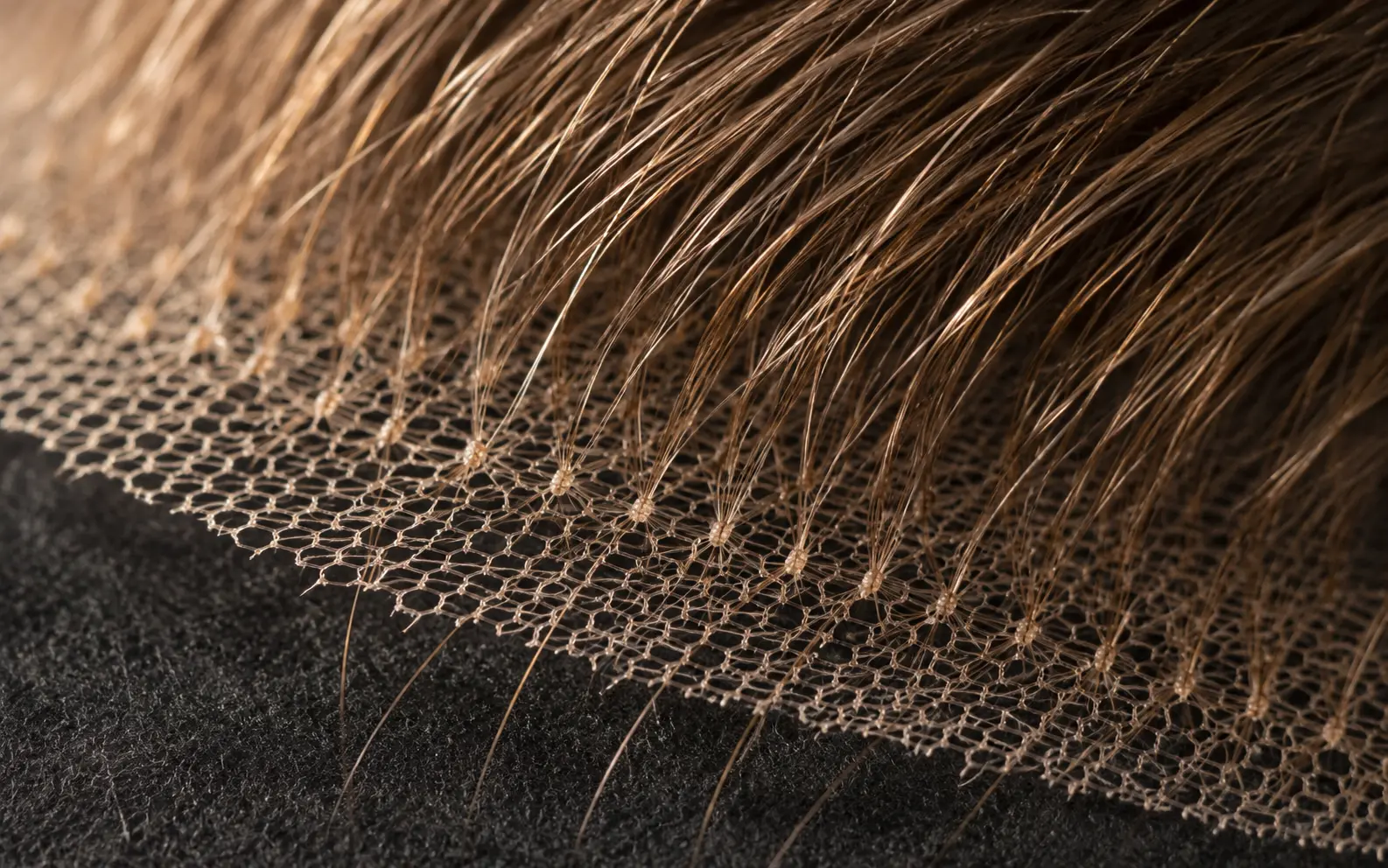
Swiss lace (0.08mm) is what we use for all our premium lace front sheitels. It's thin enough to disappear against the skin, yet durable enough to withstand daily wear for 12 to 18 months. The 0.02mm difference sounds negligible, but in our tensile testing, Swiss lace withstands 40% more pulling force before tearing. For wholesale buyers, that means fewer returns and happier clients.
French lace (0.10mm) sits at the other end — thicker, more visible at close range, but significantly cheaper to produce. It works for budget-tier orders where the priority is price over natural appearance. We're transparent about this distinction because your clients will notice the difference, even if they can't name it.
Quality Control
5 Things to Check Before Buying Lace Front Sheitels Wholesale
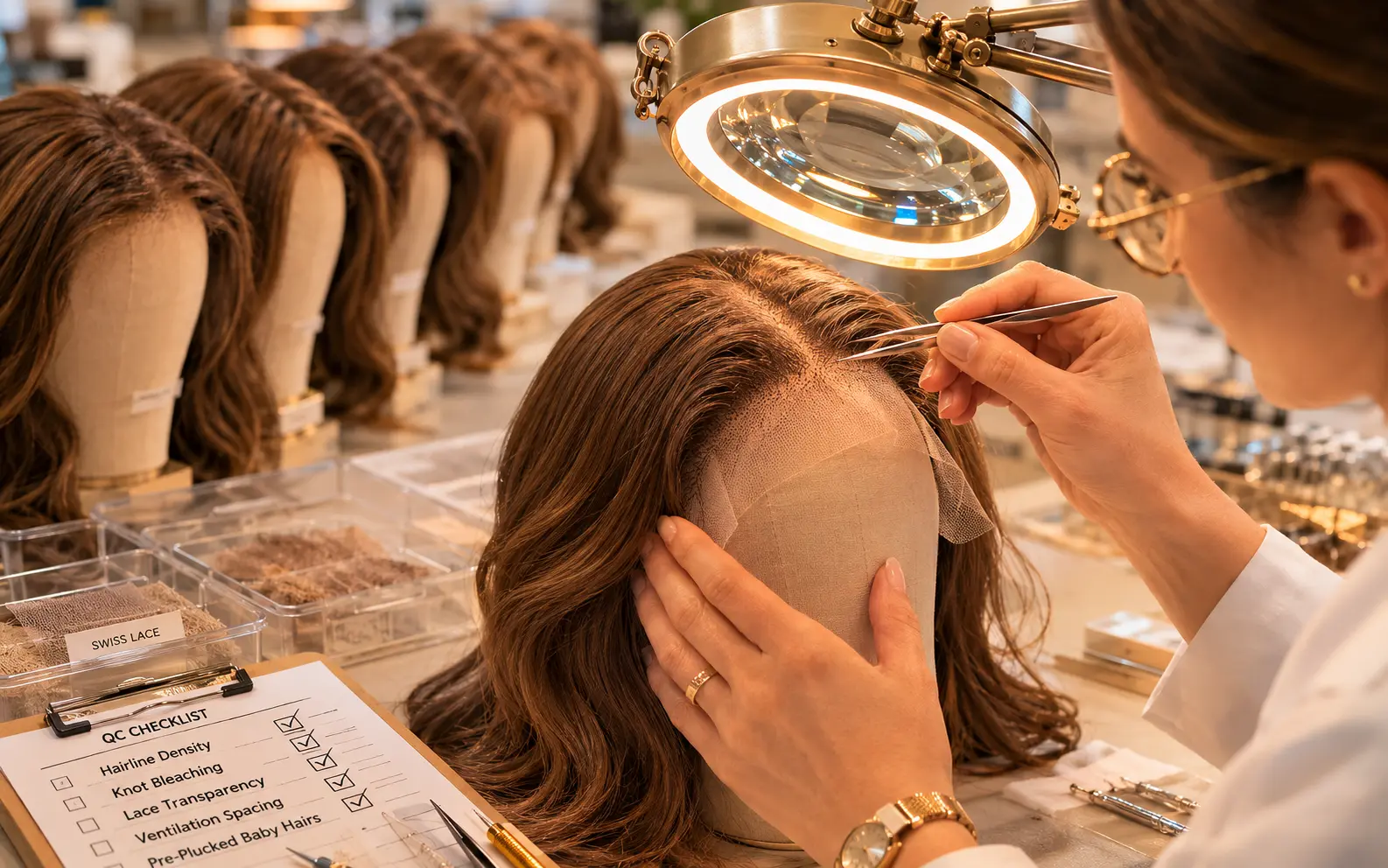
Every factory claims their lace front sheitels are "premium." Our advice: verify with your hands, not your ears. Here are the five checks our own QC team runs on every batch before shipping.
1. Lace Quality and Bleached Knots
Run your fingernail gently across the lace surface. Premium Swiss lace feels smooth, almost like silk fabric. Cheap lace catches your nail — it has a rough, netted texture. Furthermore, look at the knots under direct light. Double-bleached knots appear light blonde or transparent at the root, blending into the lace. Single-bleached or unbleached knots show as dark dots, visible from a foot away. We bleach every unit twice (before and after ventilating), which adds 6 hours of labor per cap but eliminates the dot problem entirely.
2. Hairline Design: Pre-Plucked vs Custom
A factory-line lace front ships with a dense, uniform hairline — every hair packed tight, like a toothbrush. Nobody's natural hairline looks like that. Therefore, the hairline must be plucked (density reduced) to create an irregular, natural-looking edge. Pre-plucked units arrive ready to wear. Custom plucking lets you specify density gradients — for example, 80% density at the temple tapering to 60% at the widow's peak. For wholesale orders, pre-plucked saves time. For your higher-margin bespoke clients, custom plucking is worth the 2-day lead time addition.
3. Cap Construction Behind the Lace
The lace front is only the first 2 to 4 inches. What happens behind it determines the sheitel's overall comfort. The three common configurations:
- Lace front + wefted back — Most common, most affordable. Machine-sewn tracks fill the crown and nape. Breathable enough for most clients.
- Lace front + hand-tied back — Premium option. Every strand across the entire cap is hand-tied. Feels lighter, parts naturally everywhere, costs 30 to 40% more.
- Lace front + silk top crown — Hybrid construction. Lace at the hairline for a natural front, silk base at the crown for a realistic part line. Popular with clients who want the best of both worlds.
4. Hair Source and Texture Matching
The front 4 inches of a lace front sheitel are the most scrutinized part of the entire wig. That's where someone looking at your client is checking — consciously or not — whether the hairline looks real. For this reason, the hair in the lace zone must be the finest quality in the entire cap. We always specify European hair for the lace front section, even when the back uses a blended source. The texture difference is visible under natural light — European hair has a subtle wave and translucency that synthetic or Asian-origin hair simply cannot replicate. For more on how different cap constructions compare, see our lace top vs silk top sheitel guide.
5. Knot Sealing and Longevity
After bleaching and ventilating, the knots must be sealed — typically with a silicone-based sealant applied to the underside of the lace. Without sealing, expect 15 to 25 strands to shed from the hairline during the first month of wear. With proper sealing, that number drops to 3 to 5. We run a standardized pull test on every batch: 50 gentle pulls per section with a calibrated tension gauge. If more than 2 strands release, the batch gets re-sealed. It's a small step, but it's the difference between a client who reorders and a client who asks for a refund.
Factory Insights
Common Quality Problems We See From Other Factories
When a salon partner switches suppliers and sends us their existing inventory for evaluation, the problems are remarkably consistent. Here's what turns up most often.
Lace too thin for daily wear. Some factories use 0.04mm lace — thinner than HD — to hit a lower price point. It looks invisible on day one. By week three, it has micro-tears along the hairline. By month two, sections are literally falling apart. We've seen sheitels arrive at our workshop with the front lace held together by nothing but dried adhesive residue.
Unbleached knots passing as "natural." The factory saves 6 hours of bleaching labor per unit, then markets the dark knots as a "natural root effect." Your client doesn't know what bleached knots are — she just knows her hairline looks dotted and unnatural under synagogue lighting.
Over-dense hairlines. No plucking at all. The front edge arrives with 180% density — thick, blunt, and obviously unnatural. A salon in Lakewood sent us 15 units like this from a different supplier. Every single one needed the hairline stripped and re-ventilated. That's $85 per unit in rework costs that could have been avoided at the factory.
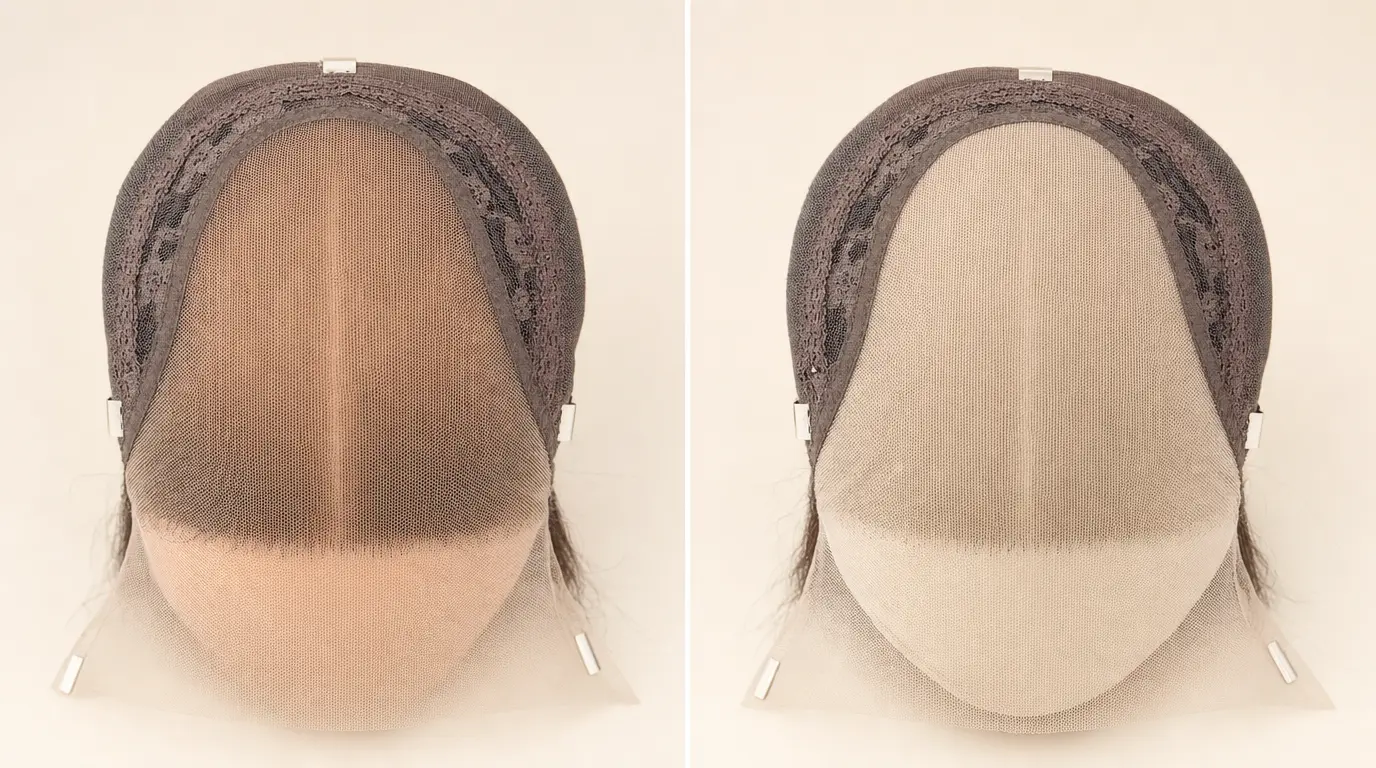
Inconsistent lace color. The lace itself has a yellowish or pinkish tint that doesn't match any natural skin tone. This happens when factories skip the lace tinting step (applying a neutral-toned dye to the mesh before ventilating). Quality lace front sheitels should have lace that disappears against the wearer's skin within a few shades — not draw attention to itself.
We switched to LEV after losing $12,000 on a bad lace front batch from another supplier. The quality difference was visible before the box was even fully open.
Sheitel Salon Owner, Lakewood NJFAQ
Frequently Asked Questions
With proper care and daily wear, expect 12 to 18 months from a quality Swiss lace front sheitel. HD lace tends to wear out 3 to 4 months sooner. Clients who rotate between two or three sheitels regularly see lifespans of 24 months or more from the same construction.
We offer custom color matching from natural black to highlighted blonde, density options from 130% to 200%, cap sizes from petite to extra large, lace upgrades in French, Swiss, or HD, hairline design pre-plucked or custom, and lengths from 14 to 28 inches. Custom orders require a minimum of 5 units per style.
Standard MOQ is 10 units per style. First-time buyers can request a trial order of 5 units at the same per-unit wholesale price. Single sample units are available at retail cost, fully deductible from your first bulk order of 10 or more pieces.
Pricing depends on four factors: hair origin (European, Russian, or Slavic), lace grade (French, Swiss, or HD), length from 14 to 28 inches, and density from 130% to 200%. European hair with Swiss lace starts around $280 to $520 per unit at MOQ 10. Contact our team for a detailed quote tailored to your specifications.
Show them the lace up close. Premium Swiss lace is soft, thin, and nearly invisible against the skin. Cheap lace looks and feels like netting. Point out the bleached knots: quality lace fronts have lightened roots that blend into the lace, not dark dots visible from across the room. We supply free swatches for exactly this purpose.
Conclusion
Sourcing Lace Front Sheitels Starts With Knowing What to Look For
Three things matter when buying lace front sheitels wholesale: lace grade (Swiss over HD for daily wear), knot treatment (double-bleached and sealed), and hairline density (pre-plucked or custom). Everything else — packaging, branding, marketing materials — is secondary to the physical product your client puts on her head.
As a manufacturer, we've built our business on the principle that wholesale buyers deserve to know exactly what they're ordering. That's why we send free lace swatches to every new partner, provide detailed spec sheets with each order, and run standardized QC tests on every unit before it leaves our Qingdao workshop. If you're evaluating lace front suppliers for your salon or retail store, start with a sample order and run the five checks above. Your clients — and your return rate — will thank you.


Ready to Source Quality Lace Front Sheitels?
LEV Wigs manufactures lace front sheitels in Qingdao, China. Swiss lace, European hair, double-bleached knots, and custom hairline design. MOQ as low as 5 units for trial orders.
Request Wholesale Pricing