Construction Guide
Injection Lace Sheitels vs Traditional Lace-Front Wigs

“Injection lace” has started appearing in Jewish wig listings next to a short French lace front. The two listings checked for this guide cover the term in a single line of marketing each — no process description. This guide lays out what injection means in wig construction, how a traditional knotted lace front differs, and which fields to confirm so the label turns into a specification.
The Technique
What Injection Means in Wig Construction
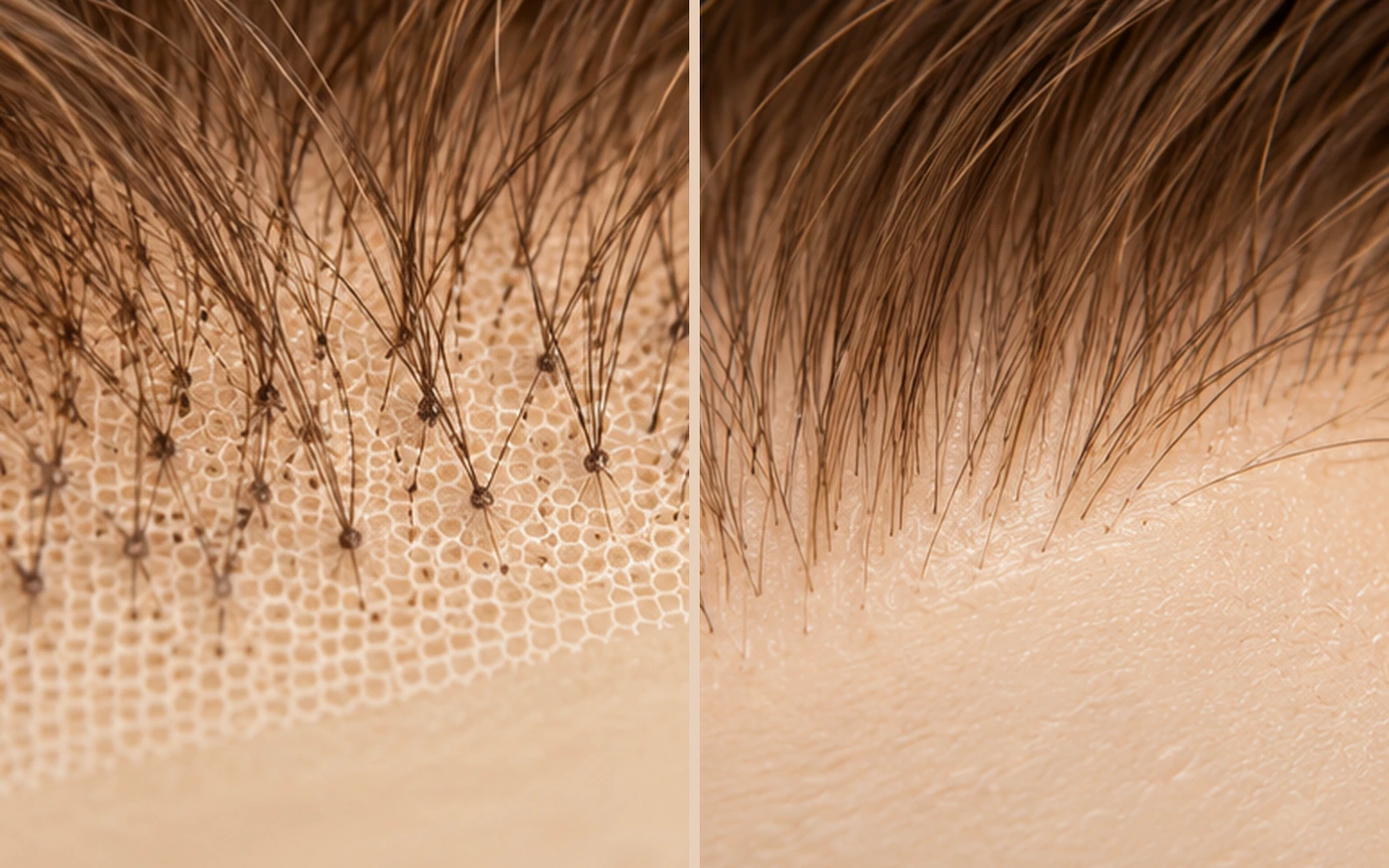
The word “injection” on a product listing does not establish a particular attachment method. Lord Hair’s knotting guide describes its injected version on skin or PU bases: “the base is placed on a mould and a special needle is used to inject the hair into the base,” with the hair “then secured with a thin layer of glue” — in that method, no knot sits on the visible surface.
A general knot-hiding comparison from another direction: Emeda’s Jewish-wig guide describes a silk top as hiding its knots beneath the silk layer rather than showing them on the surface — a “hidden-knot” goal shared across constructions and reached by different means. Emeda’s page is a general construction description, not an account of how any particular seller builds an “injection lace” cap.
Note how little these descriptions overlap: Lord Hair’s injected method is specific to skin or PU bases with a needle and a glue seal, and a silk top’s hidden knots are a different construction again. “Injection” on a listing label does not tell you which process — if either — a maker uses, so the label alone is not a construction specification.
The Traditional Front
How a Traditional Knotted Lace Front Is Built
The conventional lace front is knotted. Hair is tied to the lace base by hand — the same guide describes using “a ventilating needle that helps to pull out hair from the base holes and tie it with a knot.” Fine single split knots are placed at the front because they produce a gradual hairline, and stronger double knots handle the wear zones toward the top and back; the same guide notes bleach treatments can make lace knots less visible (“only available with lace material, e.g. French lace, Swiss lace”).
Knotted fronts are built strand by strand: each hair is tied to the lace by hand, and the knot type changes by zone. The knots — however finely tied and bleached — are visible at the surface by construction; hidden-knot approaches like Lord Hair’s injected method and the silk-top construction above are written to avoid exactly that.
The Listings
What Sellers Mean by “Injection Lace” on a Sheitel
Two current listings show how differently the term is used:
- Hair Queen LA sells an “Injection Lace” Jewish wig at $714 with this construction line: “1" French Lace Front + New Injection Lace for scalp-like realism,” and describes the injection lace cap as breathable and lightweight. The page says nothing about the sides or back, and nothing about the process behind “new injection lace.”
- ReHair System lists a “Virgin Hair Wig Injection Lace Jewish Wig” from $359, with its cap design stated as a new injection lace build, a one-inch French lace front and temples, and wefted sides and back — the same label, but with the remaining zones named on the page.
Same two words, different disclosed zones, and a price gap of hundreds of dollars between them. Neither page documents the actual process, and the two makers have not shown they use the same one. Treat “injection lace” on a listing as a claim to verify, not a specification you have already received.
Zones and Terms
Reading the Zones — and the Term That Gets Confused
The two listings checked for this guide disclose a label and a zone list — not a process. Each pairs the words “injection lace” with a one-inch French lace strip at the hairline, and only one of the two pages names the zones behind the front at all. How either maker actually ventilates its front edge or cap body — knotted, injected, or something else — is not documented on either page, so the front and back construction on these caps is a question to confirm, not a fact the label carries.
One term needs separating from all of this: injected silk top. That phrase describes a crown construction — a silk top whose knots sit beneath the silk layer, the general construction described above. It answers “how is the top built.” “Injection lace” is the listing label whose actual zones and process are undocumented on the pages checked — which is exactly why the two names belong on separate lines of your notes and confirmation. A sheitel can carry an injected silk top crown, a lace front, and other labeled zones at once — three names, none of them interchangeable.
For the zone-by-zone vocabulary of sheitel caps in general, the cap construction guide is the background read.
Client Fit
Which Clients Ask About Injection Lace
When the conversation turns to scalp appearance — for example, a client bothered by visible knots at the front, or one who wants the cap body to read skin-like under a fine part — the questions worth taking to the supplier are:
- Which zones are knotted, which are injected, and which are wefted on this exact cap?
- How is the injected zone finished underneath — sealed, glued, or layered — and what does that mean for repair if a strand zone is ever damaged?
- How does the one-inch lace front meet the injected zone at the hairline?
- What care does the injected zone need compared with a knotted front?
None of this argues that injection construction suits everyone or outperforms knotting — durability and repairability comparisons were not documented on any page checked for this guide. It is a different way of attaching hair, with its own care and repair conversation to have before the order.
Before You Order
Turn the Label Into a Written Specification
Because “injection lace” is maker vocabulary rather than a standard, the order fields do the real work:
| Field to confirm | What a specific answer looks like |
|---|---|
| Front zone | Lace type and strip width — e.g. 1" French lace — and the knotting at the edge |
| Injected zone | Where it sits, how hair is secured in the base, and what seals the underside |
| Sides and back | Named explicitly — wefted, hand-tied, or otherwise — as one maker’s page does and another’s does not |
| Crown term | Whether any “silk top” on the same cap is an injected silk top, kept distinct from the front construction |
| Care and repair | The maker’s instructions for the injected zones, in writing |

A marketing label some sellers place on caps listed with a short French lace front. Knot-hiding approaches differ by construction — Lord Hair’s guide describes hair injected into a skin or PU base with a needle and sealed with glue, while a silk top hides its knots beneath the silk layer — and the two listings checked here document neither their process nor all their zones, so confirm the zones and the securing method in writing.
No. The Sarah listing uses injected silk top for its crown, alongside a French lace front and a machine-wefted back. The two Injection Lace listings checked here do not explain the exact construction or scope of that label. Do not treat the terms as interchangeable; ask the selected supplier to identify the zones, materials, and attachment method.
A traditional lace front is knotted: each hair is tied to the lace by hand, fine knots build the hairline, and bleaching can make the knots less visible. Knot-hiding alternatives are described by construction: Lord Hair’s injected version works on skin or PU bases with a needle and a glue seal, while a silk top conceals its knots beneath the silk layer. The two listings checked for this guide disclose only the label and zone names, not their process, so how any given “injection lace” cap is actually ventilated is a question to confirm in writing.
Which zones are knotted, injected, and wefted on the exact cap; how the injected hair is secured and sealed; whether any silk top on the piece is an injected silk top kept distinct from the front construction; and the maker’s care instructions for the injected zones. Two listings checked for this guide used the same term with different disclosed zones and very different prices, so the written specification is what protects the order.
Conclusion
Verify the Word, Then Order the Construction
The two “Injection Lace” listings disclose different amounts of zone information, but neither documents its manufacturing process. That does not establish whether their methods or meanings are the same. Ask the selected supplier to identify each zone and its attachment method in writing, and compare the supplied sample with that specification. Keep injected silk top and Injection Lace labels separate in your notes.



Ordering a Sheitel With an Injection Construction?
Use the zone-confirmation fields above to record which areas are knotted, injected, and wefted before a sample is approved.
Contact LEV Wigs