Sheitel Craft
Hand-Tied Sheitels: What Ventilation Quality Actually Means
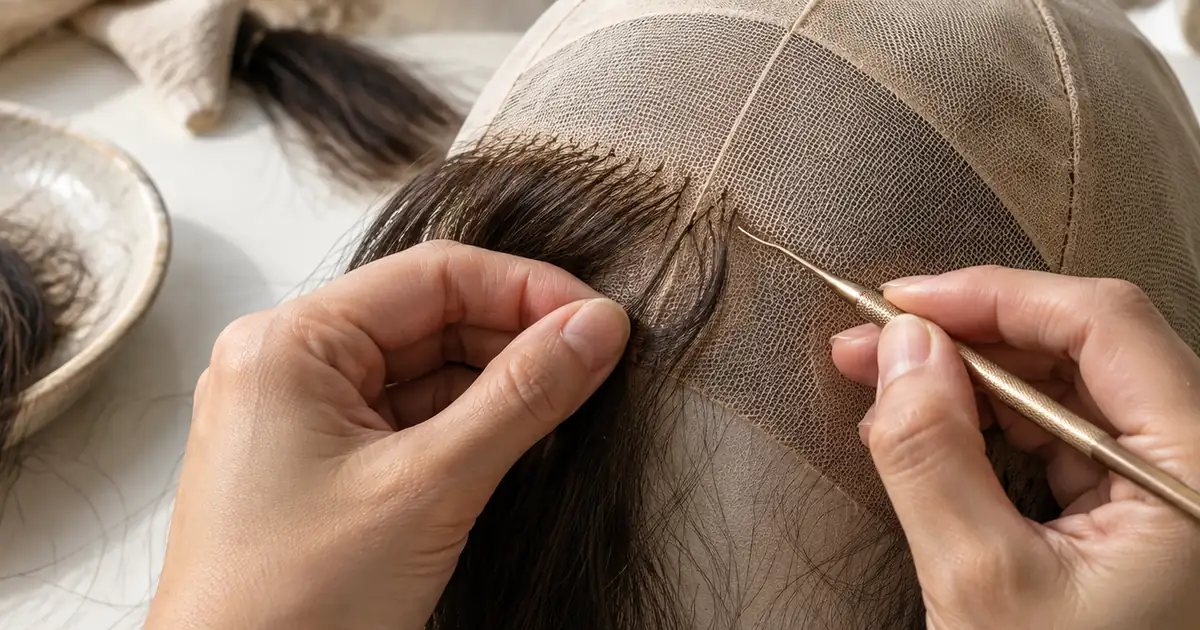
"Hand-tied" is a common phrase in sheitel marketing and a poorly defined one. In a fully hand-tied area, individual hairs or small groups of hairs are knotted to the base by hand until the area is covered. That process is called ventilation, and it is one of the factors — alongside base material, density, and finishing — that shapes how a piece moves, parts, and reads on the head.
The label alone does not tell you whether the work is good. Two sheitels can both be described as hand-tied and still differ in knot size, knot direction, density zoning, and consistency between zones. A product described only as "hand-tied" may refer to one element rather than the whole cap, so the specification you order from should name the zones. For salons, boutiques, and sheitel retailers, those are fields worth specifying and checking.
This guide explains what ventilation actually is, how single, double, and split knots trade strength against visibility, where the craft shows up in density and hair flow, and how to inspect a finished piece before committing to volume. If you are comparing base materials first, start with our sheitel cap construction guide.
Ventilation
What Ventilation Actually Means
Ventilation is the step that turns an empty cap into a sheitel. A maker called a ventilator holds a ventilating hook — a needle-thin tool with a small hook at the tip — and uses it to knot individual hairs or small groups of hairs into the base material. Group size and total knot count vary with the base, the density ordered, and the design, so treat them as specification details rather than fixed numbers.
In hand-tied zones, each hair or small group is knotted individually, by hand, rather than sewn in machine-made rows. When a supplier says a sheitel was ventilated strand by strand, ask which zones that description actually covers before treating it as a statement about the whole cap.
Why the Knot Also Decides Hair Direction
A knot is not just an anchor. Ventilation angle and knot method can influence which way the hair lies, so direction is part of the craft. Because the intended look varies by cap design and styling, the practical move for a buyer is to record the intended hair direction zone by zone in the specification, and to check the finished piece against it.
Where the knots sit and how visible they are also depends on the base construction. The base materials themselves are a separate subject, covered in the cap construction walkthrough.
Full ventilation means more hand-knotted work than a partially ventilated cap, and suppliers price that difference in their own ways. Rather than assuming what a hand tied sheitel description includes, define the phrase on every order: which zones are ventilated by hand, which are not, and what knot work each zone should carry.
Knots
Knot Types: Single, Double, and Split
Wig-making guides describe a small family of knot methods, and the vocabulary appears on spec sheets and order confirmations. The useful distinction is not the name but the tradeoff each method makes between visibility and holding strength, and whether the bundle exits the knot divided or in one direction.
Single Knots
A single knot wraps the hair once before locking. Guides describe it as the smaller and less visible option, with the tradeoff that it can hold less than a doubled tie. Where a single knot belongs — for example at a visible hairline or parting, on a given base — is a decision for the maker and the style, so treat placement as something to specify rather than a fixed rule.
Double Knots
A double knot wraps the hair twice before locking. It is generally larger and offers stronger holding than a single knot. Ask which zones of your piece will carry double knots and record the answer in the order rather than assuming a universal placement rule.
Split Knots
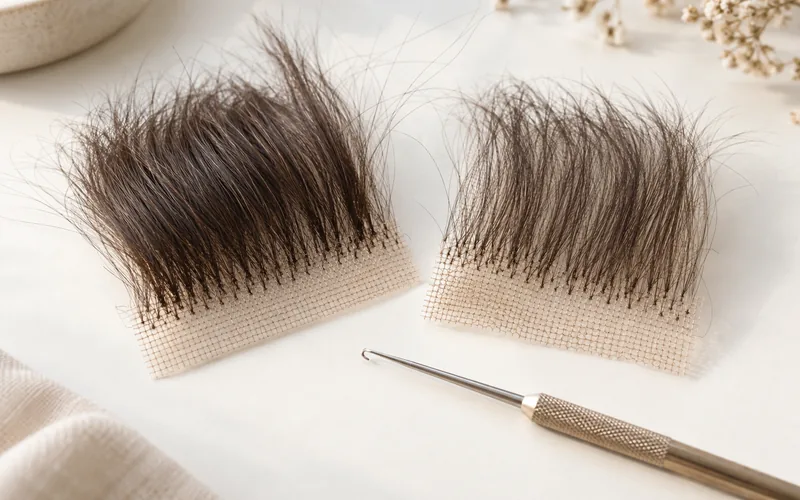
Wig-making guides also distinguish flat knots from split knots: in a split knot the strands of the bundle exit in different directions. Whether a split knot is used — and where — belongs to the specification, not to a universal rule.
No single knot method is "best." The craft is in matching method to zone and style: smaller knots where the eye goes, stronger knots where the wear goes, divided exits where the hair must part. When a supplier cannot state which knot is used in which zone, treat that as an open specification question and get the answer in writing before ordering.
Tradeoffs
Hand-Tied vs Machine-Ventilated: The Real Tradeoffs
Machine work enters the picture through wefts. Hair is sewn into long strips by machine, and those strips are then attached to the cap in rows. That construction changes how the finished piece behaves on the head, and it changes the balance of hand labor in production.
The honest comparison is not "hand good, machine bad." It is about which properties your clients actually pay for:
| Property | Hand-tied ventilation | Machine wefts |
|---|---|---|
| Hair movement | Individually knotted hairs can move and be directed one by one | Hair moves with the strip it is sewn into |
| Parting realism | Hair can be parted in multiple directions where zones are ventilated | Weft edges can read as tracks |
| Perimeter feel | Graduated hand knots at the edge | Bulkier seam where strips attach |
Some hybrid caps combine hand-tied front or parting zones with a wefted back. Treat those zones as separate specification fields. A hand-tied front and a fully hand-tied cap are different products, and the order confirmation should state which zones are which. How any piece is later repaired depends on its construction and the supplier's own repair process, so ask before assuming a repair path.
For boutiques whose clients part their hair in different places or pull hair up off the neck, it is worth specifying full ventilation across every zone that will be visible, and weighing that requirement against the quoted cost.
The Craft
Where Craft Shows Up: Density Zones and Hair Flow
Density zoning is a specification, not an accident. If a cap arrives ventilated at one even thickness where the approved sample or the agreed specification showed graduation, that difference is an observable variance to record and compare with the approved sample — not a conclusion to reach on sight.
Zone-by-zone density is something you can request and check. The front edge can be tied lighter and finer; the crown can carry more coverage; along an intended parting the knots can be kept small and close together. Our sheitel density guide covers how to read and order it.
Hair flow is the second half of the craft. Because ventilation angle and knot method influence how the hair lies, direction is set zone by zone as the work is done. On a finished piece, check the hair's fall against the direction the specification called for, zone by zone, rather than judging styling alone.
Zoning is also where hand work concentrates. When comparing quotes on hand-tied pieces, ask which zones the hand work covers before comparing prices — prices for different zone coverage are not directly comparable.
Inspection
How Buyers Record Ventilation Differences
If these fields form part of the approved sample or written specification, use the following observations as a comparison record. They document visible differences to raise with the supplier; they do not by themselves prove workmanship quality or cause:
- Knot size consistency. Within one zone, note whether knot sizes look uniform. Noticeable variation is worth photographing and querying — it is an observation about the piece in front of you, not a diagnosis of why it happened.
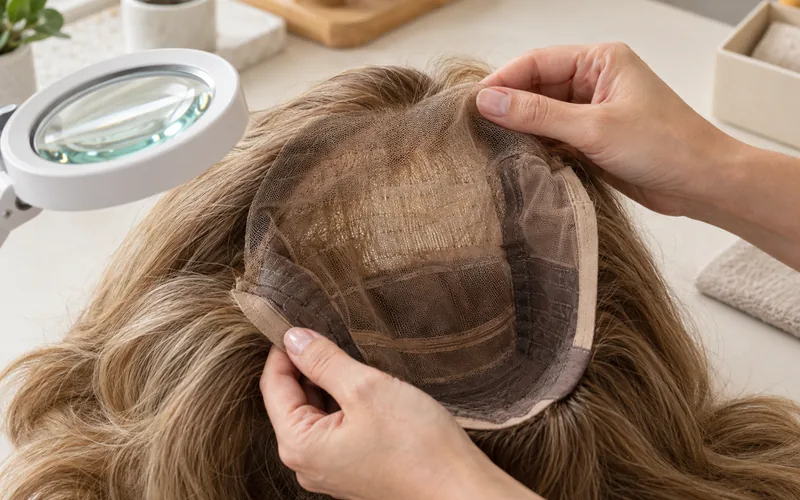
- The inside view. Turn the cap inside out and look at the knot rows. Record the spacing, the direction, and how cleanly one zone transitions into the next, and compare what you see with the approved sample.
- The gentle pull test. Hold a few strands between your fingers and pull lightly. A strand shifting or releasing on a gentle pull is something to record and query; on its own it does not prove how the piece was made.
- Parting in several places. Move the parting left, right, and center. At each line, note how the exposed base reads and whether the hair falls as the specification intended.
For a wider sample-comparison procedure — including washing, combing, and wear-in behavior — our lace top sheitel sample evaluation guide provides a separate checklist.
Care
Making Hand-Tied Last
Care can affect wear and shedding alongside construction and use. Start with these three maker-guided habits.
Start from the care instructions of the unit's maker. For hand-tied areas, wig manufacturers commonly advise keeping conditioner and detangling products off the base and knots, because product buildup at the knots is associated with loosening and shedding; unless your maker instructs otherwise, apply conditioner from the mid-lengths down.
Brush from the ends upward. Detangle the last few centimeters first, then work toward the roots in stages. Dragging a brush root-first can place avoidable tension on many knots at once.
Store the sheitel as the maker recommends — on a stand or in its original box — since manufacturers note that proper storage helps avoid kinks and crushing. Washing matters too: follow the maker's routine, and be gentle at the base.
Ventilation is one durability variable among several. Service life also depends on hair grade, how often the piece is worn, and how it is cared for, and it varies from unit to unit. Our sheitel lifespan guide breaks the full picture down.
FAQ
Frequently Asked Questions
It should mean that every zone of the cap is knotted by hand with a ventilating hook, with no machine-sewn weft panels anywhere. Some partially hand-tied pieces combine ventilated zones with wefted zones. Because the phrase is not standardized, ask the supplier to state zone by zone which construction is used, and put that zone list in the order confirmation.
Knot methods trade visibility against holding strength: single knots are smaller and less visible, double knots are larger and generally stronger. Which method belongs in which zone varies by maker, base, and style — it is a specification, not a fixed rule. The supplier should be able to state which knot is used in which zone.
If knot size, spacing, direction, strand security, or parting behavior is part of the approved sample or written specification, record any visible difference with the unit and zone identified, then ask the supplier to review it. These notes document a comparison; they do not by themselves diagnose workmanship or cause.
Ventilation is one durability variable, not the whole answer. Service life depends on hair grade, how often the piece is worn, and how it is cared for, and it varies from unit to unit. If repair becomes necessary, what is possible depends on the construction and the supplier's repair process, so ask about repair options before you need them.
Follow the care instructions from the maker of your unit. For hand-tied areas, manufacturers commonly advise keeping conditioner off the base and knots and applying it from mid-length to ends, detangling from the ends upward rather than dragging root-first, and storing the piece as the maker recommends — on a stand or in its box.
Conclusion
Conclusion
Ventilation quality is not a mystery category. It is visible, checkable craft: knots matched to zones, density graduated across the cap, and hair flow tied into the direction it should fall. A buyer who knows what to turn inside out holds the advantage in any conversation about price.
When you scale from one sample to a full order, knot-related defects enter batch inspection territory — our wholesale sheitel quality control guide covers how they are classified and sampled. And if the piece will carry your own label, the ventilation spec is confirmed at the production checkpoint described in the private label production walkthrough.
If you are comparing constructions, send the specification fields you want a supplier to confirm in writing: knot method, density by zone, cap construction, and the approved-sample reference.


Ready to Specify Ventilation?
Prepare the knot methods, density zones, cap requirements, and approved-sample fields you want confirmed in a written quote.
Discuss Specs