Wholesale Procurement
Lace Top Sheitel Sample Evaluation: The Buyer's Checklist

The sample has landed on your desk. This guide proposes a checklist for that moment: record, checkpoint by checkpoint, what you observe on this sample against the brief you agreed with the supplier, so the approval decision rests on written findings rather than on an impression. Whether the production units match the sample is controlled by the written order the parties agree to — not by this evaluation alone.
This guide is written from the factory side of that handshake: what a maker can confirm in writing, and what a buyer can check when a sample is part of the order. At LEV Wigs, when a sample is appropriate for a request, the applicable terms are confirmed before your studio evaluates the construction. A written record also gives both parties something concrete to review together if a later question arises.
What follows is the full evaluation sequence: the record you set up before the sample arrives, the physical checks in order, the combing and wear observations, and the written approval that converts a good sample into a production reference. If you are still selecting a factory, our kosher wigs wholesale supplier guide covers that earlier stage; here we assume the courier has already done his part.
Preparation
Before the Sample Arrives: Set Up Your Evaluation Record
A sample evaluation starts days before the parcel is opened. The single most useful artifact is a written brief — the same specification document you intend to use for the production order — covering lace grade, hair origin, density, length, cap size, color reference, and whether the top is lined or unlined. Evaluating against a written brief, rather than against memory of a WhatsApp photo, is what turns opinions into findings a factory can act on.
Prepare four things before the courier arrives:
- The order brief. Every check in this guide ends by comparing the sample against something you wrote down earlier. No brief, no baseline.
- An evaluation sheet. One page, one row per checkpoint, three columns: what you expected, what you observed, and the action it requires. The table in the approval section below gives you a ready-made version.
- Neutral daylight. Evaluate under daylight or daylight-balanced light, near a window if possible. Agree and record the comparison lighting with the supplier, and use the same setup for the sample and the reference materials.
- Reference materials. Your color swatch or the reference unit the color is matched to, a soft measuring tape, and a wide-tooth comb plus the brush you actually sell to clients.
One more preparation: photograph the sealed parcel and the sample as it first emerges, before any handling, and keep the photographs as supporting records. Agree with the supplier in advance how damage or wrong-item reports will be raised and what evidence will be reviewed.
Physical Checks
Inspecting the Lace and the Knots
Work through the lace in three passes, because each pass exposes a different failure mode.
First Pass: the Lace Itself
Hold the top section up to the window and look through it. You are checking the mesh for even weave, for snags or runs, and for discoloration along the edges. Run a fingertip across the lace surface. You are checking for a consistent feel across the whole top; record any patches that feel stiffer or rougher than the rest, and raise them with the supplier. Check the lace edge perimeter for fraying or unfinished borders — the edge sees daily handling first.
Second Pass: the Knots
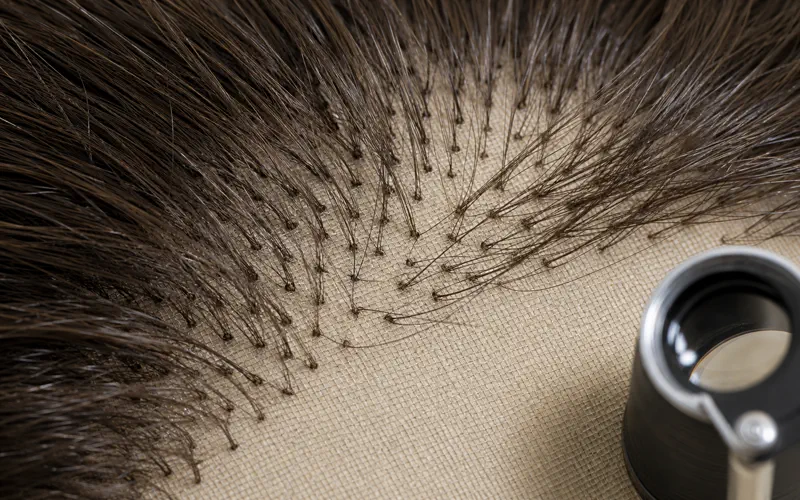
Turn to the underside and examine the knot work under direct light. On a lace top sheitel the knots should sit close to the mesh and appear reasonably consistent across comparable areas of the top. Press a small section of hair gently against the lace and release. Visible movement, sliding, or breakage under the same light handling is a concern to photograph and raise with the supplier. If the knots appear lightened, compare their visibility and strand integrity with the approved sample criteria. This observation can flag a weakness, but it does not by itself establish the processing history.
Third Pass: the Seam Between Lace and Cap
Where the hand-tied lace top meets the machine-made cap body, check the transition against the specified cap construction. A visible ridge, gap, or loose thread at this junction is a difference to record; ask the supplier to explain or correct it as agreed in the order.
For what separates HD, Swiss, and French lace at the specification level, see the lace grades section of our lace top sheitels complete guide. The evaluation question here is not which grade is best, but whether the sample matches the grade you ordered.
Physical Checks
Crown, Parting, and Hairline
The lace top exists to produce a scalp-real impression, so judge the three zones where that impression lives or dies.
The crown and part line. Part the sample where your typical client would wear it, then look at the exposed line under daylight. What to record here is appearance, as an agreed field rather than a universal rule: whether the brief calls for a soft, gradual density transition at the part, and what grid visibility, knot visibility, and taper are acceptable. Record what you observe — for example a part line that shows a visible grid, knots that read as dots, or density that drops off abruptly at the parting — as a comparison against those agreed fields.
The front hairline. Study the transition from lace to forehead line and check it against the appearance fields in your brief — for example, whether the brief specifies a graduated edge, slightly lighter density at the very edge and fuller behind it. A lace-top crown does not by itself specify the front hairline; agree this field with the supplier in writing. Also check that the front lace lies flat when the sample is on a stand: lifting or curling at the front edge on the stand is a finding to raise with the supplier before approval.
The ear tabs and perimeter. Feel inside the ear tabs and along the side perimeter for the same flat, finished construction you demanded at the front. Uneven or scratchy ear tabs are a comfort risk for daily wearers worth flagging at sample stage, before it becomes your after-sales conversation.
Physical Checks
Density and Hair Direction
Density evaluation is a comparison, not an impression. Lift sections of hair at the crown, the sides, and the nape and compare how much light passes through each zone against what your brief specified. How full each zone should be — including whether the crown is intentionally fuller than the hairline — is an appearance field to agree in the brief; patchy thin spots within the same zone are a deviation from the specified evenness to record.
Direction is quieter but more consequential. If the order specifies aligned cuticles running root-to-tip, comb a small section flat, then lift and let it fall, and record what you observe — whether the hair lies smooth and stays put, or bristles or tangles against itself — together with your handling setup. Bristling or tangling is an observation on this unit, not a diagnosis of the hair. Ask the supplier separately what documentation supports the alignment claim, and agree in writing what the acceptance criteria for direction are before you approve.
The density specification itself — how full for which clientele, and how it maps to your market — is covered in the customization parameters of the complete guide. At the evaluation table your job is only to confirm the sample delivers the number you specified.
Physical Checks
Cap Measurement and Fit
Measure the sample before you judge it worn. With the sample on a stand, measure the circumference following the same path the cap sits on a head, then front-to-nape, ear-to-ear, and temple-to-temple. Write each measurement next to the figures in your brief. A cap that deviates from the agreed measurements at sample stage is a finding to raise with the supplier before production, while the agreed correction route still covers this sample.
Then evaluate fit on a real head — yours, a colleague, or your most size-typical client model. You are checking three things: whether the cap sits where a cap should without sliding during normal head movement, whether the perimeter exerts even pressure with no specific point that pinches, and whether the stretch zones flex and recover instead of staying bagged out after removal. A tight spot that pinches on the head you test is an observation for this unit and this setup — record it and ask the supplier how fit will be confirmed for the order.
For custom cap sizing — including non-standard measurements for clients who need them — the specification route is described on our lace top sheitels wholesale page, where sample terms and the order flow are confirmed before your studio evaluates construction.
Physical Checks
Texture, Color, and Consistency
Run the hair through your fingers from mid-length to ends and record observable surface behavior: drag, residue, static, stiffness, and luster. Keep handling observations separate from conclusions, and request the documentation supporting any cuticle-alignment or processing claim. If the hair feels heavily coated, unusually stiff, or changes after the agreed wash routine, record the result and ask the supplier to explain it before approval.
Color evaluation happens in two comparisons under neutral daylight. First compare the sample with the approved swatch or reference unit at the root, through the length, and at the ends. Then, if you received more than one sample, compare the samples with one another. Record any variation photographically and against the tolerance in the brief; visual consistency supports the approval decision but does not by itself prove how the color was produced.
The hair assessment section of the complete guide explains the sourcing terms buyers may encounter. At evaluation, confirm the sample against observable fields in the approved specification, and request the documentation supporting any hair-origin claim.
Performance Checks
The Combing Test: Movement and Early Shedding
The combing test is a repeatable handling check, not a laboratory test. Start at the ends and work upward with your wide-tooth comb, then repeat with the brush specified for the evaluation. Watch two things.
Movement. Watch how the hair of this sample behaves as a mass — whether it parts, falls, and reassembles smoothly. Stiff movement that holds a comb track, or hair that flies apart with static under ordinary brushing, is a surface-behavior difference to record and ask the supplier to explain before approval.
Shedding, read consistently. Use the same section, brush, and counted number of passes for every sample, then record the amount and location of loose hair. Repeated localized loss near the lace deserves closer inspection of that zone and written follow-up with the supplier. The handling test identifies a concern; it does not by itself establish the manufacturing cause or predict the behavior of every production unit.
A note on expectations: evaluate shedding relative to the wearing reality of your clients, not against a zero-hair fantasy. Record the pattern and location of any shedding and compare them with the acceptance criteria agreed in the brief.
Decision
Writing the Approval Record: Approve, Correct, or Reject
The Three Properties of a Working Approval Record
Every check above now funnels into one document. An approval record that works has three properties: each finding is written against the brief, each deviation carries a requested action, and the decision names its conditions. Verdicts like "looks good" or "not quite right" transfer nothing to the production order. A finding such as "density at the crown reads visibly fuller than the specified level, please confirm the production units match the agreed specification" transfers everything.
The Sample Evaluation Checklist
The record below is the working checklist we recommend to buyers evaluating a factory sample:
Use its fields only where your agreed brief specifies them, recording the agreed criteria before you mark pass or corrective action.
| Checkpoint | What You Verify | Result and Action |
|---|---|---|
| Lace integrity | Even weave, no snags or runs, clean edges, consistent surface feel | Pass / corrective note |
| Knot work | Tight, even knots; secure under light pressure; visible strand and knot appearance recorded against the agreed criteria | Pass / corrective note |
| Crown and part line | Gradual density taper at the part, no grid visibility, no dot-row of knots | Pass / corrective note |
| Front hairline | Graduated edge density, lace lies flat, no lifting at the perimeter | Pass / corrective note |
| Density by zone | Matches the specified level; even within each zone | Pass / corrective note |
| Hair direction | Lies smooth one direction, no bristling or self-tangling when lifted | Pass / corrective note |
| Cap measurements | Circumference and lengths recorded against the brief figures | Pass / corrective note |
| Fit on head | Sits stable, even perimeter pressure, stretch recovers | Pass / corrective note |
| Texture and color | Root-to-end color match under daylight; natural surface behavior | Pass / corrective note |
| Combing test | Free movement; no localized repeating shedding from any zone | Pass / corrective note |
| Decision | Approve / approve with corrections / reject — with conditions named | Signature and date |

Three Outcomes Close the Record
The distinction matters:
| Outcome | When It Applies | What You Do |
|---|---|---|
| Approve | Sample matches the brief across all checkpoints | Sign, date, seal the sample as the production reference |
| Correct | Deviations you want corrected: for example color drift, density, cap adjustment | Ask the supplier what is feasible; approve conditionally only with the correction, any revised sample, and the acceptance conditions confirmed in writing |
| Reject | Structural failures: unstable knots, lace faults, mis-sized cap, wrong hair behavior | Document the findings with photos, state the non-negotiables, and decide whether a new sample is worth the round |
Record Exceptions Even When You Approve
One habit strengthens this entire framework: record exceptions even when you approve. The kosher wholesale guide puts the principle plainly: approval notes give the factory a measurable production reference. An approval that names what was borderline, and what tolerance you accepted, says more than a clean approval with no notes.
Decision
Which Issues Go Back to the Factory
For each recorded deviation, ask the supplier and your local evaluator who should review it and what correction route is available. Record the agreed responsibilities before requesting a correction.
Factory corrections are findings rooted in how the unit was built: unstable knots, lace flaws or fraying edges, a cap that misses the agreed measurements, color outside the accepted tolerance, or density that differs from the specified level. Raise these before production because they may indicate a repeatable specification or process risk; document the zone and deviation rather than assuming every unit will reproduce it exactly.
Local adjustments are styling and finishing changes to this unit: a trim to the perimeter shape, personalizing the cut, thinning a style that was ordered full, or adding the styling finish your particular client expects. Agree with the supplier and your bench who reviews each finding and who is authorized to perform any alteration — a sheitel macher can be one option for that finishing layer between factory output and the client's head.
Sort each finding by what it is, without assuming its cause: a deviation from the written specification — measurements, color tolerance, density level, construction — is a matter for the supplier under the order; a desired styling change is a matter for your bench. Write each supplier-bound item as a measurable instruction — the zone, the deviation, the requested result — and agree with the supplier who reviews it and on what terms.
Production
From Approved Sample to Production Specification
Approval is not the end of the sample's job. When both parties agree in writing, the approved unit can be retained as a physical reference alongside the purchase specification. The agreement should state which attributes the reference controls and how later differences will be reviewed.
- Identify the approved unit. Label it with the article, date, and signatory, then store it unworn, unstyled, and protected from light. Record in writing whether both parties accept it as a reference and which specification fields it controls.
- Translate the record into the purchase order. The written specification your order rides on should carry the exact brief the sample was evaluated against, plus every tolerance you noted in the approval record. Any deviation your production units show at incoming check is now measured against two references: the paper and the sealed sample.
- Confirm the incoming-check arrangement. Agree with the factory what inspection is performed per unit before shipment and whether it is documented per unit or sampled, and ask that orders ship with a specification sheet to check goods against on arrival. Our complete guide's inspection and documentation section frames these as inquiry-stage questions; what becomes a commitment is defined by the written order the parties agree to.
- Keep the photo trail. The before-photos, the evaluation-sheet scans, and the signed record stay in the order file, so that a later question about this season's order can be compared against what was actually recorded — within the scope the parties agreed the record controls.
Handled this way, the approved sample and its record support later comparison: color, density, cap behavior, and knot standard held in one physical object that later orders can be compared against — as far as the parties agree it controls.
FAQ
Sample Evaluation Questions Buyers Ask
Agree the timing with the parties who will do the evaluation. Decide in advance how much time the session gets, what handling is permitted, which wear or wash checks are part of it, and where the correction checkpoints sit. Record the proposed evaluation period and confirm when any additional checks or corrections would be reviewed.
Treat a color deviation against the tolerance written in your brief rather than assuming it is minor or correctable. Photograph the sample beside the approved swatch under neutral light, record the difference, and ask the factory to confirm whether a corrected sample is required before production. Approve only when the agreed correction and acceptance route are documented.
The approval is your written decision after evaluating the sample. A golden sample is a physical reference retained after approval. It becomes a controlling production reference only when both parties identify it clearly and agree in writing how it will be used alongside the purchase specification.
The sample decision and the incoming check are two different layers. Confirm with the factory during inquiry what inspection is performed on each unit before shipment and whether it is documented per unit or sampled, and ask for a specification sheet to check goods against on arrival. Agree which approved sample and written specifications will serve as references for the incoming check.
It can work, provided the person is suitably experienced with this construction and both parties agree the arrangement. Ask the assessor directly whether they can evaluate knot work, density, and hairline behaviour against the agreed brief, agree their role and the record they will produce, and keep your own written record so the factory receives documented findings rather than verbal impressions.
Closing
A Record Both Sides of the Order Can Use
What this process produces is a written trail: a brief agreed in advance, a measured record of what was observed, and a reference the parties agreed to retain. Every checkpoint in this guide feeds that trail.
Use the same documented process for every sample and each new comparison has a written baseline. Your supplier receives clearer tolerances, and your team can consult records rather than memory.

Have a Sample on Your Desk Right Now?
LEV Wigs builds lace top sheitels to a confirmed written specification; when a sample is appropriate for an order, its terms are confirmed before your studio evaluates construction. Bring your evaluation record and specification questions to the inquiry page.
Contact LEV WigsWholesale lace top sheitels