Construction Guide
Hatfall Sheitel Construction: Choosing a Cap for Hats

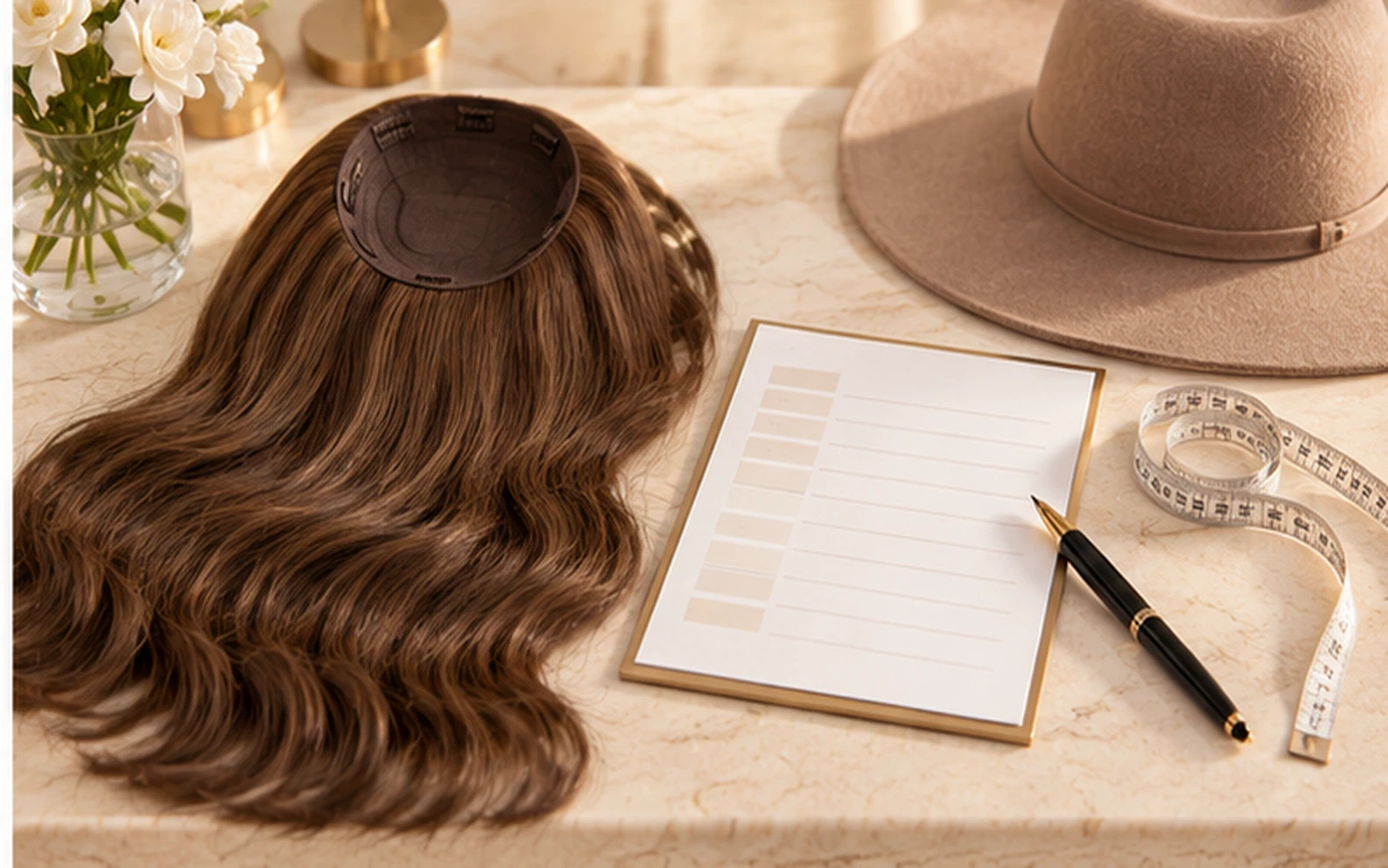
A hatfall is a sheitel built to be worn under a hat. The hat covers the top of the piece, and the hair that stays visible below the brim does the visual work. That single fact changes the whole construction brief — the top does not need to imitate a scalp, and the cap is designed around coverage, breathability, and staying put under headwear. This guide walks the construction zone by zone and ends with the checks to run before ordering.
Why the Top Differs
Why a Hatfall Top Is Not a Lace Top or Silk Top
Aeria Hair defines the category plainly: a hatfall sheitel is “designed to be worn together with a hat or suitable head covering,” and “unlike a conventional full wig, a Hatfall focuses on the hair that remains visible beneath the hat.”
Because the hat hides the upper cap, “its construction and styling priorities may differ from those of a traditional lace top or silk top sheitel” — Aeria’s own wording. A lace top exists to show an exposed, natural-looking top and parting; a hatfall top exists to sit comfortably under a brim. Spending the budget on an exposed-part construction makes less sense when the top stays covered under the brim, and breathability under a hat becomes the more useful property.
For the choice between a hatfall and a full sheitel in general, the fall vs full wig comparison covers that decision; this article stays inside the hatfall’s own construction.
Top Materials
Top Materials: Named and Unnamed
Of the product pages checked for this guide, one maker names its top approach, and the others leave the top construction unstated:
- A named bamboo-cotton top. Milano Wigs’ HatFall collection names a “GripCap bamboo-cotton top with a WiGrip band edge.” That is the naming Milano uses on this series — the other pages checked for this guide use different wording or none — so treat the phrase as that maker’s naming and ask each supplier what the top is actually made of.
- Tops left unstated. Wonderful Wigs’ hatfall collection, from a UK general wig maker outside the Jewish wig market, and Yaffa Wigs USA’s virgin European hair hat fall, a listing for a piece “designed to be worn with a hat, scarf or beanie,” both give measurements and use cases — Yaffa’s measurements run from the crown and the nape — but neither page states what the top of the piece is built from. There, the top construction is a question for the supplier, not something the page shows.
One page names its top; the others leave it unstated. Ask each supplier what the top of their hatfall is made of and how it grips.
The Back
The Back: Open or Closed Wefting
Milano’s HatFall overview names an open-wefted back. What open or closed wefting looks and feels like on a specific piece is a sample observation, not something to generalize from the option name: check the sample for how the rows read from the outside, how the piece wears under the client’s actual hat, and how the back looks at the nape and sides below the brim. Record the stated option and what the sample shows in the order notes.
Length and texture are the same kind of field: on any wavy or textured hatfall, confirm the exact curl pattern and the length in writing before the batch runs.
Top, Back, Attachment
Top, Back, and Attachment: Three Makers Compared
Turn from what tops are made of to how each piece is held on, and the three pages again differ — now zone by zone. Milano’s HatFall overview names a top (the GripCap bamboo-cotton top with a band edge noted above), an open-wefted back, and “optional earpieces provide added coverage if desired.” The band edge is what that page names at the perimeter; the overview states nothing further about how the pieces hold.
IRENES NYC states its hatfalls “feature an open top on a wefted cap” and are “designed to be worn with hats, or scarves.” That names a top (open) and a back (wefted cap) — it does not name how the piece is held on. No fixation mechanism is disclosed on the page, so attachment for an IRENES hatfall is a field to confirm in writing, not a described method.
Tallie’s Hatfall Conversion page describes an in-salon service that turns a wig into a hat fall; for that conversion service, the fall is attached inside the hat. The page describes that service only — not hat falls in general — so attachment on any other unit stays a question for its maker.
| Maker (page checked) | Top | Back | Attachment |
|---|---|---|---|
| Milano — HatFall overview | GripCap bamboo-cotton top with band edge (the maker’s own naming) | Open-wefted | Band edge at the perimeter; earpieces optional |
| IRENES — Hatfalls page | Open top (material not named) | Wefted cap | Not disclosed — confirm in writing |
| Tallie — Hatfall Conversion page | Not stated on the conversion page | Fall attached inside the hat, for that conversion service | |
Treat each maker’s own description as the only statement that holds for that maker’s piece, and confirm top, back, and attachment as three separate fields in writing with the order.
Hat Depth
Hat Depth, Volume, and Where the Piece Sits
The hat is half of the construction decision. Aeria states it directly: “the shape, depth and positioning of the hat can influence how much hair remains visible and where the wig sits,” and its product guidance adds “choose a hat that comfortably covers the upper cap area.”
How much room any specific top leaves inside a specific brim, and whether it rubs, is not stated on any page checked: try the piece under the actual hat and record the space and contact points you observe.
Practically, the check is to fit the piece with the actual hat the client will wear:
- Where does the brim line fall — how much hair shows below it, at the sides and the nape?
- Does the hat sit flat over the top, or does the piece’s volume push it out of shape? Note the clearance between the piece’s top and the hat’s crown while fitting.
- Where does the piece settle after a wearing session, and does the grip hold under the hat’s own band?

Before You Order
The Fit Checks and Fields to Confirm
Run the checks above on the sample with the client’s own hat, then record the order fields that hatfall pages often leave vague:
| Field to confirm | What a specific answer looks like |
|---|---|
| Top construction | The material named — bamboo-cotton, another fabric, or no cap design — and how it grips |
| Back construction | Open or closed wefting, stated for this piece |
| Attachment method | How the piece is held on, per the maker’s own description for this piece — for example, a band edge like Milano’s; where the maker names no mechanism (as IRENES’ page does not), record “not disclosed, needs confirmation” |
| Length measured from | From the top of the crown or from the nape — makers differ, and the numbers are not comparable until the reference point matches |
| Texture | The exact wave or curl pattern, confirmed in writing on any textured unit |
| Hat reference | The hat style and depth used for the fitting, noted with the order |
Common Questions
Hatfall Sheitels: Common Questions
A human hair piece designed to be worn together with a hat or suitable head covering. The hat covers the upper cap, and the visible hair at the sides and nape does the visual work — so the top is built for comfort and grip under headwear rather than for an exposed, natural-looking parting.
A top construction named by Milano Wigs on its HatFall line — the collection page names a GripCap bamboo-cotton top with a band edge. That is the naming Milano uses on this series — the other pages checked for this guide use different or no top-material naming — so confirm the top material with each supplier in writing.
Often yes, but the result depends on the hat. Seller guidance notes that hat shape, depth, size, and positioning all affect how much hair remains visible and where the piece sits. Fit the sample with the hat the client will actually wear before ordering.
The top material and grip method, the back construction (open or closed wefting), the reference point for the stated length, the exact texture on any wavy unit, and the hat style used at the fitting. Texture and the length reference belong in the written order.
Conclusion
Fit the Hat, Then Specify the Piece
A hatfall is engineered around a brim: a top chosen for comfort and grip rather than display, a back chosen for airflow or finish, and a fit that only means something under the client’s actual hat. Run the fitting checks, then put the top, back, length reference, and texture into the written order fields.


Specifying Hatfalls for Your Assortment?
Use the confirmation fields above — top material, back construction, length reference, texture, and the fitting hat — to prepare your supplier conversation before approving a sample.
Contact LEV Wigs