Construction Guide
Silk Top Sheitels With Lace Fronts: Hybrid Cap Construction

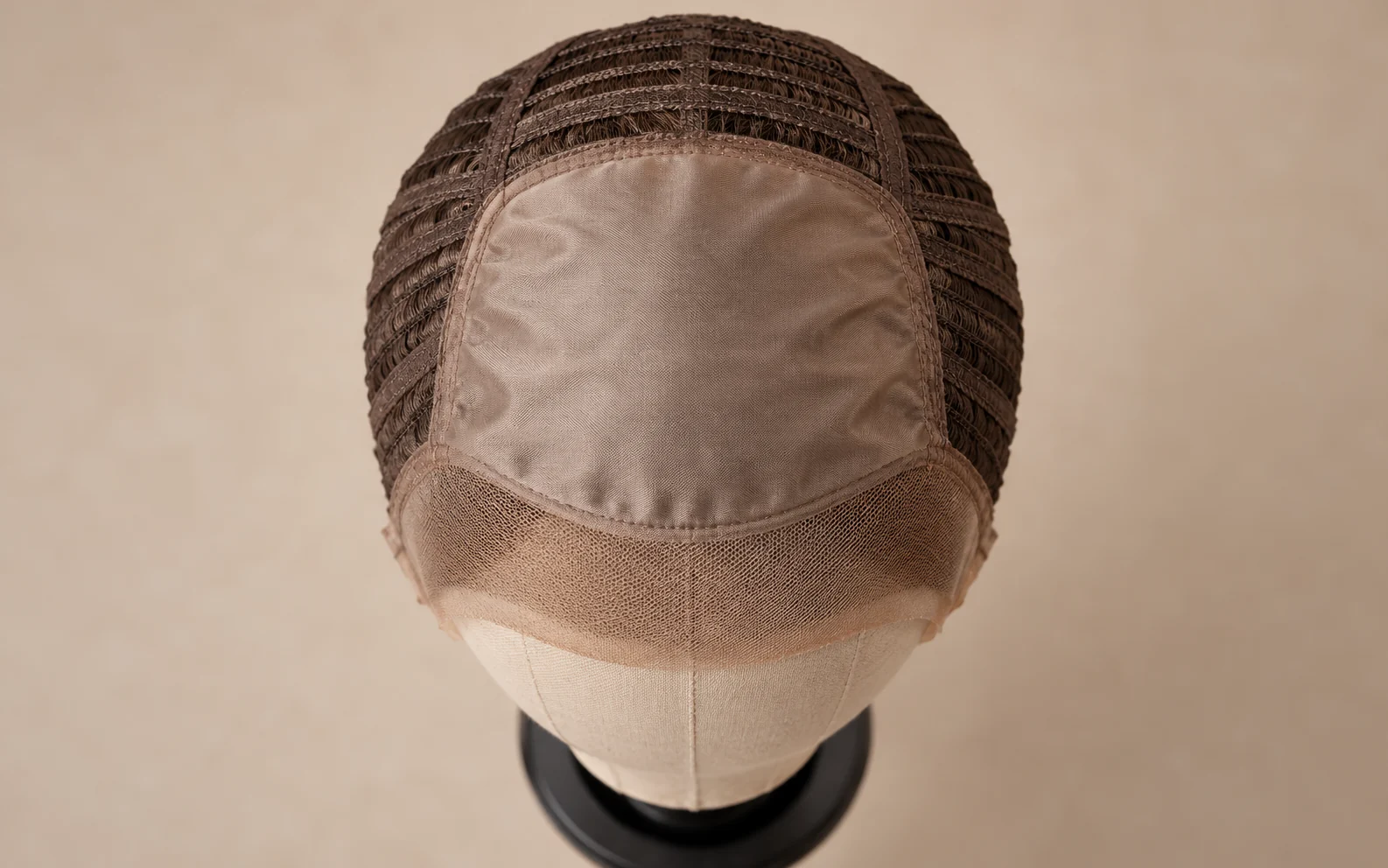
Silk top and lace front are often presented as competing choices, but a silk top lace front sheitel uses both: a silk top crown behind a lace front hairline, with a third construction at the back. This hybrid layout appears across current sheitel listings, and understanding it zone by zone makes the order conversation much shorter.
Three Zones
A Hybrid Cap Works in Three Zones
The clearest single-page description of the layout found for this guide comes from Superhairpieces’ Sarah kosher sheitel: “French lace front for a natural hairline, an injected silk top for a realistic scalp, and machine wefts in the back with clips on the sides and front, an elastic band for a secure, adjustable fit.”
Read that as three construction zones plus a grip plan:
- Front: a French lace strip with knotted hair, carrying the hairline.
- Crown: a silk top, carrying the visible parting surface.
- Back: machine wefts, in the three-zone layout the fullest listing describes. That page names clips on the sides for grip but never states a side construction — the sides are undisclosed, so treat them as a field to confirm.
- Grip: clips and an elastic band, placed where the maker specifies.
The cap construction guide covers what each zone of any sheitel cap has to do; this article is about how the silk-and-lace combination behaves in practice.
How They Combine
Why Silk Top and Lace Front Combine Well
The two constructions solve different problems, which is exactly why they can sit on one cap. A lace front puts knotted hair at the hairline so the edge graduates into the skin. A silk top hides knots from the visible surface: in the general silk-top construction Emeda’s Jewish-wig guide describes, the knots sit beneath the silk layer rather than on it — which is why no knots show at the surface of a silk top.
Put together, the lace handles the edge and the silk handles the part. Hair Queen LA’s 4x4 French lace + silk top sheitel words it the same way in its feature list: the lace front “creates a seamless, natural-looking hairline,” while the silk top “mimics the look of a real scalp, offering versatility and realism in every part.”
One caution from the same research pass: that listing describes the front and the top, but says nothing about the sides and back. A hybrid order should specify all three zones, not two.
Front and Part
What Each Zone Gives You at the Edge and the Part
At the hairline, the hybrid behaves like a lace front piece: the edge is knotted lace, and the questions to ask are the usual lace ones — how fine the knotting is, whether any knot treatment is applied, and how the edge should be cared for.
At the crown, it behaves like a silk top piece: the parting reads as scalp because the knots sit under the silk layer, and the part can move within the top area. The parting freedom is bounded by the size of the silk panel, which is a field to confirm on the order rather than a property of “silk top” as a class.
For buyers weighing this against a pure either/or choice, the lace top vs silk top comparison lays out the single-construction tradeoffs this hybrid is designed to sidestep.
Real Examples
Two Listings, Two Levels of Disclosure
The two real examples opened for this guide disclose different amounts, and the gap itself is the lesson:
| What the listing specifies | Superhairpieces “Sarah” | Hair Queen LA 4x4 sheitel |
|---|---|---|
| Front | French lace front, “zero-edge” hairline wording | 4x4 French lace front |
| Crown | Injected silk top that “completely conceals knots” | Jewish silk top, realism “in every part” |
| Back | Machine wefts, named explicitly | Not described on the page |
| Sides | Not disclosed — clips are named on the sides for grip, not a side construction | Not described on the page |
| Grip | Clips on sides and front, elastic band | Not described on the page |
| Price observed | USD 1,668 | USD 864 |
Both are legitimate hybrid listings; one simply tells you more. When the back, sides, or grip are missing from a page, ask for them in writing before the sample stage. A small verification note from the same pass: the Sarah page’s own spec table labels its base “French top” while its description says “French lace front” — wording drift like this is common on product pages, which is one more reason the order fields, not the page copy, should carry the construction.
Front-to-crown check
Check the front-to-crown join on the actual piece
Before approving a hybrid cap sample, ask to see where the front lace meets the crown panel. Record the connection on the actual sample rather than relying on the product name.
Before a sample is approved:
- Ask the supplier for inside and outside views of the join between the front zone and the crown.
- Ask for each zone’s dimensions and coverage — the front strip’s width and the crown panel’s size.
- View the part on the sample under one consistent light, and record how the join looks from the outside.
- Note where the seam sits — for instance, relative to the hairline and the part — and how it appears.
- Match the record against the written specification, and flag any difference before approving the sample.
Keep the photographs and notes with the written specification. For a silk-top crown reference, see LEV’s silk-top kosher sheitel page.
Before You Order
Specifying a Hybrid Cap on a Wholesale Order
Write the hybrid down as three named zones plus a grip plan, so nothing is left to the supplier’s default:
- Front zone: lace type, width of the strip, knotting and any knot treatment.
- Crown zone: silk top, with the parting area’s size and the scalp-tone approach stated.
- Back and sides: wefted or otherwise, named explicitly.
- Grip: clips, bands, or strips, with placement.
- Sample check: inspect the hairline and the part on the sample, and confirm the written spec matches the piece.

Yes. The combination is a documented hybrid layout: a French lace strip at the hairline, a silk top crown behind it, and a third construction at the back — machine wefts in the fullest listing checked for this guide. Current sheitel listings sell this layout as one cap.
Front, crown, and back. In the fullest listing checked for this guide, that reads: French lace front for the hairline, injected silk top for the scalp appearance at the part, and machine wefts at the back, with clips and an elastic band for grip. Confirm each zone in writing when ordering.
Because they handle different areas. The knotted lace strip builds the gradual hairline at the edge; the silk top hides knots from the visible parting surface, so the crown reads as scalp. Using both on one cap borrows the strength of each construction for its own zone.
All three zones and the grip plan: lace type and strip width at the front, silk top and parting area at the crown, the named back construction — plus the sides, which the fullest listing checked leaves undisclosed — and the clip or band layout. Record each zone and the fixation components separately in the written order, including any details the selected listing leaves undisclosed.
Conclusion
Specify the Combination, Not the Slogan
A hybrid cap is not a mystery construction — it is three named zones and a grip plan. Ask for each zone in writing, check the hairline and the part on the sample, and the silk-plus-lace combination becomes one of the easiest caps to order with confidence.



Planning an Order With a Hybrid Cap?
Bring the three zone specifications and the grip plan to your supplier conversation, and confirm each zone in writing before the sample is approved.
Contact LEV Wigs