Orthodox Buyer's Guide
Choosing Jewish Wigs: Orthodox Buyer's Guide for 2026

Walk into any sheitel store in Brooklyn or Jerusalem and the options are overwhelming. In fact, prices for jewish wigs range from $200 to $6,000+, and the wrong choice gets expensive fast. For instance, a wig that sheds after three weeks, fits poorly around the temples, or arrives with the wrong cap construction can set you back hundreds of dollars with no return policy to fall back on.
After a decade of manufacturing sheitels for stores and individual clients worldwide from our factory in Qingdao, we have seen every mistake buyers make. We have also seen what the smart ones do differently. Therefore, this guide pulls together those lessons into a practical framework you can use whether you are buying your first sheitel or your fiftieth. Specifically, we cover hair grades, cap types, quality testing methods, pricing breakdowns, and the supplier questions most people never think to ask.
Key Takeaways
- Virgin hair and Remy hair are not the same thing. Virgin means unprocessed; Remy means cuticle-aligned. The best sheitels are both.
- Cap construction affects comfort more than hair quality does. Swiss lace (0.08mm) is the premium standard for daily orthodox wear.
- You can evaluate quality at home with three simple tests: the water test, the stretch test, and the shedding test.
- Factory-direct pricing from a manufacturer like our Qingdao workshop typically runs 40-60% below retail store prices.
- Measuring your head correctly before ordering eliminates the single most common fit problem for first-time buyers.
What to Look For
Understanding the Basics: What to Look For
Hair Quality — Virgin, Remy, or Processed?
Three hair categories dominate the sheitel market. Virgin hair has never been chemically treated. The cuticle layer is fully intact, and all strands run root-to-tip in the same direction. This is the most expensive grade because it is the rarest and performs the longest. Remy hair is cuticle-aligned (all strands running the same direction) but may have been color-treated or lightly processed. It is the most common grade in mid-range sheitels. Processed hair has had the cuticle layer stripped entirely and been coated with silicone for shine. It looks good out of the box but degrades noticeably after a few washes.
For orthodox jewish wigs intended for daily wear, virgin or high-grade Remy is the practical minimum. The silicone coating on processed hair wears off in 4 to 8 weeks of regular washing, leaving the hair dry, tangled, and prone to breakage. See our guide to 7 jewish wig types for the full breakdown on how hair grade interacts with each construction style.
| Hair Grade | Durability | Feel | Typical Price | Best For |
|---|---|---|---|---|
| Virgin | 18-24+ months | Natural, soft, slight texture variation | $1,500-$6,000+ | Daily orthodox wear, premium clients |
| Remy | 12-18 months | Smooth, consistent | $500-$1,500 | Mid-range daily wear, budget-conscious |
| Processed | 4-8 months | Silky at first, then dry | $200-$500 | Occasional wear, backup sheitel |
Cap Construction — Why It Matters More Than You Think
Most first-time buyers focus entirely on the hair and treat the cap as an afterthought. That is backwards. In reality, the cap determines how the wig feels on your head for eight or more hours a day. It determines whether the hairline looks natural or obviously wig-like. Furthermore, it determines how long the unit lasts before the knots start loosening and shedding accelerates. In our Qingdao workshop, we spend as much time on cap construction as we do on hair selection because the cap is the structural foundation of every sheitel.
| Cap Type | Natural Look | Comfort | Durability | Price Range |
|---|---|---|---|---|
| Silk Top | Excellent — knots invisible | Moderate — multi-layer | 18-24 months | $$$ |
| Swiss Lace Full | Very Good — near-invisible lace | Excellent — breathable | 12-18 months | $$ |
| Lace Front + Wefted Back | Good at front | Good — mix of lace and stretch | 12-16 months | $ |
| Full Wefted (Machine) | Fair — visible tracks | Variable | 8-12 months | $ |
Practical Verification
Step-by-Step: How to Evaluate a Jewish Wig
You do not need a laboratory to tell a good sheitel from a bad one. Three hands-on tests take less than ten minutes and reveal more about construction quality than any spec sheet. In fact, we use variants of these same tests on our factory production line in Qingdao before any unit ships.
The Visual Inspection
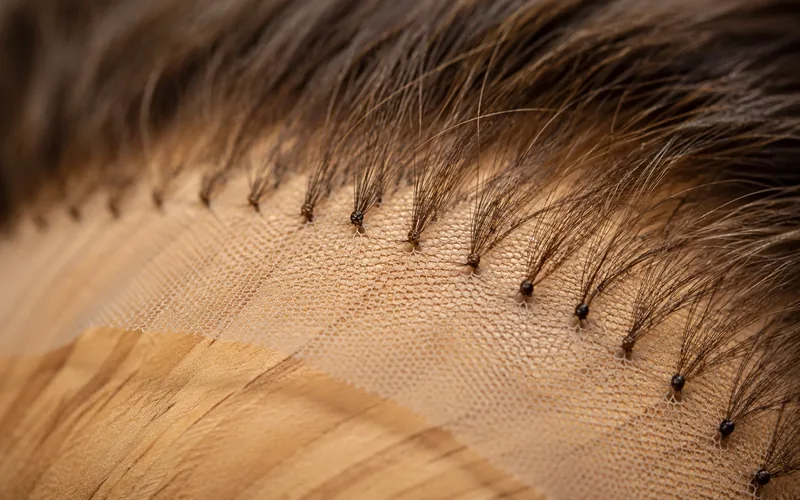
Hold the wig up to a bright window or lamp. Look at the part line. On a silk top unit, the scalp should appear uniform with no visible knots or grid pattern. On a lace unit, check whether the knots have been bleached to match the lace color. Dark knots showing through light lace are an immediate red flag. Next, examine the hairline. Individual hairs should graduate in length (shorter at the temples, longer toward the crown). A perfectly uniform hairline is a sign of machine-made construction rather than hand-tied ventilation.
The Touch and Feel Test
Run your fingers from the tips of the hair toward the roots. Virgin hair will feel slightly rough in that direction because the cuticle scales are intact and pointing downward. Processed hair feels the same in both directions because the cuticle layer has been stripped away. This is the single fastest way to distinguish virgin from non-virgin hair without any equipment.
The water test confirms it. Next, drop a few loose strands into a glass of water. Virgin hair sinks slowly because the intact cuticle creates slight surface resistance. Processed hair often floats or sinks very quickly because the silicone coating either repels water or the stripped cuticle makes the strand denser.
Tip
Run a wide-tooth comb through the wig 50 times. Quality hair should lose fewer than 10 strands. If you see more than 15, the knots are either poorly ventilated or the hair cuticle has been damaged during processing. This test alone tells you whether the sheitel will last.
The Shedding and Stretch Test
Pull 5 or 6 individual strands gently from different sections of the wig. Virgin hair stretches roughly 20-30% of its length and springs back to its original shape. That elasticity indicates healthy protein structure inside the hair shaft. Processed hair either snaps immediately or stretches without bouncing back, both signs of structural damage from chemical treatment. Our factory rejects any batch where the stretch recovery rate falls below 80%.
Note
Swiss lace (0.08mm) lasts 4-6 months of daily wear before the front hairline begins to show wear, while HD lace typically needs replacement after 2-3 months. For orthodox women wearing a sheitel every day, Swiss lace is the practical choice for durability.
| Quality Check | What to Look For | Red Flags |
|---|---|---|
| Part Line | Uniform scalp color, no visible knots or grid | Visible knot dots, grid pattern showing through |
| Hairline | Graduated lengths, baby hairs present | Uniform density edge, no natural variation |
| Cuticle Direction | Slightly rough tip-to-root, smooth root-to-tip | Same feel in both directions (stripped cuticle) |
| Elasticity | 20-30% stretch with full recovery | Snapping, no bounce-back |
| Shedding | Fewer than 10 strands in 50-stroke comb test | 15+ strands, visible thin spots after combing |
Price Guide
Price Guide: What Should You Expect to Pay?
Sheitel pricing can feel opaque because so many variables affect the final number. Hair origin (European vs. Mongolian vs. Indian), hair grade (virgin vs. Remy vs. processed), cap construction (silk top vs. lace front vs. full wefted), length, density, and whether the unit is stock or custom-made all factor in. Below is a realistic price map based on current 2026 market data from our factory and retail partners.

| Type | Entry ($200-500) | Mid-Range ($500-1,500) | Premium ($1,500-6,000+) |
|---|---|---|---|
| Full Lace Sheitel | Processed hair, machine-tied, standard cap | Remy hair, hand-tied, Swiss lace | Virgin European hair, custom cap, silk top crown |
| Silk Top Sheitel | Not commonly available at this tier | Remy hair, silk top front, wefted back | Virgin hair, full silk top, custom scalp tone |
| Lace Front Sheitel | Processed hair, short lace front, machine back | Remy hair, 4-inch lace front, stretch cap | Virgin hair, full Swiss lace front, hand-tied throughout |
| Factor | Impact on Price | Example |
|---|---|---|
| Hair Origin | European commands 2-3x Mongolian | Same 18" silk top: $800 (Mongolian) vs. $2,200 (European) |
| Hair Length | +15-25% per 4 inches | 18" to 22" typically adds $200-400 |
| Density | +10-20% above 130% | 180% density adds $150-300 vs. standard 130% |
| Custom Cap | +20-35% over stock sizes | Custom fit adds $200-500 depending on complexity |
| Knot Bleaching | +$50-100 (factory-done) | Double-drawn, pre-bleached knots save salon labor |
Factory-direct suppliers like our Qingdao workshop can offer these specs at 40-60% below retail because there is no store markup, no middleman commission, and no inventory holding cost built into the price. The trade-off is lead time (typically 15-25 business days) and the inability to try the unit on before purchasing.
Supplier Selection
Finding the Right Supplier
A sheitel is only as reliable as the supplier who stands behind it. Whether you are buying from a Brooklyn sheitel macher or ordering direct from a manufacturer in China, the same evaluation principles apply. The difference is in how much transparency you can expect and what recourse you have if something arrives wrong.
Questions to Ask Before You Buy
Start with specific, technical questions. A supplier who cannot answer with precision is probably reselling stock they did not make. For example, ask what lace weight they use. Find out whether the hair is single-drawn or double-drawn, and inquire about their knot bleaching technique. Then ask what their quality rejection rate is. A factory that inspects properly should reject 5-8% of units during production. A rejection rate of zero usually means nobody is checking.
Red Flags to Watch For
Overall, be wary of suppliers who cannot provide production photos, refuse sample orders, or quote prices that seem too good. A virgin European hair silk top sheitel for $150 does not exist anywhere in the world in 2026, and anyone claiming to sell one is either misrepresenting the hair grade or cutting corners on cap construction. Also watch for suppliers who insist on full payment upfront with no order protection. Reputable manufacturers will offer a deposit-and-balance structure with photos before final payment.
| Question | Good Answer | Warning Sign |
|---|---|---|
| "What lace weight do you use?" | "Swiss lace, 0.08mm" or specific mm measurement | "Premium lace" with no specification |
| "Can I order a sample first?" | "Yes, here is our sample kit pricing" | "Minimum order 50 pieces, no samples" |
| "What is your rejection rate?" | "5-8% on standard production runs" | "Zero — all our wigs are perfect" |
| "Can I see production photos?" | Sends workshop photos, progress shots | Only stock catalog images available |
| "What is the payment structure?" | "30% deposit, 70% after photos/approval" | "100% payment before we start" |
We encourage every potential partner to request a sample kit before committing to any order. A sample lets you evaluate hair quality, cap construction, and knot ventilation firsthand rather than relying on photos or descriptions. It costs a fraction of a full order and eliminates most of the risk.
Sizing and Fit
Sizing and Fit: Getting It Right the First Time
The most common complaint we hear from first-time buyers is that their sheitel slides, gaps at the temples, or feels tight across the forehead. However, the problem is usually not the wig. Nine times out of ten, it is the measurement. Most people have never measured their head for a wig, and the size they assume they need is often wrong.
How to Measure Your Head for a Sheitel
You need a soft measuring tape and three measurements. First, circumference: wrap the tape around your head, starting at your front hairline, going behind your ear, across the nape of your neck, behind the other ear, and back to the front. Keep the tape snug but not tight. Second, front-to-nape: measure from the center of your front hairline straight back to the nape of your neck where the hairline ends. Third, ear-to-ear across the top: place the tape at one ear, bring it over the crown, and down to the other ear.

Tip
Measure at the end of the day when your head is at its largest. Morning measurements can be off by half an inch or more because your scalp expands slightly as the day progresses. A sheitel that fits perfectly at 8 AM may feel tight by 6 PM.
| Size | Circumference | Front-to-Nape | Recommended For |
|---|---|---|---|
| Petite | 20.5"-21" | 13"-13.5" | Smaller frame, teen buyers |
| Average | 21.5"-22.5" | 14"-14.5" | Most women, standard fit |
| Large | 23"-24" | 15"-15.5" | Larger frame, custom often needed |
Common Fit Problems and Solutions
If the sheitel slides back, the circumference is too large. Red marks on your forehead, by contrast, usually mean the cap is too small or the material is too rigid. When gaps appear at the temples, the front-to-nape measurement is too long for your head shape. These problems are all fixable with the right size or a minor cap adjustment. For daily wear guidance on keeping your sheitel in good condition, see our lace top sheitel washing guide and our lace top sheitel styling guide for care and maintenance tips.
Common Mistakes
First-Time Buyer Mistakes
We have seen hundreds of first-time sheitel buyers come through our factory's wholesale partners. The same five mistakes come up over and over. None of them are irreversible, but all of them cost money and frustration that could have been avoided.
The Five Mistakes That Cost the Most
Choosing based on price alone. The sheitel market has a genuine quality ladder. A $200 wig and a $2,000 wig are different products built with different materials and different labor. Buying the cheapest option almost guarantees you will buy again within six months, spending more total than if you had purchased a mid-range unit the first time.
Ignoring cap construction. We covered this already, but it bears repeating because it is the single most common oversight. A sheitel with great hair on a poor cap is uncomfortable, looks less natural, and wears out faster. Cap construction should be the first thing you evaluate, not the last.
Not requesting samples. Whether you are buying from a store or a manufacturer, try before you commit. Most reputable suppliers offer sample programs. A sample adds $100-200 to your upfront cost but saves you from a $1,000+ mistake.
Wrong size. We see this constantly. Specifically, someone orders a 22-inch circumference sheitel because that sounds "average" without actually measuring their head. Spend five minutes with a tape measure before you place any order. If you are between sizes, go slightly larger. A too-big sheitel can be tightened with adjustable straps. A too-small one cannot be stretched.
Skipping the shedding test. Do the 50-stroke comb test the day your sheitel arrives. If it fails, contact the supplier immediately. Most manufacturers and stores have a return window, but it closes quickly. Once you have worn the unit outside, returns become much harder to negotiate.
FAQ
Frequently Asked Questions
How do I know if a jewish wig is good quality?
Start with a shedding test: brush the wig 50 times with a wide-tooth comb and count the strands that come out. Quality pieces lose fewer than 10. Then check the cuticles by running your fingers from tip to root on a few strands. Virgin hair feels slightly rough in that direction because the cuticles are intact and aligned. Processed hair feels uniformly smooth both ways, which means the cuticle layer has been stripped. Look at the cap interior under bright light. A well-ventilated lace cap shows consistent knot size and even density distribution across the entire base. Our Qingdao factory inspects every unit under 3x magnification before shipment to catch exactly these issues.
What is the best cap construction for daily wear?
For orthodox women who wear a sheitel every day, Swiss lace with a silk top crown section offers the best balance of comfort, realism, and durability. The silk top at the parting area hides knots completely, while Swiss lace around the perimeter keeps the unit breathable.
Should I buy from a store or direct from a manufacturer?
Both routes have merit. Stores offer try-on convenience and immediate availability, which matters for first-time buyers who need to see the color and cap fit in person. Going direct to a manufacturer like our Qingdao workshop cuts the retail markup by 40 to 60 percent and gives you more control over customization, from cap size to density to silk tone. The trade-off is lead time: factory orders typically take 15 to 25 business days to produce, while a store purchase ships or walks out the same day.
How often should I replace my sheitel?
With daily wear, a quality sheitel lasts 12 to 18 months before the cap or hair shows noticeable decline. Rotating between two wigs extends each to roughly 24 months. Clean storage, gentle detangling, and avoiding excessive heat are the main variables that stretch the replacement cycle.
Conclusion
Choosing the Right Sheitel for You
Buying a jewish wig does not have to be complicated, but it does require some homework. First, understand the difference between hair grades. Know which cap construction suits your daily routine. Test quality before you commit to a large order. Measure your head. Ask suppliers specific technical questions. These steps are not optional if you want to avoid the expensive mistakes we see every week from buyers who skipped them.
| Buyer Profile | Recommended Type | Budget | Key Feature |
|---|---|---|---|
| First-time orthodox buyer | Lace front, Remy hair | $500-$1,000 | Breathable, lower commitment |
| Daily wear, premium | Silk top, virgin hair | $1,500-$3,000 | Invisible knots, zero maintenance |
| Wholesale / store owner | Factory-direct, mixed inventory | $200-$2,000 per unit | 40-60% below retail, custom options |
| Occasional / backup sheitel | Full lace, processed hair | $200-$500 | Low cost, acceptable for infrequent use |
Our Qingdao factory produces sheitels across all price tiers with consistent quality standards. Whether you need a single custom piece or a wholesale order for your store, we offer sample kits, detailed spec sheets, and per-unit pricing tailored to your volume. Orders ship worldwide with standard lead times of 15 to 25 business days for production.


Ready to Find the Right Sheitel?
Whether you are a first-time buyer or stocking your store, our team in Qingdao can help you select the right jewish wigs with the right construction at the right price.
Request a Sample Kit