Jewish Wig Traditions
Hasidic Jewish Hair — Wig Traditions and Community Standards

Introduction
Understanding Hasidic Hair Covering Traditions
Hasidic Jewish communities include many distinct traditions of hair covering. For married women who cover their hair, the practical choice of a sheitel, scarf, hat, or layered covering can reflect halacha, local custom, personal preference, and advice from trusted community authorities. A supplier should therefore treat a community name as the beginning of a conversation, not as a complete product specification.
In practice, LEV Wigs asks retailers and sheitel machers for a written fit brief before sampling or production. Useful details include whether another covering will be worn over the sheitel, the preferred cap base, intended level of coverage, density, colour family, ventilation, and the wearer’s styling routine. That process avoids reducing a diverse community to a fixed template.
Key Takeaways
- Hasidic women follow distinct hair covering traditions rooted in stringent interpretations of tzniut (modesty)
- Customs can differ between communities and even between local settings within a broader group
- Many Hasidic communities layer additional coverings (hats, snoods) over wigs
- A sheitel macher serves as both stylist and community advisor
- LEV's Qingdao factory manufactures sheitels meeting Hasidic community specifications
As a result, questions about Hasidic hair practices often focus on wigs, additional coverings, and head-shaving customs. This article explains the difference between religious law, community custom, and individual choice, then outlines the questions a wholesale buyer should ask before treating a sheitel as appropriate for a particular customer.
Defining the Practice
What Does "Hasidic Jewish Hair" Mean?
Women's Hair Traditions
Tzniut — the Hebrew word for modesty — is the foundation of Hasidic hair covering practices. In Hasidic communities, this concept is interpreted with particular stringency. The principle is that a married woman's hair is considered private, meant only for her husband to see. Therefore, after marriage, women cover their hair in public. The sheitel (Yiddish for wig) has become the preferred method for most Hasidic women because it provides full coverage while allowing for a natural appearance in professional and social settings.
However, practices vary across Orthodox and Hasidic communities. Some women prefer sheitels, while others may use scarves, hats, or a combination according to their circumstances and local guidance. It is more accurate to describe these choices as community and individual practice than to treat one covering as universally more appropriate than another.
Beyond the Sheitel: Layered Coverings
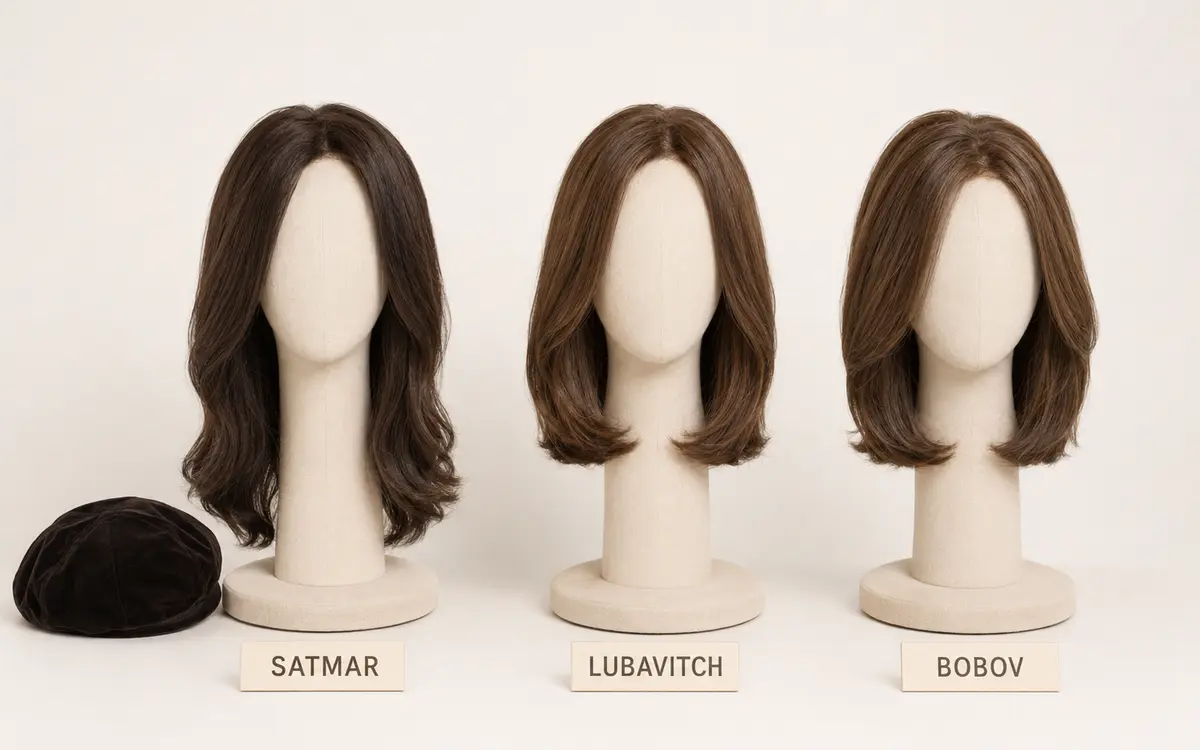
In addition, one aspect of Hasidic hair covering that often surprises outsiders is the practice of wearing additional coverings over the sheitel. In many Hasidic communities, particularly Satmar and some Bobov groups, women wear hats, berets, or snoods on top of their wigs. This creates a layered system: the sheitel provides full coverage of the natural hair, while the hat or snood adds another layer of modesty.
The shpitzel — a small silk or satin cap with hair attached at the temples — is another variation worn by some Hasidic women, typically underneath a tichel. The hair at the temples creates the illusion of sideburns, maintaining some hair framing while keeping the rest covered. This practice is less common today but still exists in certain communities where the highest level of hair concealment is valued.
By contrast, Hasidic men may observe practices concerning peyos (sidecurls) that are separate from women’s hair covering. Their appearance and the way peyos are worn also vary by community, so this article does not use men’s practice to infer a woman’s sheitel requirements.
| Covering Type | Who Wears It | Community | Layering |
|---|---|---|---|
| Sheitel (wig) | Married women | Used in many communities | May be layered depending on local practice |
| Hat/Beret | Married women | Varies by community and occasion | May be worn over a sheitel where customary |
| Snood | Married women | Varies by community and wearer | May be used with or instead of another covering |
| Shpitzel | Married women | Some communities | Construction and use should be confirmed locally |
| Peyos (sidecurls) | Men | Varies by community | Not a women’s hair-covering practice |
The important thing to understand is that these practices aren't random — they're part of a coherent system of modesty that has developed within each Hasidic dynasty. When our factory receives specifications for "Satmar-style" or "Bobov-style" sheitels, we're not just getting measurements. We're getting a set of cultural requirements that reflect generations of community tradition.
Community Standards
Community Context and a Responsible Fit Brief
Ask Before Assigning a Style
Names such as Satmar, Bobov, Ger, Belz, and Chabad identify communities with their own histories and local norms. They should not be used as a shortcut for a fixed length, colour, cap construction, or hairline specification. Individual households, local leaders, and sheitel machers may apply customs differently.
Therefore, before a retailer recommends or orders a sheitel, confirm whether an additional covering will be worn, how much crown volume is comfortable, whether the piece is worn over natural hair or a close cut, the preferred base material, ventilation, density, length, colour family, and any local guidance the customer wants observed. This fit brief is more reliable and more respectful than a dynasty label alone.
Where a Supplier Can Add Value
In addition, suppliers can support a better decision by documenting hair origin, cap materials, ventilation method, density range, colour options, care instructions, and any customization requested by the retailer. If a buyer raises a halachic question, the supplier should record the request accurately and defer the religious determination to the customer’s qualified local authority.
Even so, community context can matter to a wearer, but a sheitel is not a reliable visual label of affiliation. Treat every order as an individual brief, and leave room for the wearer’s own preference and guidance.
Tip
For retailers serving Hasidic communities, ask open questions rather than assigning a product from a community label. Confirm the wearer’s practical needs and any guidance she wishes to follow before proposing a cap, density, colour, or style.
Manufacturing Perspective
From Supplier Brief to Finished Sheitel
Recording the Buyer’s Requirements
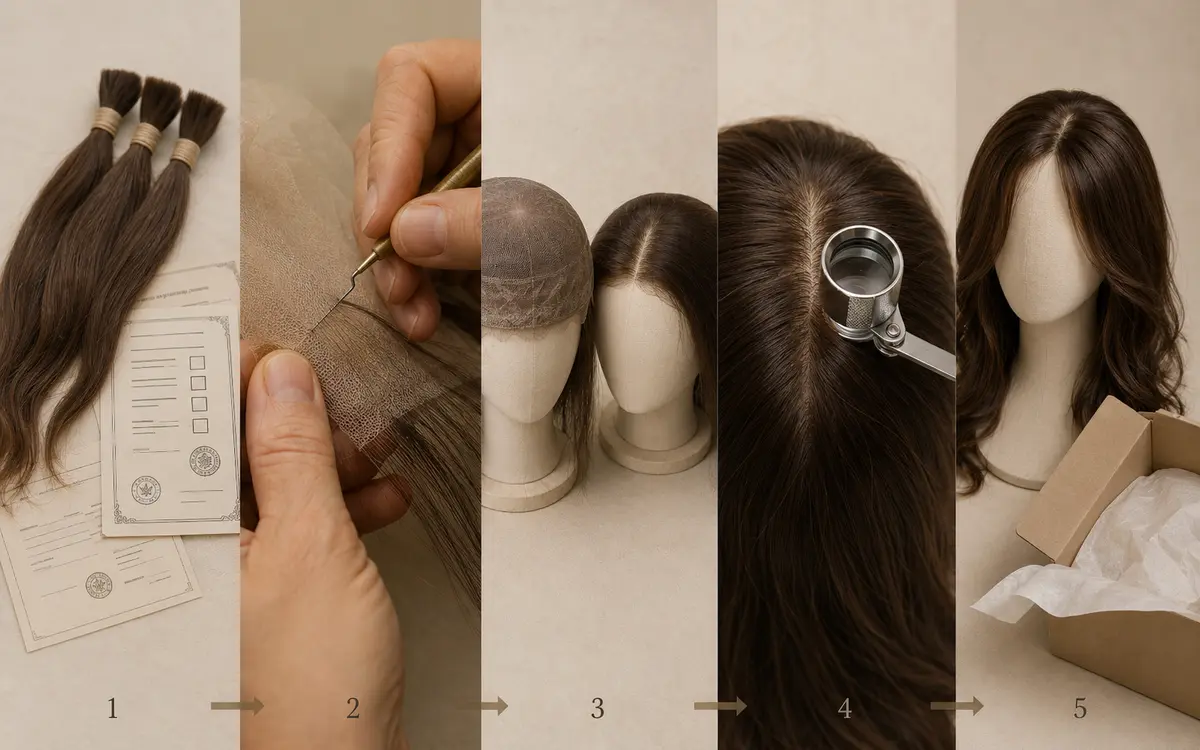
First, our Qingdao workshop uses the retailer’s written brief to plan the construction and final inspection of a sheitel. The practical work is not about manufacturing a universal “Hasidic” wig; it is about producing a piece that matches the buyer’s agreed specifications.
The process then begins with hair sourcing. When a buyer requests traceability, we document the information available from the supplier and retain it with the order record. Questions about religious suitability of a particular source belong to the buyer and their qualified local authority; a factory should not present its paperwork as a universal religious ruling.
Ventilation, Customization, and Final Inspection
Next comes ventilation — the process of hand-tying individual hair strands into the cap. For Hasidic sheitels, our artisans use higher knot density to create fuller coverage, particularly at the part and crown where the wig must withstand daily wear and potential layering with hats. As a result, tension is carefully controlled: tight enough to secure the hair, but not so tight that the knots bulge visibly through the cap material.
Then, buyer-specific specifications are applied at this stage. A retailer may request less crown volume for an additional covering, a particular density at the temples, or a specific lace or silk-base construction. We document those choices in the order brief rather than assuming them from a community name.
Finally, quality inspection is the last production step. We check the finished piece against the agreed order brief for knot coverage, cap fit, hair alignment, density, and the requested construction details. The retail partner then remains the appropriate person to confirm that the final piece suits the customer and any local guidance.
Practical Verification
A product specification can verify construction and order details, but it cannot determine whether a sheitel is appropriate for every Hasidic customer. Confirm the fit brief with the retailer and, where relevant, the wearer’s local guidance before approving a style.
In practice, a supplier’s responsibility is to make the agreed product accurately, communicate its materials and construction clearly, and avoid overstating what a factory can decide about religious or community practice.
Community Role
The Sheitel Macher — A Community Institution
Practical Advice and Technical Feedback
The sheitel macher (Yiddish for "wig maker") occupies a unique position in Hasidic communities. This isn't just someone who cuts and styles wigs — it's a trusted advisor who understands both the technical aspects of sheitel maintenance and the cultural standards of the community. A good sheitel macher knows which styles work for which dynasties, how to modify a wig for a woman who's switched communities after marriage, and how to balance individual preference with community expectation.
In addition, the relationship between factory and sheitel macher is collaborative. When our workshop receives feedback from a Hasidic salon about a cap construction issue or a density adjustment, we treat it as critical input. These are the people on the front lines, working directly with community members, and their observations help us refine our manufacturing processes. Over time, this collaboration has led to improvements in everything from knot placement to hair blend ratios.
Ongoing Support for the Wearer
Beyond construction, the emotional dimension matters too. For many Hasidic women, buying a first sheitel after marriage is a significant moment. A skilled sheitel macher understands this and provides guidance that goes beyond technical considerations. For example, she might explain how to care for the wig, how to style it for different occasions, and how to navigate the sometimes-unspoken rules about what's appropriate in her specific community. This mentorship role is why sheitel machers are so respected — they're not just service providers, they're custodians of community standards.
For that reason, our factory respects this relationship. We don't sell directly to individual consumers in Hasidic communities — we work through established wig salons and sheitel machers who understand their clientele. This ensures that when a woman buys one of our sheitels, she's getting it from someone who can provide the ongoing support and guidance that makes the wig truly work for her life and community.
Addressing Misconceptions
Common Questions About Hasidic Hair
After years of manufacturing for Hasidic communities and answering questions from wholesale buyers, we've encountered the same misconceptions repeatedly. Addressing them directly helps clarify what Hasidic hair practices actually involve.
Do Hasidic women shave their heads? Practices differ. Historical and scholarly sources describe head shaving in some groups, while many women cover their natural hair without shaving it. It should not be presented as a universal Hasidic practice, and a supplier should not infer cap requirements from this question without a confirmed fit brief.
Why do some Hasidic women wear hats over wigs? Some women use an additional covering for reasons of custom, occasion, or personal preference. The practice is not universal. If a covering will be layered over a sheitel, the retailer should confirm that need so crown volume, cap shape, and comfort can be discussed with the wearer.
Note
The diversity of practices within Hasidic communities is often underestimated by outsiders. What's true in one dynasty might not be true in another. When discussing Hasidic customs, specificity matters — Satmar is not the same as Lubavitch, and generalizations often miss important distinctions.
What makes a wig "Hasidic-approved"? The phrase is not a universal product certification. A responsible retailer confirms the wearer’s fit brief and any local guidance, then specifies the materials, coverage, construction, styling, and documentation required for that individual order.
How are Hasidic wigs styled differently from other Orthodox wigs? There is no single Hasidic styling standard. The right approach is to ask the wearer or retailer about local expectations, the desired level of naturalness, practical daily wear, and any covering or styling routine before making a recommendation.
FAQ
Frequently Asked Questions
Sheitels are one accepted hair-covering choice in many Hasidic communities, but scarves, hats, and layered coverings are also used. The appropriate choice depends on local custom, the wearer’s preference, and any guidance she follows; no single covering is universally required for every Hasidic woman.
No. Practices can vary between communities, local settings, and individual households. A retailer should not infer a fixed length, colour, cap, or layering requirement from a dynasty name; instead, confirm the wearer’s fit brief and any local guidance before recommending a sheitel.
There is no universal Hasidic certification for a sheitel. A buyer should confirm local rabbinic guidance and the wearer’s practical fit brief, including coverage, cap comfort, construction, hair source documentation, styling expectations, and whether another covering will be worn over the piece.
Replacement timing varies widely. Hair quality, construction, daily wear, heat styling, storage, and repair access all affect service life, so a sheitel macher or retailer should assess the individual piece rather than apply a fixed replacement schedule to every wearer.
Styles are shaped by personal preference and local community guidance, not one universal rule. Before cutting or restyling a sheitel, the wearer should consult a trusted sheitel macher and, where relevant, local rabbinic guidance about what is customary in her setting.
Conclusion
Understanding Hasidic Sheitel Traditions
Hasidic hair covering practices are a blend of religious obligation, community custom, and practical adaptation to modern life. The sheitel sits at the intersection of these forces: it's a halachic solution, a cultural marker, and a functional tool that allows observant women to navigate the secular world without compromising religious commitments.
For our Qingdao factory, serving Hasidic communities means more than manufacturing wigs. It means understanding dynastic differences, respecting community standards, and collaborating with sheitel machers who serve as cultural intermediaries. Every sheitel we produce carries this context — it's not just a product, it's a carefully considered response to a community's needs.
If you're a wholesale buyer looking to serve Hasidic communities, or if you simply want to understand these traditions more deeply, we're here to help. Our team has years of experience manufacturing sheitels that meet specific dynastic requirements, and we're happy to share what we've learned about matching products to community standards.
Choosing the Right Sheitel Through a Fit Brief
| Question to Confirm | Why It Matters | Supplier Action |
|---|---|---|
| Will another covering be worn? | It may affect crown volume, cap shape, and comfort. | Record the intended layering and review a sample fit. |
| What cap base and ventilation are preferred? | Comfort and coverage depend on the wearer’s daily routine. | Specify the base material and construction in the order brief. |
| What density, length, and colour family are wanted? | These are personal and local preferences, not universal group rules. | Confirm the selection with the retailer or sheitel macher. |
| Is there relevant local guidance? | Religious and customary questions should not be decided by the factory. | Document the buyer’s direction without making a religious claim. |
| What ongoing styling and care support is available? | Maintenance needs affect the suitable construction and hair choice. | Provide clear care information and a repair path through the retailer. |
Reach out to our team to discuss a wholesale fit brief, material documentation, and construction options for the customers your retailer serves.



Ready to Source Hasidic-Compliant Sheitels?
Our Qingdao factory manufactures sheitels meeting Hasidic community specifications with documented hair sourcing, dynastic-specific construction, and full coverage cap designs. Contact us for wholesale pricing and samples.
Request Wholesale Pricing